Feeling scared to have sex even though you genuinely want it can be confusing. The desire is real. The attraction is real. But the moment sex becomes a possibility, something shifts: anxiety rises, the body tightens, and you pull back in ways you do not fully understand. This is not genophobia, which is a fear or aversion to sex itself. This is something different and far more common: a conflict between genuine sexual desire and a fear response that activates at the point of intimacy. It happens to both men and women, in new relationships and long-term ones, and it is treatable. Understanding why this happens is the first step towards changing it.
In many cases, people are not afraid of sex itself. They are afraid of failing, being judged, feeling vulnerable, disappointing their partner, or repeating a previous negative experience.
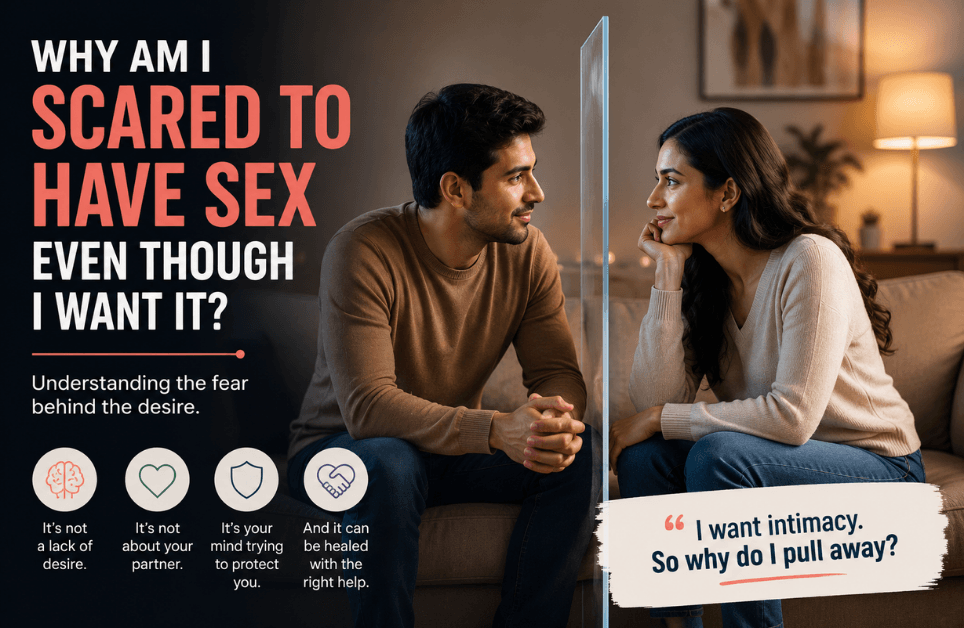
The Desire-Fear Paradox: Why You Can Want Sex and Still Be Scared of It
Most articles about fear of sex describe genophobia: a condition where a person has no desire for sex and experiences panic at the thought of it. That is not what most people searching this question are experiencing. If you want sex and are scared of it at the same time, you are not experiencing a phobia. You are experiencing a conflict between two very real and legitimate parts of your psychological experience.
Sexual desire is driven by one part of your nervous system. Fear and self-protective responses are driven by another. Both can be active at the same time. In fact, the stronger your desire, the more intense the fear can become, because more is at stake. You care about this. You want it to go well. You want to feel connected, desirable, capable, and present. And that very investment is what generates the fear.
Understanding this paradox is the first step. Feeling scared to have sex despite wanting it is far more common than most people realise. It does not automatically mean you have a phobia, low libido, or that something is wrong with your sexuality. In most cases, it reflects a learned fear response that can be understood and changed. You are someone who’s nervous system has learned to associate sexual intimacy with threat, and that association is getting in the way of something you genuinely want.
Why Am I Scared to Have Sex Even Though I Want It? The Real Reasons
Fear of sex despite desire almost always has a specific psychological origin. It is rarely random. Understanding your particular reason is essential, because different causes require different approaches. The most common reasons are explained below.
Performance Anxiety
Performance anxiety is the single most frequent cause of fear of sex despite desire, particularly in men. It involves a fear of not performing well sexually: not maintaining an erection, ejaculating too quickly, not satisfying a partner, or simply not being “good enough” in bed. The harder you try to control the outcome, the more your nervous system registers the situation as high-stakes, and the more anxiety increases.
People with performance anxiety often find that the anticipation of sex is more anxiety-provoking than sex itself. They may feel excited by the idea of sex in the abstract, or during early stages of intimacy, but as the moment of sex approaches, a wave of fear overrides the desire. The body may respond with physical symptoms: a racing heart, shallow breathing, muscle tension, or for men, a loss of erection at the critical moment.
This fear is not about lack of attraction. It is about what sex represents: a test of adequacy, a moment where you could fail, be judged, or disappoint someone you care about. Read more about how this cycle works in the full guide to sexual performance anxiety.
Fear of Emotional Vulnerability
Sex is one of the most emotionally exposing experiences a human being can have. It requires you to be seen, physically and emotionally, in a way that few other situations demand. For people who have learned, consciously or not, that being vulnerable leads to pain, rejection, or loss of control, sex triggers a deeply automatic self-protective response.
This is particularly common in people who have experienced emotional unavailability from caregivers in childhood, relationships where closeness led to hurt, or a pattern of connecting deeply and then being abandoned or rejected. The body learns that intimacy equals danger. Even when the rational mind knows a partner is safe and trustworthy, the nervous system activates its defences.
People who fear emotional vulnerability through sex often describe a sudden urge to withdraw, make excuses, or feel emotionally flat at the moment sex is about to happen, even though they were attracted and interested moments before.
Negative Body Image and Shame
Sex requires you to be seen. For people who carry significant shame about their bodies, this can be terrifying regardless of how much they want to be intimate. Body image concerns are not about vanity. They are about a deeply held belief that your body is inadequate, unattractive, or will be found unacceptable by a partner.
This fear is pervasive and affects both men and women. Men worry about their body size, body fat, their penis, their physical endurance. Women worry about weight, shape, scars, or not meeting expectations shaped by pornography or media. The fear is: “if they see me fully, they will be disappointed or repelled.”
The desire for sex is present. The fear of being seen and found wanting is also present. And the fear often wins, because the perceived consequence, rejection at the moment of greatest vulnerability, feels catastrophic.
Past Sexual Experiences That Left a Negative Imprint
You do not need to have experienced serious sexual trauma for past experiences to create a fear response. Embarrassing encounters, experiences where you felt humiliated, a partner who was critical or dismissive of your sexual performance, or a situation where something went wrong and you felt deeply ashamed, can all create a conditioned fear association with sex.
Your nervous system learns from experience. If sex has consistently been associated with anxiety, shame, embarrassment, or pain, it will anticipate those experiences again, even in situations that are objectively different and safer. This is not a choice and it is not weakness. It is how associative learning works in the human brain.
For people who have experienced sexual trauma or abuse, this pattern can be significantly more intense and is best addressed through specialist psychosexual therapy rather than general advice.
Cultural, Religious, or Family Conditioning
Many people grow up in environments where sex is treated as shameful, sinful, dirty, or dangerous. Religious teachings, family attitudes, cultural norms, and social messaging can all create a deep internal association between sex and guilt or wrongness, even in adults who intellectually disagree with these messages.
The result is a person who genuinely desires sex but experiences an automatic guilt or shame response the moment they approach it. They may feel fine about the idea of sex in theory, but in the moment, an old internal voice activates, producing fear, guilt, or a sense that something bad will happen.
Fear of Losing Control
Sex involves a degree of surrender: to sensation, to another person, to an experience that cannot be fully scripted or controlled. For people who rely heavily on self-control as a psychological safety mechanism, this loss of control can feel genuinely threatening, not because sex itself is dangerous, but because surrender feels that way.
This often appears in high-achieving, highly controlled individuals who manage anxiety through structure, predictability, and self-monitoring. Sex asks them to let go of all of that, and the prospect produces real fear.
How Fear of Sex Affects Your Body Even When You Want It
It is important to understand that this fear is not purely psychological in the sense of being “in your head.” It produces real, measurable physical responses driven by your autonomic nervous system. When your brain registers a threat, it activates the sympathetic nervous system, triggering the stress response. This is the same system that would activate if you were physically in danger.
In the context of sex, this means:
- The body redirects blood flow away from the genitals and toward the large muscle groups, contributing to erectile difficulties in men and reduced lubrication or arousal in women.
- Muscles tighten, making physical intimacy feel uncomfortable or forced.
- The heart rate increases and breathing becomes shallow, producing a feeling of panic rather than arousal.
- The mind becomes hypervigilant, monitoring the experience rather than being present within it. This “spectatoring” intensifies anxiety and kills the natural flow of arousal.
For men, this physical stress response is often experienced as losing an erection or being unable to get one at all, despite having been fully aroused and interested moments before. This creates a secondary layer of fear: not just fear of sex, but fear of the body failing during sex. This is explored in more detail in the guide to psychogenic erection issues.
Is This Genophobia or Is It Something Else?
Genophobia is a specific phobia characterised by an intense, persistent fear of sexual intercourse that causes extreme distress and avoidance. People with true genophobia typically do not desire sex: the thought of it produces panic, not desire. It is relatively rare.
If you want sex and are scared of it, you are almost certainly not experiencing genophobia. What you are more likely experiencing is one or more of the following:
| Experience | More Likely Cause |
|---|---|
| Want sex but fear not performing well | Sexual performance anxiety |
| Want sex but freeze emotionally when it gets close | Fear of emotional vulnerability or intimacy anxiety |
| Want sex but feel shame when it is about to happen | Cultural or religious conditioning, body shame |
| Want sex but body does not respond as expected | Psychogenic sexual dysfunction driven by anxiety |
| Want sex but self-sabotage or make excuses | Avoidant attachment pattern or past trauma |
| Want sex but it has always felt frightening | Deep-seated conditioning or early sexual experiences |
Each of these has a specific pathway in psychosexual therapy. Naming the right cause is the first step to resolving it.
Why Wanting Sex Can Actually Intensify the Fear
There is a painful irony at the heart of this experience: the more you want sex, the more frightening it can become. This is because desire raises the stakes. When you care about something deeply, the fear of it going wrong becomes proportionally larger.
Someone who is indifferent to sex has very little to lose sexually. But someone who genuinely wants intimacy, connection, pleasure, and closeness has a great deal at stake every time sex is a possibility. The fear is not irrational. It is a response to perceived risk in a situation that carries real emotional weight.
This is why self-help tips like “just relax” or “think less” are almost never effective. They do not address the underlying psychological pattern. They ask you to override a nervous system response with willpower, which is not how fear responses work. The pattern needs to be understood and resolved at its root, not suppressed.
Signs That Fear Is Starting to Control Your Sex Life
- You keep postponing intimacy despite wanting it.
- You create excuses to avoid sex.
- You overthink sex hours or days beforehand.
- You feel relieved when sex does not happen.
- You panic as intimacy becomes more likely.
- You monitor your body instead of enjoying the moment.
- You worry about disappointing your partner.
- You feel pressure to perform rather than connect.
How Psychosexual Therapy Helps When You Are Scared to Have Sex Despite Wanting It
Psychosexual therapy is specifically designed for the intersection of psychology and sexual experience. It does not treat sex as a purely mechanical issue, and it does not treat fear of sex as a general anxiety problem. It works at the precise point where your psychological history, your nervous system, your beliefs, and your sexual experience meet.
Working with a qualified psychosexologist, you will:
Identify the specific reason you are scared to have sex even though you want it
There is always a specific reason. Therapy surfaces it precisely: whether it is a conditioned fear response, a belief you absorbed from your upbringing, a pattern from a past relationship, or a fear of emotional exposure. Vague self-reflection rarely reaches this level of clarity. Structured therapeutic enquiry does.
Disconnect the fear response from the experience of sex
The association between sex and fear was learned. Through psychosexual therapy, it can be unlearned. This involves a combination of cognitive restructuring, working to change the beliefs and expectations that generate the fear, and behavioural approaches that gradually reintroduce sexual experience without the anxiety conditions that previously maintained the fear.
Build genuine sexual confidence rather than performing it
Many people try to override their fear by acting confident. This works occasionally but not reliably, because the underlying fear is still present. Psychosexual therapy builds authentic confidence from the inside out: a settled sense of your own adequacy, desirability, and worth that does not depend on every sexual encounter going perfectly.
If you are ready to explore this with specialist support, you can find out more about Dr. Dhruv Bhola’s approach to sexual performance anxiety and sexual confidence.
What to Do Right Now If You Are Scared to Have Sex
While professional support is the most effective path, there are things you can do immediately that are genuinely useful.
First, stop fighting the fear. Trying to force yourself through it through willpower alone typically increases anxiety rather than reducing it. Acknowledge what you are experiencing without making it mean something catastrophic about you.
Second, name the specific fear. Not “I am scared of sex” but: what precisely are you afraid will happen? What is the worst-case scenario your mind is generating? Bringing specificity to the fear begins to give you more clarity and, over time, more control over it.
Third, if you are in a relationship, consider whether you can have an honest conversation with your partner about what you are experiencing. You do not need to have all the answers. Simply naming that sex creates fear for you, even though you want it, can significantly reduce the pressure and isolation of the experience.
Fourth, take the step of seeking professional support. This is not a problem that responds well to avoidance or to time alone. It requires active, informed intervention. The longer the fear is accommodated without being addressed, the more entrenched it tends to become.
Frequently Asked Questions
Why am I scared to have sex even though I want it?
You are scared to have sex even though you want it because your nervous system has learned to associate sexual intimacy with some form of threat: fear of failure, fear of emotional exposure, fear of judgment, or shame from past experiences or conditioning. Desire and fear are driven by different neurological systems that can both be active simultaneously. This is a psychological pattern with a specific cause, and it responds well to psychosexual therapy.
Is it normal to want sex but be afraid of it?
Yes, this is very common. Research consistently shows that sexual anxiety affects a significant proportion of both men and women across all age groups. Wanting sex and being afraid of it are not contradictory: they reflect two different parts of your psychological experience operating at the same time. It is not a sign that something is fundamentally wrong with you.
Does being scared of sex mean I have genophobia?
Almost certainly not, if you also want sex. Genophobia is characterised by a persistent, intense fear of sex without desire. If you desire sex and are scared of it, what you are more likely experiencing is sexual performance anxiety, intimacy anxiety, body shame, or a conditioned fear response from past experience. Each of these has a clear treatment pathway in psychosexual therapy.
Can anxiety cause you to be scared of sex?
Yes. General anxiety and specifically sexual performance anxiety are among the most common drivers of fear around sex. When you are anxious, your sympathetic nervous system activates and produces a physical stress response that directly interferes with sexual arousal and functioning. This creates a cycle: anxiety causes difficulty during sex, and the difficulty reinforces the anxiety about future sexual encounters.
Why does being scared of sex make me avoid it even though I want it?
Avoidance is the nervous system’s default response to perceived threat. Even when you consciously want sex, if your subconscious associates it with danger, embarrassment, or pain, the impulse to avoid it will often override your desire. This avoidance provides short-term relief from anxiety but reinforces the fear pattern over time, making the problem progressively worse without intervention.
How do I stop being scared of sex?
The most effective way to stop being scared of sex when you want it is through psychosexual therapy with a qualified specialist. This involves identifying the specific psychological root of the fear, addressing the beliefs and conditioned responses that maintain it, and rebuilding your relationship with sexual intimacy from a foundation of genuine confidence rather than managed anxiety. Self-help strategies can provide short-term relief but rarely resolve the underlying pattern.
The Next Step
Being scared to have sex even though you want it is a genuinely painful experience. It creates distance in relationships, damages self-esteem, and generates a cycle of avoidance that compounds over time. But it is not permanent, and it is not who you are. It is a learned psychological pattern with an identifiable cause, and with the right support, it can be resolved.
Dr. Dhruv Bhola is a certified sex therapist and psychosexologist specialising in the psychological dimensions of sexual health. If fear of sex despite desire is affecting your life or your relationship, book a confidential consultation to begin understanding what is driving your experience and how to move past it.