If you ejaculate sooner than you want to, the most important question is not “how do I stop it?” The most important question is: why is it happening? Because the answer determines everything about how it should be treated. Premature ejaculation (PE) is most commonly psychological in origin, particularly in men who have experienced it since their first sexual encounter or in men whose ejaculation timing changes depending on stress, anxiety, or relationship dynamics. Physical causes exist but are far less common and usually involve an underlying medical condition. This article will help you understand the difference, identify which type applies to you, and explain why addressing the psychological root cause produces lasting results.
What Is Premature Ejaculation?
Premature ejaculation is defined clinically as ejaculation that occurs within approximately one minute of penetration, on almost all or all occasions, for at least six months, and causes personal distress. However, many men experience PE in a broader sense: they ejaculate earlier than they or their partner would prefer, even if the time is slightly longer than one minute. The condition is extremely common. Research consistently shows it affects between 20 and 30 percent of men across all age groups, making it the most prevalent male sexual dysfunction globally.
What matters clinically is not just the timing but the pattern, the context, and whether it is causing distress. A man who occasionally ejaculates quickly is not necessarily experiencing PE. A man who cannot control the timing of his ejaculation consistently, who avoids sex as a result, or who feels significant anxiety before and during sex almost certainly is.
The Two Types of Premature Ejaculation: Why They Matter
Before answering whether your PE is psychological or physical, you need to identify which type of PE you have. This distinction alone gives you significant diagnostic information.
Lifelong (Primary) Premature Ejaculation
Lifelong PE means you have ejaculated quickly since your very first sexual experience. It has always been present. You have never had a period of normal ejaculatory control. This type is often linked to a combination of biological predisposition and early psychological conditioning. Some research suggests men with lifelong PE may have heightened penile sensitivity or differences in serotonin receptor function. However, psychological factors including anxiety about sexual performance, early conditioning from rushed masturbation, and deep-seated beliefs about sex also play a significant role in lifelong PE and should not be dismissed.
Acquired (Secondary) Premature Ejaculation
Acquired PE means you previously had normal ejaculatory control but developed PE at some point in your life. This is almost always driven by psychological factors: a stressful life event, a difficult relationship, a specific sexual experience that created anxiety, the development of erectile dysfunction, or a significant increase in performance pressure. Acquired PE can also have physical triggers such as prostate inflammation, thyroid dysfunction, or hormonal changes, but these are less common than psychological causes. If your PE is acquired, the cause is highly likely to be psychological or a mix of psychological and physical.
Is My Premature Ejaculation Psychological or Physical? Key Signs to Look For
There is no single test that tells you definitively whether your PE is psychological or physical. A proper assessment by a qualified psychosexologist involves taking a detailed sexual history, reviewing relevant health factors, and understanding the pattern, context, and emotional experience of your PE. However, the following signs provide strong indicators.
Signs Your Premature Ejaculation Is Psychological
- Your ejaculation timing varies depending on the situation. You last longer with some partners, in some settings, or during masturbation compared to partnered sex.
- You feel significant anxiety, pressure, or self-consciousness before or during sex.
- The problem worsens during periods of high stress, conflict in your relationship, or when you have had a previous episode of PE with that partner.
- You can delay ejaculation during masturbation more easily than during intercourse.
- You started experiencing PE after a specific event: a relationship breakdown, sexual rejection, a new partner, performance pressure, or a stressful life period.
- You notice your mind racing during sex: monitoring your arousal, checking whether you are about to ejaculate, trying to distract yourself mentally.
- You have erection difficulties alongside PE, particularly losing your erection after ejaculation, or rushing through sex because you fear losing your erection.
- You have a strong fear of disappointing your partner sexually.
- Your PE is acquired: you had normal ejaculatory control at some point in the past.
Signs Your Premature Ejaculation May Have a Physical Component
- Your PE has been present since your very first sexual experience and has never improved under any circumstances.
- You ejaculate quickly even during masturbation with no anxiety or performance pressure present.
- You experience pelvic pain, discomfort during ejaculation, or urinary symptoms such as burning or frequent urination (which may suggest prostatitis).
- You have been diagnosed with or have symptoms of thyroid dysfunction, hormonal imbalance, or a neurological condition.
- You ejaculate quickly regardless of how relaxed, confident, or comfortable you feel in a sexual situation.
- There is no situational variation at all: the timing is consistently and uniformly rapid across all situations and partners.
It is important to note that even when a physical factor contributes to PE, psychological factors almost always develop alongside it. A man who begins ejaculating quickly due to prostate inflammation will quickly develop anxiety about his performance, which then maintains the PE even after the physical issue is treated. This is why addressing both dimensions matters.
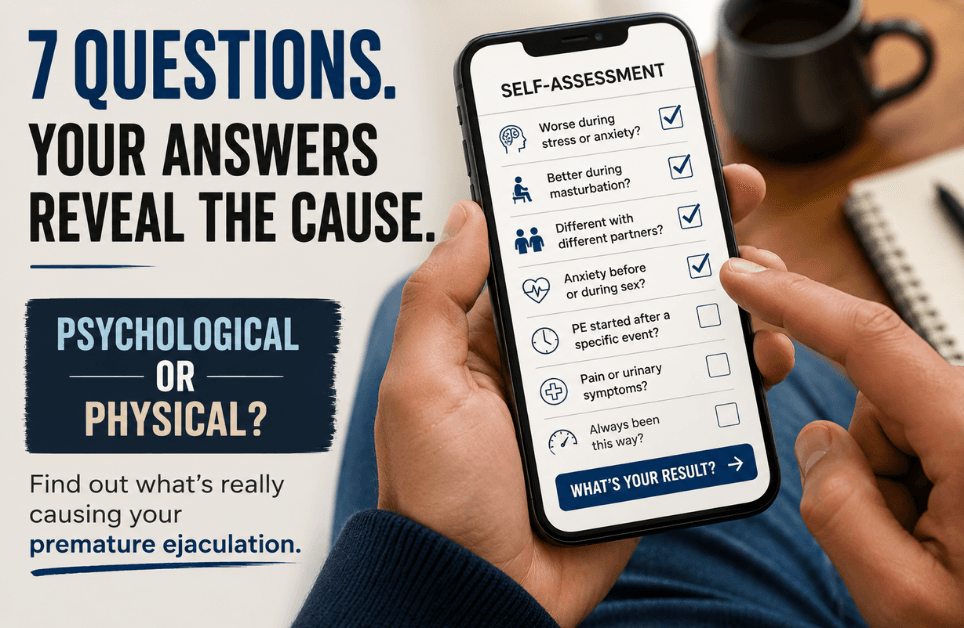
A Practical Self-Assessment: Is My Premature Ejaculation Psychological or Physical?
Answer the following questions honestly. They are not a clinical diagnosis, but they reflect the key indicators a psychosexologist uses when taking a sexual history.
| Question | Likely Psychological | Possibly Physical |
|---|---|---|
| Have you always had PE since your first sexual experience? | No | Yes |
| Does your timing vary with different partners or situations? | Yes | No |
| Do you feel anxious before or during sex? | Yes | No |
| Can you delay ejaculation more easily during masturbation? | Yes | No |
| Did PE develop after a specific stressful event or relationship change? | Yes | No |
| Do you experience pelvic pain or urinary symptoms alongside PE? | No | Yes |
| Does stress or anxiety make your PE significantly worse? | Yes | No |
| Do you monitor your arousal level during sex, trying to hold back? | Yes | No |
If most of your answers fall in the “Likely Psychological” column, your PE is almost certainly psychological or psychosexual in origin. If you have a mix, you may be dealing with both factors, and a thorough assessment is strongly recommended before committing to any treatment approach.
The Most Overlooked Cause: How Performance Anxiety Drives Premature Ejaculation
Performance anxiety is the single most common psychological driver of premature ejaculation, yet it is consistently underestimated and misunderstood. When you feel anxious about ejaculating too quickly, your nervous system shifts into a heightened state of arousal. Your sympathetic nervous system, the system responsible for the “fight or flight” response, becomes dominant. This is the same system that controls ejaculation. The result is a direct, physiological acceleration of the ejaculatory reflex.
This creates a vicious cycle that maintains PE over time: you ejaculate quickly, you feel embarrassed or frustrated, you begin the next sexual encounter already anxious about repeating the experience, the anxiety increases your arousal threshold and speeds up your ejaculation, and the cycle continues. Over time, this pattern becomes deeply conditioned. The anticipation of sex itself becomes a trigger for anxiety and rapid ejaculation.
Many men in this cycle report that they ejaculate quickly even before penetration, or immediately upon penetration, not because their body is physically incapable of control, but because their nervous system has been primed by months or years of anxiety-driven sexual experience. This is a learned response. And learned responses can be unlearned.
For a deeper understanding of how anxiety affects sexual performance, read the guide to sexual performance anxiety on this website.
When Premature Ejaculation Is Both Psychological and Physical
It is a mistake to think of psychological and physical causes as mutually exclusive. In clinical practice, a significant proportion of men with PE present with both dimensions at play simultaneously.
Consider these common scenarios:
- A man with lifelong PE may have a biological predisposition to rapid ejaculation, but his PE is maintained and worsened significantly by performance anxiety and avoidance of sexual intimacy.
- A man who developed erectile dysfunction due to cardiovascular issues begins rushing through sex to complete intercourse before losing his erection. This creates acquired PE. Even after his erection quality improves, the psychological habit of rushing persists.
- A man with prostatitis experiences painful ejaculation and develops PE as a result. The prostatitis is treated, but the anxiety about pain and ejaculation continues to drive PE.
In all of these cases, treating only the physical dimension is insufficient. The psychological dimension must be addressed for PE to resolve fully and sustainably.
What Happens When You Only Treat the Physical Side
Many men seek treatment for PE through medication alone, most commonly topical anaesthetics that reduce penile sensitivity, or antidepressants prescribed off-label to delay ejaculation. These approaches can produce short-term improvements in ejaculation latency. However, they do not address the underlying psychological drivers of PE.
The consequences of relying solely on physical or pharmacological treatment include:
- PE returns as soon as medication is stopped, because the anxiety, performance pressure, and conditioned responses remain intact.
- Reduced sensation can itself create new anxiety: men worry they are not fully present during sex or that their partner notices the change.
- The psychological relationship with sex does not improve. Many men continue to dread sex, avoid intimacy, and carry shame about their sexual performance even while on medication.
- Underlying relationship issues that are driving or worsening PE remain unresolved.
Sustainable resolution of premature ejaculation requires addressing the mind and the body together, with the psychological dimension receiving primary attention in the majority of cases.
How Psychosexual Therapy Treats Psychological Premature Ejaculation
Psychosexual therapy is the most effective treatment approach for psychological premature ejaculation. Unlike generic counselling, psychosexual therapy is specifically designed to address the intersection of psychological experience and sexual function. A trained psychosexologist works with you to identify the precise psychological factors driving your PE and address them systematically.
Treatment typically involves several interconnected approaches:
Reducing Performance Anxiety
Therapy helps you understand the anxiety-PE cycle and interrupts it. This involves restructuring the meaning you attach to sex, reducing the pressure you place on ejaculation timing, and developing genuine confidence in your sexual self rather than relying on external performance measures.
Reconditioning the Ejaculatory Response
Structured behavioural techniques are used to rebuild ejaculatory control at a neurological level. These include sensate focus exercises, which reduce goal-oriented pressure during sex, and graduated exposure to sexual arousal without the anxiety of performance. The aim is to recondition your nervous system’s response to sexual stimulation.
Addressing Relationship and Intimacy Factors
Where PE is driven or maintained by relationship dynamics, partner communication issues, or emotional disconnection, these are addressed directly within therapy. Sexual problems rarely exist in isolation from the relationship context in which they occur.
Processing Underlying Psychological Factors
Past sexual experiences, shame, unrealistic expectations shaped by pornography, and negative beliefs about masculinity and sexual performance are all explored and resolved where they are contributing to PE. For many men, this deeper work is what produces lasting change.
If you are ready to understand the specific psychological drivers of your PE and begin treatment, read more about premature ejaculation treatment with Dr. Dhruv Bhola.
When to See a Doctor First
If you have symptoms that suggest a physical cause, you should see a doctor or urologist before or alongside psychosexual therapy. Specifically, seek medical evaluation if you have pelvic pain, pain during ejaculation, urinary symptoms, recent unexplained changes in sexual function, or any diagnosed health conditions that could affect sexual response. A medical review will rule out prostatitis, hormonal imbalances, thyroid dysfunction, or other physical contributors, allowing you to then focus fully on the psychological treatment that most men with PE require.
Frequently Asked Questions: Is My Premature Ejaculation Psychological or Physical?
Is premature ejaculation usually psychological or physical?
Premature ejaculation is most commonly psychological in origin. Research and clinical experience consistently show that the majority of men with PE have anxiety, performance pressure, conditioned responses, or relationship factors driving their condition. Physical causes are less common but should be ruled out, particularly in men with symptoms of prostatitis, hormonal issues, or neurological conditions.
How do I know if my premature ejaculation is psychological?
The strongest indicators that your PE is psychological include: your timing varies with different partners or situations, you feel anxious before or during sex, you can delay ejaculation more easily during masturbation, and your PE developed or worsened during a period of stress or relationship difficulty. If PE is situational rather than constant, it is almost always psychological.
Can psychological premature ejaculation be cured?
Yes. Psychological premature ejaculation responds very well to psychosexual therapy. The majority of men who complete a structured course of therapy with a qualified psychosexologist experience significant and lasting improvement in ejaculatory control, reduced performance anxiety, and improved sexual confidence and satisfaction.
Does stress cause premature ejaculation?
Yes. Stress activates the sympathetic nervous system, which is the system that controls ejaculation. High stress levels, whether from work, relationships, or life circumstances, increase baseline physiological arousal and can significantly reduce ejaculatory latency. Many men notice a direct correlation between stressful periods in their life and worsening PE.
Is premature ejaculation psychological or physical when it has always been present?
Lifelong PE that has been present since the first sexual experience may involve a biological predisposition, but psychological factors including anxiety, early sexual conditioning, and performance pressure are almost always present alongside it. Even lifelong PE benefits significantly from psychosexual therapy, which addresses the psychological dimensions that physical treatments alone cannot resolve.
What physical conditions can cause premature ejaculation?
Physical conditions associated with PE include prostatitis (inflammation of the prostate), hyperthyroidism, hormonal imbalances affecting testosterone or serotonin levels, hypersensitivity of the penile nerves, and in some cases, erectile dysfunction. These require medical evaluation and are typically accompanied by symptoms beyond ejaculation timing alone.
Next Step: Get a Proper Assessment
Most men with premature ejaculation spend years trying to manage it on their own or looking for the right medication, without ever understanding the real reason it is happening. Getting a proper assessment from a qualified psychosexologist is the single most important step you can take. It gives you clarity on whether your PE is psychological, physical, or both, and allows you to pursue a treatment approach that actually addresses the root cause rather than masking the symptom.
Dr. Dhruv Bhola is a certified sex therapist and psychosexologist with specialist expertise in premature ejaculation. If you are ready to understand your PE and address it properly, book a confidential consultation here.