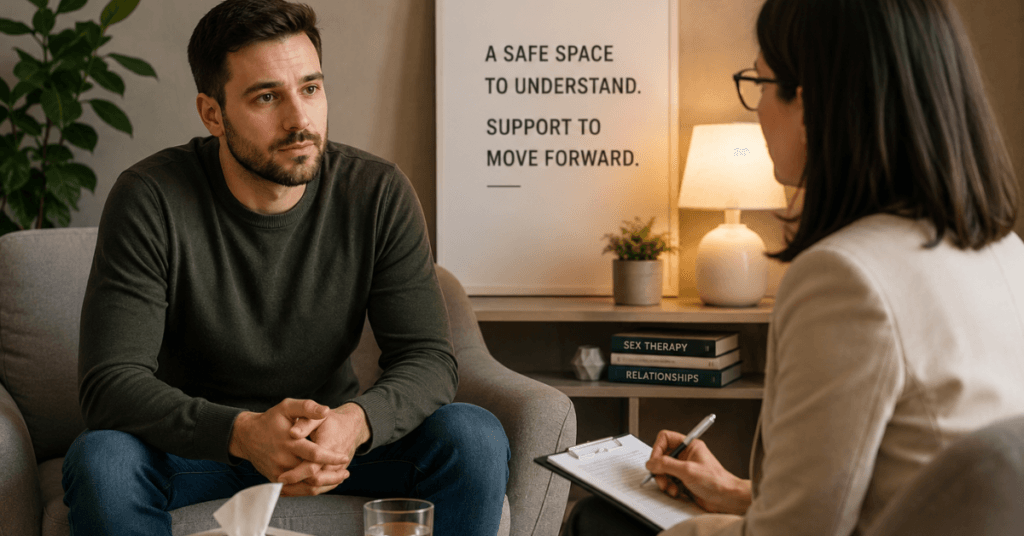
In the first session with a sex therapist for performance anxiety, you have a private, structured conversation, completely confidential, with no physical examination or contact of any kind. The sex therapist identifies the psychological patterns behind erection anxiety, performance pressure, and psychogenic erectile dysfunction the same patterns that explain why sex therapy can actually help with erectile dysfunction in most men under 50, while understanding your triggers, history, and relationship context. For many men, the first sex therapy session provides clarity and relief after months of silent worry.
If you are reading this, you are probably trying to understand what happens in a sex therapy session before committing to one. Most men spend weeks researching quietly before speaking to anyone. This page covers the process directly: what happens, what the therapist asks, how psychosexual therapy works, and what changes most men notice after that first session.
Performance anxiety is a common cause of psychogenic erectile dysfunction. It is also one of the most treatable. Sex therapy gives you an accurate understanding of why it is happening and a structured path to reversing it.
What Happens in the First Session With a Sex Therapist?
Here is exactly what to expect in a first sex therapy session:
- You talk privately with a trained sex therapist, completely one-to-one and confidential
- There is no physical examination, no touching, and no sexual activity of any kind
- The therapist asks about performance anxiety, erection difficulties, stress, relationships, and sexual history
- The goal is to identify the psychological patterns behind erectile dysfunction or ED caused by anxiety
- The sex therapist maps when difficulties began, what triggers them, and what thoughts accompany them
- Most first sex therapy sessions last 45–60 minutes
- Sex therapy is a talking therapy. Everything happens through conversation
What Happens Before Your First Sex Therapy Session?
Before the first sex therapy session, most men experience a specific mix of anxiety and uncertainty. They know they need help. They are not sure what to expect. And they are still carrying the weight of having kept this private for a long time.
Most men arrive at psychosexual therapy after living with performance anxiety or erection difficulties far longer than necessary. Several fears are common: fear of being judged, fear of humiliating questions, and underneath all of that, the persistent fear that the sex therapist will confirm something is permanently wrong with them.
A psychosexual therapist works with performance anxiety and ED caused by anxiety every day. Nothing you describe will be unusual. The belief that your situation is uniquely broken is itself one of the most recognised features of sexual anxiety, and an experienced sex therapist will understand it immediately. Most men find the first sex therapy session far more straightforward than they expected.
Who Should See a Sex Therapist?
Sex therapy is appropriate for any man experiencing sexual difficulties that are psychological rather than purely physical in origin. Common reasons men seek psychosexual therapy or erectile dysfunction counselling include:
- Performance anxiety: fear of sexual failure or not meeting expectations
- Erectile dysfunction caused by anxiety or psychological pressure
- Erection loss during penetration or right before it
- Erections that work reliably alone but fail with a partner
- Psychological ED: when no physical cause has been found
- Persistent fear of sexual failure after a single difficult experience
- Sexual self-monitoring or spectatoring during intimacy
- Anxiety-related erection difficulties linked to condoms, new partners, or high-pressure situations
If any of these patterns are familiar, psychosexual therapy is likely the appropriate treatment. The clearest indicator is situational erectile function: erections that work in some contexts but not others point directly toward an anxiety mechanism that sex therapy is designed to address.
What Happens in a Sex Therapy Session?
A sex therapy session is a confidential, structured conversation with a trained psychosexual therapist. The first session involves discussing performance anxiety, erection difficulties, relationship context, sexual history, stress patterns, and psychological triggers behind erectile dysfunction. There is no physical examination and no sexual contact of any kind.
The first sex therapy session is primarily about mapping. The therapist builds a detailed picture of your specific pattern: how and when the difficulty began, what situations it occurs in, what thoughts accompany it, and what has changed over time.
Areas that typically come up in a first psychosexual therapy session:
- When did you first notice erection difficulties, and what was happening at the time?
- Is the problem consistent across all situations, or does it occur in specific circumstances?
- What happens in your mind during the moments it becomes a problem?
- How does your body respond when you are alone versus with a partner?
- Has anything shifted in your relationship, sleep, stress levels, or general health around when this started?
The sex therapist is not assembling a verdict. They are identifying whether what you are experiencing is psychogenic erectile dysfunction, meaning erection difficulties driven by psychological pressure rather than physical impairment, or something else requiring a different approach.
Most men researching sex therapy already know their erections work well in certain conditions. That observation is clinically significant. It almost always points toward an anxiety-based pattern, and anxiety-based patterns are exactly what psychosexual therapy is designed to treat.
Does a Sex Therapist Touch You During Therapy?
No. A sex therapist does not touch you, examine you, or ask you to do anything physical. Psychosexual therapy and psychosexual counselling are entirely talking therapies. There is no nudity, no physical examination, and no sexual activity of any kind, in any session, under any circumstances.
This applies equally to in-person sessions and online sex therapy.
Sex therapy is a structured, confidential conversation. The therapist asks questions, listens carefully, identifies patterns, and works with you to understand the psychological mechanisms behind performance anxiety or psychogenic erectile dysfunction. Everything happens through dialogue.
If you have been avoiding psychosexual counselling because you were unsure what it involved physically, the answer is straightforward: nothing physical happens. Sex therapy is a talking therapy.
Sex therapy is not sexual activity, physical intimacy, or physical treatment of any kind. It is a structured form of psychological counselling focused on sexual concerns, performance anxiety, and relationship-related sexual difficulties. Understanding this distinction matters, because it is one of the most common reasons men delay seeking help.
The same limits apply whatever the practitioner calls themselves, and titles in this field vary widely. If you are still weighing up who to approach, what a psychosexologist actually does sets out the role, the training behind it, and the professional boundaries that apply in every country.
How Performance Anxiety Causes Erectile Dysfunction
Performance anxiety is one of the most well-documented causes of psychogenic erectile dysfunction. Sex therapy helps men understand exactly why, because once the mechanism is clear, the experience stops feeling like random malfunction and starts looking like a predictable, understandable process.
ED caused by anxiety follows a consistent, well-documented pattern. Sexual arousal requires present-focused attention and the absence of perceived threat. When anxiety enters, arousal and anxiety compete, and anxiety tends to win.
The clinical term for what often happens is spectatoring. Instead of being inside your own experience, part of your attention splits off and watches from the outside. Is it still hard? Is it going to fade? What is she thinking? Why is this happening again?
That internal monitoring activates a physiological threat response. The result is reduced blood flow. That is exactly what erection depends on. Counselling for erectile dysfunction driven by anxiety works by interrupting this cycle at the psychological level.
The situation becomes self-sustaining through conditioning. An unexpected erection difficulty from tiredness, alcohol, or stress registers as alarming. The next encounter carries that memory forward. Anticipatory anxiety takes hold. The dread of failing becomes what precipitates the failure.
Men who find erections reliable alone but not with a partner are typically in exactly this loop. It is not about desire or attraction. It is about perceived evaluation. Sex therapy helps men understand why erections work during masturbation but fail during partnered sex, because psychological pressure is the variable that changes.
Learned associations can be unlearned. That is what therapy for erectile dysfunction caused by performance anxiety is designed to do.
What Does a Sex Therapist Ask During the First Session?
A sex therapist asks questions designed to identify the specific shape of your anxiety. The same surface problem can have meaningfully different structures underneath. What a psychosexual therapist is doing in the first sex therapy session is identifying your particular pattern, not offering a generic explanation.
For some men, erection is present throughout intimacy but collapses specifically at the moment of penetration. The expectation at that juncture shifts from pleasure to performance, and the body responds accordingly.
Men who experience erection loss during penetration or find that things fall apart specifically right before penetration begins will find the sex therapist listening carefully for that transition point as a key diagnostic detail.
For others, the trigger is more discrete. The interruption of putting on a condom breaks the attentional state just enough to introduce self-monitoring. That brief pause activates awareness, awareness activates evaluation, and the erection responds to evaluation as threat. Condom-related erection anxiety is a specific and well-recognised phenomenon in psychosexual practice.
First-failure conditioning is another thread the sex therapist will explore. Many men can identify a specific incident, such as a new partner, a high-stakes encounter, or an unexpected failure, that sits at the origin of the anxiety. That event did not cause permanent damage. But it created a reference point that subsequent sexual encounters keep returning to.
The role of pornography also comes up in psychosexual therapy, without judgment. When pornography has been a primary source of stimulation, arousal can become conditioned toward a particular experience that differs significantly from real intimacy. This is a conditioning issue, not a moral one. Conditioning can be recalibrated.
Relationship context matters too. Unspoken expectations, a partner’s reaction to previous incidents, pressure to “prove” something. These are all part of the anxiety landscape a sex therapist will map carefully.
Dr. Dhruv Bhola, a psychosexual specialist based in Gurgaon offering online sessions across India, works with men specifically on performance anxiety and psychogenic erectile dysfunction. Many men seeking a sex therapist in India first arrive believing their problem is purely physical, before sex therapy helps them understand the anxiety mechanism driving it.
Is Sex Therapy Awkward or Embarrassing?
Most men feel anxious before the first sex therapy session. That is normal. You are about to say things aloud that have been kept entirely private, sometimes for years. The first few minutes can feel uncomfortable.
The awkwardness almost always reduces within minutes.
Psychosexual therapists discuss performance anxiety, erection difficulties, and psychological erectile dysfunction every day. Nothing you describe will be surprising. There are no raised eyebrows. The sex therapy session is about understanding your pattern, not evaluating your character.
Many men describe the first sex therapy session as unexpectedly straightforward once it is underway. What most men experience is not embarrassment. It is relief at finally discussing something they have been carrying alone.
Online sex therapy reduces the initial awkwardness further. In a familiar environment, self-consciousness is lower. For men in Delhi, Gurgaon, and across India who have avoided psychosexual counselling because of how it might feel in person, online sex therapy sessions have changed the access picture entirely.
How Sex Therapy Helps Performance Anxiety and Psychogenic ED
Sex therapy for performance anxiety and psychogenic erectile dysfunction is more structured than simply talking about feelings. Effective psychosexual therapy uses specific, evidence-based techniques to change the anxiety conditioning that drives erectile dysfunction.
Cognitive work begins early. The sex therapist identifies the specific automatic thoughts that arise in anxious sexual moments, not just “I’m anxious” as a general state, but the actual commentary: I’m going to lose it again. She’ll be disappointed. There’s something wrong with me. These thoughts drive physical outcomes. Recognising and interrupting them is a concrete, teachable skill.
Sensate focus, developed within the foundational research of psychosexual medicine and refined across decades of clinical practice, is one of the most well-established tools in sex therapy. It is a graduated approach to physical intimacy that deliberately removes the expectation of erection and penetration, rebuilding connection in a pressure-free context.
This allows the arousal system to re-associate intimacy with safety rather than evaluation. For men working through sexual performance anxiety treatment, this structured progression produces genuine, measurable shifts. It is one of the most effective tools in therapy for erectile dysfunction caused by anxiety.
Attentional training is another component of psychosexual therapy, bringing awareness back to present sensory experience rather than evaluative internal commentary. This is applied specifically to the sexual context and the thought patterns that characterise performance anxiety.
The goal of sex counselling for men with erection anxiety is not to force confidence. It is to help the nervous system stop reading intimacy as a threat. That shift changes the physiological conditions that erection depends on.
Psychosexual counselling focuses on anxiety-driven erectile dysfunction patterns. This is why psychological ED treatment through sex therapy is more effective for this presentation than medication alone, targeting the conditioning mechanism rather than just the symptom.
Working with a certified online sex therapist in India is important because anxiety-driven sexual dysfunction requires specialized psychosexual training and structured therapeutic intervention rather than general counselling alone.
How Long Does Sex Therapy Take for Performance Anxiety?
The length of sex therapy for performance anxiety depends on how long the pattern has been present and how deeply conditioned the anxiety response has become.
Some men see meaningful shifts within four to six sex therapy sessions, particularly when the anxiety is relatively recent and the psychogenic erectile dysfunction has not been reinforced over many years.
For longer-standing performance anxiety (patterns conditioning over years, or involving significant relationship dynamics), psychosexual therapy typically takes longer. The conditioning has more history, and the treatment needs to address more layers.
Performance anxiety rarely improves through pressure, self-monitoring, or repeated testing. The pattern becomes easier to reverse once it is understood properly and addressed early with the right psychological approach.
Fear responses become more established the longer they are reinforced. Earlier engagement with erectile dysfunction counselling tends to mean a faster process of change and a shorter total course of sex therapy sessions.
What Happens After Your First Session With a Sex Therapist?
Most men feel immediate relief after discussing performance anxiety openly with a sex therapist for the first time. The problem does not resolve overnight, but it stops feeling uniquely shameful and starts feeling like something with a name, a mechanism, and a direction.
You will typically leave the first sex therapy session with a clearer understanding of what has been driving the anxiety and a rough map of what the psychosexual therapy process involves. Your sex therapist may suggest a small, low-pressure exercise before the next session. The pace is gradual and built around where you actually are.
Sexual anxiety survives partly on secrecy. One honest conversation with a psychosexual therapist reduces that weight considerably, even before formal treatment has progressed far. Many men find their first sex therapy session worth more than months of self-directed attempts to resolve it alone.
Online Sex Therapy and Psychosexual Counselling in India
Online sex therapy is a fully established, clinically effective option for performance anxiety and psychogenic erectile dysfunction. For most forms of this work, it is comparable in effectiveness to in-person psychosexual counselling.
Many men find online sex therapy sessions easier to open up in. There is less physical self-consciousness, no waiting room, no commute, and no clinical setting. Familiar surroundings reduce the heightened state you might arrive in walking into a clinic for the first time.
For men in Delhi, Gurgaon, and across India, access to a qualified sex therapist has historically been limited, both in terms of availability and the significant social stigma around seeking sex counselling for men. Online sex therapy has changed that access in a real way.
Many men searching for a sex therapist in Delhi or a sex therapist in Gurgaon initially assume erection problems are purely physical. Online psychosexual counselling provides the same structured, evidence-based erectile dysfunction counselling, with the added advantage of accessibility from anywhere in India.
Working with a certified sex therapist in India who understands psychogenic erectile dysfunction shortens the recovery process significantly, because the treatment targets the actual anxiety mechanism rather than only the symptom.
Dr. Dhruv Bhola offers confidential psychosexual consultation for performance anxiety, erection difficulties at or before penetration, and psychological erectile dysfunction. Sessions are available in person in Gurgaon and online across India and internationally. The first conversation does not have to feel like a commitment. It can just be a conversation.
Can Sex Therapy Actually Help Psychological Erectile Dysfunction?
Yes. Psychogenic erectile dysfunction, meaning erection difficulties driven by psychological pressure rather than physical impairment, responds directly to psychological treatment. Sex therapy is the primary evidence-based treatment for this pattern.
Erection anxiety and performance-based erectile dysfunction are not permanent conditions. They are signs that an arousal system has learned to associate a particular context with threat. Learned associations can be unlearned.
Psychological ED treatment through psychosexual therapy has strong clinical support. Performance anxiety is one of the most treatable causes of erectile dysfunction when addressed with the right approach. Counselling for erectile dysfunction that is anxiety-driven is more effective than medication alone, because it targets the conditioning mechanism directly.
A sex therapist identifies the psychological triggers behind erection anxiety and works systematically to change the conditioned response. Psychosexual counselling focuses specifically on anxiety-driven erectile dysfunction, which is why it produces lasting change rather than temporary symptom relief.
Men searching for a trusted sex therapist in Gurgaon or online psychosexual counselling often spend months assuming the problem is purely physical. The sooner sex therapy begins, the fewer sessions it typically requires.
Frequently Asked Questions
What does a sex therapist actually do?
A sex therapist conducts structured, confidential conversations to identify and treat psychological patterns behind sexual difficulties, including performance anxiety, psychogenic erectile dysfunction, and erection anxiety. They use evidence-based techniques including cognitive work, sensate focus, and attentional training. There is no physical examination, touching, or sexual activity of any kind in a sex therapy session.
What happens in the first psychosexual therapy session?
The first psychosexual therapy session is a confidential conversation in which the sex therapist maps the specific pattern of your anxiety: when erection difficulties began, what situations they occur in, what thoughts accompany them, and relevant history. It is an assessment and orientation session, not a treatment session. Most men describe it as more straightforward and relieving than they expected.
Can sex therapy help erectile dysfunction?
Yes, specifically when the erectile dysfunction is psychogenic (driven by psychological pressure rather than physical impairment). Sex therapy is the primary evidence-based treatment for performance anxiety-related erectile dysfunction. If erections work reliably in low-pressure situations but fail in partnered contexts, psychosexual therapy is almost always the appropriate treatment.
Is sex therapy confidential?
Yes. Confidentiality is a fundamental ethical requirement in all forms of psychosexual practice. What you discuss in a sex therapy session is not shared with partners, family members, employers, or any third parties. For the concerns that bring most men to therapy, everything remains entirely private.
How do I prepare for a sex therapy session?
No formal preparation is needed. It helps to think roughly about when erection difficulties began, what situations they occur in, and your general stress and relationship context. You do not need prepared answers or notes. The sex therapist will guide the conversation. Honesty about what has been happening is the only preparation that matters.
Does online sex therapy work?
Research supports online psychosexual counselling as comparably effective to in-person sex therapy for most forms of this work. Many men engage more openly in online sex therapy sessions because familiar surroundings reduce self-consciousness. Online sex therapy is a fully established, clinically effective option for performance anxiety and psychogenic erectile dysfunction across India.
Can performance anxiety cause ED?
Yes. This is one of the clearest mechanisms in psychosexual medicine. When anxiety activates a threat response during sexual activity, the physiological conditions needed for erection are disrupted. Performance anxiety is one of the most common causes of psychogenic erectile dysfunction. ED caused by anxiety responds directly to psychological treatment through sex therapy rather than medical intervention.
Is seeing a sex therapist for the first time awkward?
The first few minutes can feel uncomfortable. You are saying things aloud that have been kept private. That passes quickly. Psychosexual therapists work with these concerns daily. Nothing you describe will be surprising. Most men describe the first sex therapy session as unexpectedly straightforward once it is underway.
Will the therapist judge me based on what I tell them?
No. A psychosexual therapist is trained to create a non-judgmental environment. Their interest is in understanding the pattern, not evaluating your character. The sex therapy session is about understanding what is driving your anxiety, not assessing who you are.
Is there physical contact, examination, or anything sexual during a session?
None. Psychosexual counselling is entirely a talking therapy. No physical examination, no contact, no nudity, no sexual activity of any kind occurs in any sex therapy session. This applies equally to in-person and online sex therapy.
My erections work alone but not with a partner. What does that mean?
It almost certainly means the problem is psychological rather than physical. Situational erectile function, reliable in low-pressure contexts and unreliable when perceived evaluation is present, is one of the most consistent indicators of performance anxiety and psychogenic erectile dysfunction. This pattern points clearly toward psychosexual therapy as the appropriate treatment.
How many sessions does sex therapy take before things improve?
Some men see meaningful shifts within four to six sex therapy sessions; others need longer if the performance anxiety has been present for years or involves relationship dynamics. The first sex therapy session provides clarity rather than resolution, giving you a realistic picture of the psychosexual therapy process and what to expect.
Could avoiding sex therapy make the anxiety worse over time?
Not in a physical sense, but anxiety responses become more established the longer they are reinforced. Long-standing performance anxiety takes longer to address than recently developed patterns. Earlier engagement with psychosexual counselling and erectile dysfunction counselling tends to mean a faster process of change.