Yes, sex therapy can actually help with erectile dysfunction, particularly when the cause is psychological. Research shows that psychosexual therapy resolves stress-related ED in 50 to 70 percent of cases when a partner participates in treatment. It works by breaking the anxiety cycle that physically blocks erections, using techniques such as cognitive behavioural therapy (CBT), sensate focus exercises, and mindfulness. Sex therapy is most effective when erections are normal during sleep or masturbation but consistently fail with a partner.
If your erection works fine when you are alone but disappears with a partner, or if it fades the moment you try to penetrate, you are not dealing with a broken body. You are dealing with a nervous system that has learned to treat sex like a threat. That distinction matters enormously, because it means the solution is not a pill. It is a process of understanding and unwinding the very pattern that is keeping your erections from returning.
This article explains what sex therapy for erectile dysfunction actually involves, when it works, what happens physiologically when anxiety blocks erections, and what recovery genuinely looks like. It goes significantly deeper than most articles you will find on this topic.
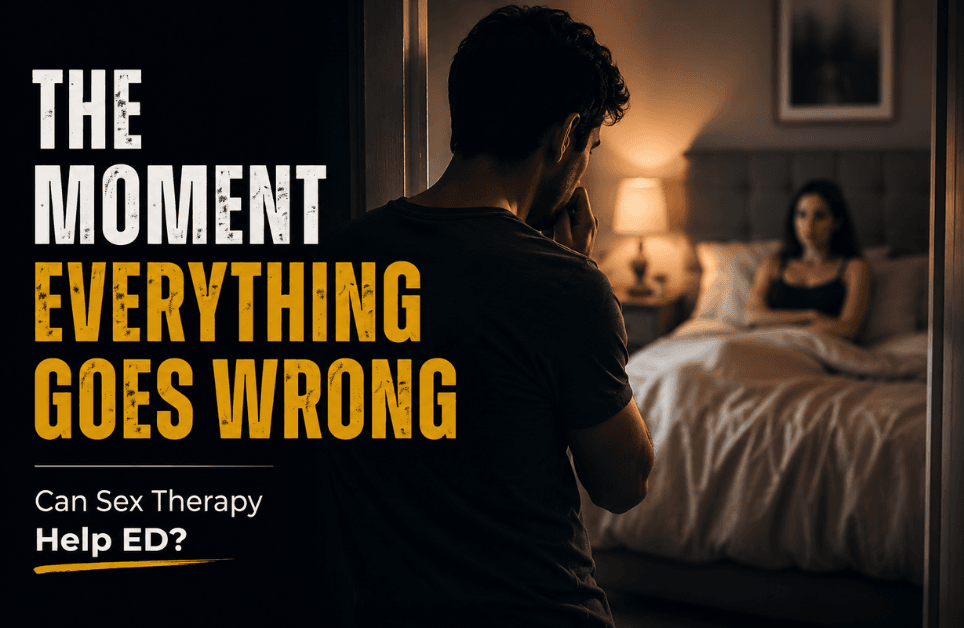
How Do You Know If Your Erectile Dysfunction Is Psychological?
Before deciding whether sex therapy is the right path, it helps to understand whether the problem is rooted in psychology rather than physical disease. The signs are usually clear once you know what to look for.
Psychogenic erectile dysfunction is strongly indicated when erections are fully normal during sleep, during masturbation, or in certain situations but not others. If you can achieve a firm erection reliably when alone but lose it with a partner, the mechanism driving the problem is almost certainly anxiety, not vascular disease or nerve damage.
Other indicators that point toward a psychological cause include ED that began suddenly after a specific event such as a breakup, a first sexual failure, or a stressful period. ED that is situational rather than consistent, anxiety about sex that starts hours or days before it happens, and the sense of watching yourself during sex rather than being present in it are all classic signs. You can read more about how to tell the difference between physical and psychological ED in detail.
A physical medical assessment is still necessary before starting psychosexual therapy. Erectile dysfunction can occasionally be an early signal of cardiovascular disease, and conditions such as diabetes, low testosterone, and certain medications can all suppress erections. A good psychosexual therapist will ask about your medical history and, if needed, recommend that you see a urologist or GP first. Therapy and medical treatment can run in parallel when both are needed.
Why Erections Work When You Are Alone But Fail With a Partner
This is the question most men actually want answered, and it is the one that almost no article online addresses in any meaningful depth. If you get hard alone but lose your erection with a partner, the reason is not physical. Here is what is actually happening.
When you are alone, there is no audience. There is no one to disappoint, no risk of judgment, no moment where you might be found inadequate. Your nervous system is relaxed. Specifically, your parasympathetic nervous system, the part responsible for rest and arousal, is allowed to do its job. Blood flows into the erectile tissue of the penis because nothing is signalling danger.
With a partner, all of that changes. Not because your partner is doing something wrong, but because the presence of another person introduces stakes. The question shifts from “am I turned on?” to “am I performing well enough?” That shift is invisible and happens in milliseconds. But its effect on your physiology is dramatic.
The moment your brain registers performance pressure, it activates the sympathetic nervous system: the fight-or-flight response. Cortisol and adrenaline are released. Blood is redirected away from the genitals and toward the large muscle groups needed for survival. The smooth muscle in the penis contracts rather than relaxes, and blood flow drops. Erection requires exactly the opposite physiological state.
What makes this particularly difficult is that once a man has experienced erection failure with a partner even once, the anticipation of failure becomes the very thing that causes it. The nervous system has now learned to associate sex with threat. It does not distinguish between a genuine physical danger and the fear of losing your erection. It responds to both the same way. Sex therapy directly targets this learned pattern and teaches your nervous system, through repeated experience and deliberate technique, that sex is safe again.
Why the Erection Disappears at the Moment of Penetration
A significant number of men experience a specific and distressing pattern: the erection is present during foreplay, firm enough to feel confident, and then fades precisely at the moment of attempted penetration. Many men also lose their erection right before penetration for the same underlying reason. To anyone experiencing this, it can feel like the body is working against them deliberately.
What is actually happening is neurological. Penetration is the highest-stakes moment in the sexual encounter for a man with performance anxiety. It is the point at which success or failure becomes visible and undeniable. The brain, having been conditioned by previous failures or by fear of failure, sends a flood of stress signals at exactly that moment. The sympathetic nervous system fires. Adrenaline spikes. Blood leaves the penis. The erection fades during penetration not because anything is physically wrong, but because the brain has triggered a threat response at the worst possible time.
What compounds the problem is timing. Because the erection was present just seconds before, the man typically interprets the loss as sudden and inexplicable, which increases panic, which accelerates the loss further. The partner may also sense the shift, and their reaction, whether they pull back, become concerned, or say nothing at all, feeds directly back into the man’s anxiety loop.
In psychosexual therapy, this specific pattern is addressed through a staged reintroduction of penetration, where erection is removed as the primary goal entirely. Sensate focus exercises are designed to make penetration just one of many forms of intimacy rather than the definitive moment of success or failure. Once the stakes drop, the nervous system relaxes, and the erection returns naturally.
Spectatoring: Why Checking Your Erection During Sex Makes It Disappear
Spectatoring is a term coined by sex therapy researchers Masters and Johnson. It describes the experience of mentally stepping outside your own body during sex and watching yourself from the outside, monitoring your performance, checking your arousal, assessing whether your erection is still adequate.
For a man with performance anxiety, spectatoring is almost universal. It typically sounds like an internal commentary running throughout the encounter: “Is it still hard? Is it getting softer? Should I try to enter now before I lose it? Does she notice? Am I going to lose it again?” Every one of those thoughts is a stress signal. And every stress signal triggers the sympathetic response that reduces blood flow to the penis.
The deeply paradoxical nature of spectatoring is that checking your erection during sex is precisely what causes it to fade. Checking is not neutral. It introduces fear. Fear triggers adrenaline. Adrenaline restricts penile blood flow. The check produces the result it was trying to avoid.
Addressing spectatoring is one of the central tasks of psychosexual therapy. CBT techniques are used to identify the thought patterns driving the monitoring, challenge the beliefs underneath them, and train attention to return to sensory experience rather than performance evaluation. Mindfulness practices are integrated specifically to keep awareness in the body rather than in the observing, judging mind.
How Anxiety Physically Disrupts Erections
Understanding the biology makes it considerably easier to accept that psychosexual therapy is a genuine, evidence-based treatment rather than a last resort or a soft option.
An erection requires the parasympathetic nervous system to release nitric oxide into the penile arteries. Nitric oxide relaxes the smooth muscle in the corpus cavernosum, allowing blood to fill the erectile tissue. The whole system depends on a state of relative calm and safety. It is inherently incompatible with a state of fear or alertness.
When anxiety is activated, the sympathetic nervous system releases norepinephrine. Norepinephrine does the opposite of nitric oxide: it causes smooth muscle contraction, constricts blood vessels, and actively reduces penile engorgement. This is not metaphorical. It is a direct, measurable physiological effect that happens within seconds of a fear response.
The brain is wired to prioritise survival over reproduction. From an evolutionary perspective, an erection during a genuine threat would be counterproductive. So the body’s threat-detection system is extremely efficient at suppressing sexual function. Even mild, anticipatory anxiety, the kind that occurs the moment you start to worry about whether you might lose the erection, is sufficient to activate this cascade.
This is why sexual performance anxiety driven ED often worsens over time without treatment. Each failure reinforces the learned association between sex and threat, which means the sympathetic response fires earlier and more strongly each subsequent time. The problem is not getting worse because something physical is deteriorating. It is getting worse because the psychological pattern is becoming more deeply conditioned. Psychosexual therapy interrupts this conditioning at multiple levels simultaneously, which is why it produces results where willpower alone does not.
Can Sex Therapy Actually Help With Erectile Dysfunction: When It Works Best
Sex therapy is most effective for erectile dysfunction when the man can achieve erections during sleep, on waking, or during masturbation. The erection problem is situational, meaning it occurs in specific contexts rather than universally. There is a clear link between the onset of ED and a period of stress, relationship difficulty, sexual failure, or increased anxiety. The partner is willing to participate in at least some of the therapeutic process. And there are no untreated medical conditions that could account for the ED.
Research consistently shows that sex therapy resolves stress-related ED in 50 to 70 percent of cases when the partner is involved in treatment. Outcomes are somewhat lower, though still clinically significant, when the man attends alone. Drop-out is the biggest predictor of failure: men who leave after two or three sessions before the therapeutic process has properly begun are unlikely to see lasting change.
When Can Sex Therapy Actually Help With Erectile Dysfunction Caused by Porn?
Porn-induced erectile dysfunction is increasingly common, particularly in men under 40. Regular, high-stimulation pornography use can condition the sexual response to require the novelty and intensity of pornographic content, making real-world partnered sex comparatively understimulating. This is not a moral issue; it is a conditioning issue. The brain’s reward circuitry has been shaped toward a particular type of stimulus. Psychosexual therapy addresses this through a structured reduction in pornography use combined with desensitisation exercises that rebuild arousal to real-world intimacy.
When Sex Therapy Is Unlikely to Help on Its Own
Sex therapy is not a substitute for medical treatment when ED has a clear physical cause. Severe vascular disease, uncontrolled diabetes with nerve involvement, hormonal disorders, and certain medications all require medical management first. A psychosexual therapist will identify when a medical referral is needed and will often recommend a combined approach where medication addresses physiological barriers while therapy addresses the psychological ones. PDE5 inhibitors such as sildenafil are sometimes used as a short-term bridge during therapy, giving the man positive erection experiences that help break the anxiety cycle while therapy addresses the underlying pattern.
What a Sex Therapist Actually Does in Sessions
Many men avoid seeking psychosexual therapy because they are unclear about what it involves. It is worth being direct: sex therapy sessions never involve any physical contact, sexual activity, or examination. Everything happens through structured conversation and assigned exercises practised privately at home. Knowing what happens in the first session can remove a significant barrier to getting started.
In the first session, the therapist takes a detailed sexual and psychological history. They ask about the first time ED occurred, the contexts in which it is better or worse, the man’s beliefs about masculinity and sexual performance, the relationship dynamic, previous sexual experiences, and his internal experience during sex. This assessment is the foundation for everything that follows.
Subsequent sessions alternate between conversation, where cognitive patterns are identified and challenged, and reviewing homework exercises, which are the behavioural component of treatment. The therapist tracks progress, adjusts exercises based on what is and is not working, and provides psychoeducation about the mechanisms underlying the ED. A typical course of treatment runs between 8 and 20 sessions, though significant improvement is often visible by session 6 to 8.
CBT Techniques Used in Sex Therapy for Erectile Dysfunction
Cognitive behavioural therapy is the primary evidence-based framework used in psychosexual therapy for performance anxiety and ED. It works at two levels: the thought patterns that generate anxiety, and the behavioural patterns that maintain it.
At the cognitive level, the therapist helps the man identify his specific beliefs about erection failure. These typically include beliefs such as “if I lose my erection, the sex is ruined,” “my partner will leave me if this keeps happening,” “a real man should always be able to perform,” or “losing my erection means I am not attracted to my partner.” These beliefs are not facts. They are learned assumptions that create the very pressure that disrupts arousal. CBT examines the evidence for and against each belief and replaces catastrophic interpretations with more accurate, proportionate ones.
At the behavioural level, exposure exercises gradually reintroduce sexual activity without erection as the goal. This eliminates the behaviours that maintain anxiety, such as avoiding sex, monitoring the erection constantly, or rushing to penetration before the erection fades. Mindfulness-based techniques train the man to keep attention on physical sensation rather than on performance monitoring, directly countering the spectatoring pattern described earlier.
Sensate Focus: The Core Exercise in Psychosexual Therapy
Sensate focus exercises are a structured series of touching exercises developed by Masters and Johnson and still used as a central component of psychosexual therapy today. The principle is deceptively simple: remove the demand for erection or intercourse entirely, and allow the nervous system to relearn that physical intimacy is pleasurable rather than threatening.
In the early stages, the couple is instructed to engage in non-genital touching, focused entirely on the sensory experience of touch rather than on any goal. Erection is explicitly not the aim. Intercourse is explicitly off the agenda. This is not a failure of ambition; it is the most direct route to restoring natural erectile function, because it removes the threat that was blocking it.
Over subsequent weeks, genital touch is gradually reintroduced, again without any requirement for erection or intercourse. By the time intercourse is reintroduced, the nervous system has had repeated experiences of intimacy without failure, and the conditioned fear response has significantly weakened. The erection often returns before the formal reintroduction of intercourse because the anxiety that was suppressing it has already been resolved through the earlier stages of the exercise.
What Recovery From Psychological ED Typically Looks Like Week by Week
This is one of the most practically important things a man considering therapy wants to know, and almost no article addresses it. The timeline below is approximate, based on a standard 12 to 16 week course of psychosexual therapy. Individual variation is significant.
Weeks 1 to 3 involve assessment and psychoeducation. The therapist maps the history, identifies specific triggers and maintaining factors, and begins explaining the anxiety mechanism. Many men find the psychoeducation alone partially relieving, because understanding why the problem is happening reduces the catastrophic interpretation of it. Erections do not typically improve yet during this phase, but anxiety about the problem usually begins to reduce.
Weeks 4 to 6 introduce sensate focus stage one. Non-genital touching is practised at home with the partner. The instruction to remove erection as a goal is initially difficult for many men to accept, but within one to two weeks most men report noticing spontaneous partial or full erections during these exercises precisely because the performance pressure has been removed. The nervous system is beginning to unlearn its threat response.
Weeks 7 to 9 introduce sensate focus stage two, with genital touch reintroduced but penetration still explicitly off the agenda. Erections are typically more consistent during these sessions. The man begins to trust his body again. CBT work during sessions addresses residual spectatoring and catastrophic thoughts about performance.
Weeks 10 to 12 reintroduce intercourse gradually, on the man’s terms and with explicit agreement from the therapist. The reintroduction is not pressured. If erection is lost, the couple has been trained to return to sensate focus rather than treating the event as a catastrophe. Gradually, erections during penetration become more reliable.
Beyond week 12, sessions move toward maintenance and relapse prevention. Most men who complete a full course of treatment report a qualitative change not just in erectile function but in their overall relationship to sex, which becomes less pressured and more genuinely pleasurable.
Common Mistakes That Make Psychological ED Worse
The most common mistake is trying harder. Willpower and determination are counterproductive when the problem is a conditioned anxiety response. Effort increases sympathetic activation, which makes erections less likely. Paradoxically, the path back to consistent erections runs through reducing effort, not increasing it.
Hiding the problem from a partner is the second major mistake. Silence forces the man to manage his anxiety entirely alone and prevents the partner from adjusting their behaviour in ways that would reduce pressure. Partners almost universally respond better to honest, calm communication than to the unexplained withdrawal that tends to follow unreported ED.
Dropping out of therapy after two or three sessions is the third. The early sessions are foundational. Improvement is rarely visible until the sensate focus work is underway, typically week four or five. Men who leave before reaching this stage leave before therapy has had a chance to work.
Using medication as the only strategy is also worth addressing. PDE5 inhibitors such as sildenafil can provide short-term assistance, but they do not treat the underlying anxiety pattern. Men who rely on medication without therapy often find that ED returns when medication is unavailable, or that anxiety interferes even with the medication’s effectiveness over time.
Is Online Sex Therapy Effective for Erectile Dysfunction?
Online sex therapy for ED is now the most accessible format for most men, particularly for those in India, the Middle East, and other regions where in-person psychosexual therapy services are limited. The evidence supports online delivery for anxiety-based sexual difficulties, and many men find the privacy of online sessions reduces the initial barrier to seeking help.
The sensate focus exercises and CBT techniques that form the core of treatment work identically whether sessions are conducted in person or online. The quality of the therapeutic relationship is the most important factor, not the medium of delivery.
Frequently Asked Questions: Can Sex Therapy Actually Help With Erectile Dysfunction?
Can sex therapy actually help with erectile dysfunction caused by anxiety?
Yes. Sex therapy is particularly well suited to erectile dysfunction caused by anxiety. The core techniques, including CBT, sensate focus, and mindfulness, directly target the anxiety cycle that physically blocks erections. Research shows resolution rates of 50 to 70 percent in cases where anxiety is the primary driver and the partner participates in treatment.
How many sessions of sex therapy does it take to see improvement in ED?
Most men begin to notice meaningful improvement between sessions 4 and 8, once the sensate focus exercises are underway and anxiety around erection performance starts to reduce. A full course of treatment typically runs 8 to 20 sessions over 12 to 20 weeks, depending on the complexity of the case.
Can sex therapy actually help with erectile dysfunction if my partner does not want to attend?
Yes, though outcomes are stronger when the partner participates. Individual therapy can still address spectatoring, performance anxiety beliefs, and CBT thought patterns. Sensate focus exercises can be introduced to the partner gradually, and many partners who are initially reluctant become more open once they understand what the process involves.
What is the difference between sex therapy and seeing a regular counsellor for ED?
A psychosexual therapist has specialist training in sexual function, anatomy, and evidence-based treatments for sexual difficulties including sensate focus and CBT for sexual performance anxiety. A general counsellor may have none of this training. For erectile dysfunction, psychosexual specialisation matters significantly.
Can sex therapy actually help with erectile dysfunction caused by watching too much porn?
Yes. Psychosexual therapy for porn-related ED involves a structured reduction in pornography use combined with desensitisation exercises that rebuild arousal to partnered intimacy. This is one of the more common presentations in men under 40 and responds well to a specialised approach.
Why does my erection disappear right when I try to penetrate my partner?
Penetration is the highest-pressure moment for a man with performance anxiety. The brain has learned to treat this specific moment as a high-risk event and fires a stress response, releasing adrenaline which constricts penile blood vessels and causes the erection to fade. Psychosexual therapy specifically targets this pattern through staged reintroduction and sensate focus.
What is spectatoring and can sex therapy actually help with erectile dysfunction caused by it?
Spectatoring is the experience of mentally stepping outside your body during sex to monitor your erection and performance. It is extremely common in men with performance anxiety and directly causes erection loss by generating the fear signals that suppress blood flow. CBT and mindfulness techniques in sex therapy are highly effective at reducing spectatoring.
Is sex therapy available online in India?
Yes. Psychosexual therapy is available online across India, the UK, the US, and internationally. Online delivery is evidence-supported for anxiety-based sexual difficulties. The privacy and convenience of online sessions often make it easier for men to begin treatment, particularly in cultures where seeking sex therapy carries social stigma.
Do I need to see a doctor before starting sex therapy for erectile dysfunction?
It is strongly advisable to have a medical assessment before starting psychosexual therapy. Erectile dysfunction can be an early sign of cardiovascular disease, and conditions such as diabetes, low testosterone, and medication side effects should be ruled out or addressed. A psychosexual therapist will typically ask about your medical history and may recommend a GP or urologist referral if a physical cause has not been excluded.
Can sex therapy actually help with erectile dysfunction that has been going on for years?
Yes, though long-standing patterns may take longer to resolve than recent ones. Duration alone is not a barrier to success. The more relevant factors are whether erections are still possible in some contexts, the man’s motivation to engage with the process, and whether the partner can be involved. Men with years of anxiety-based ED have successfully completed therapy and regained consistent erectile function.