There is something strange about the way anxiety works during sex. It does not arrive loudly. It arrives quietly, like a second voice that starts asking questions at the worst possible moment.
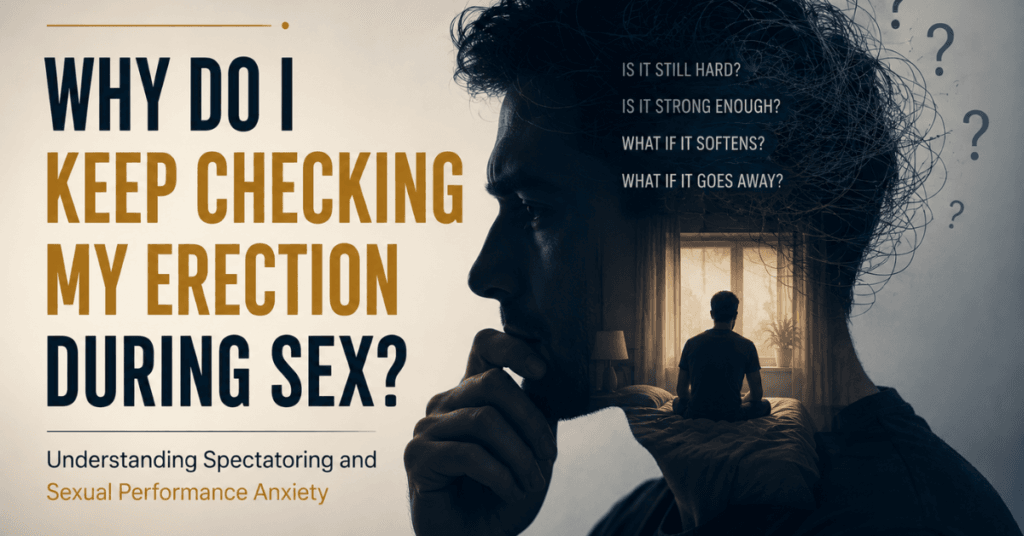
Is it still hard? Is it as hard as before? What if it softens? What if this is the moment it goes away?
Men who experience this describe something like a split. One part of them is present, physically engaged, trying to be there. Another part has stepped back and started watching. Checking. Grading. Waiting for something to go wrong.
This is not a physical malfunction. This is the mind doing something it learned to do, for reasons that made sense once, in a context where they are now deeply unhelpful.
What Is Spectatoring During Sex?
The clinical term for this pattern is spectatoring, a well-recognised psychosexual phenomenon where attention shifts away from sensation and toward self-observation during intimacy.
Instead of being inside the experience, feeling it, the person watches it. They assess it. They monitor it in real time, the way someone might grade a performance from the outside.
For men dealing with erection anxiety, spectatoring usually centres on one thing: erection firmness. The mind develops a habit of checking. Not once, not briefly, but repeatedly. Is the erection still there? Is it strong enough? Is it weakening?
What makes spectatoring particularly difficult is that it feels rational in the moment. It feels like responsible monitoring. It feels like staying ahead of a problem. But what it actually does is remove the person from the one environment where erections are naturally sustained: absorbed, distracted, present arousal.
Why Men Start Monitoring Their Erections During Sex
Erection monitoring does not start from nowhere. It almost always begins after an experience of unexpected erection loss. That first moment, whether it happened during foreplay, during penetration, or while reaching for a condom, leaves a strong psychological imprint.
The brain is designed to remember threat. When something embarrassing or frightening happens in a particular situation, the brain registers that situation as one requiring vigilance the next time it occurs. This is protective by design. In a different context, it is exactly the mechanism that keeps people safe.
Applied to sex, it becomes a problem. The brain starts treating intimacy like a situation that needs to be managed carefully. It begins scanning for early signs of trouble. It starts monitoring erection quality not out of curiosity, but out of fear.
This pattern is closely tied to sexual performance anxiety, where the mind becomes excessively focused on avoiding failure instead of staying engaged in arousal.
With each sexual encounter that follows, the checking starts earlier. A man who once checked his erection halfway through sex may find himself checking before penetration, then before undressing, then simply at the thought of being with someone. The brain keeps moving the alarm earlier in the sequence, trying to stay ahead of the failure it has learned to expect.
How Self-Monitoring Interrupts Arousal
This is the part that feels almost cruelly ironic. The very act of checking erection firmness interferes with the conditions required to maintain one.
Erections depend on a particular state of the nervous system. When a man is relaxed, absorbed, and aroused, the parasympathetic nervous system is dominant. This is the branch responsible for rest, digestion, and sexual arousal. Blood flows toward the pelvic region. The body moves toward erection naturally and without effort.
When the brain detects threat or pressure, the sympathetic nervous system activates. This is the branch associated with alertness, vigilance, and the stress response. It redirects blood away from non-essential systems, including the genitals, and toward the muscles and organs that would be needed to manage a threat.
Self-monitoring during sex activates the sympathetic nervous system. It is a form of threat assessment. The body does not distinguish between the anxiety of checking an erection and the anxiety of actual danger. Both are processed as alertness states. Both produce the same physiological response.
So the man who keeps checking his erection is, in a neurological sense, sending repeated stress signals to a system that requires calm to function. Every mental check introduces a small pulse of sympathetic activation. Over the course of a sexual encounter, these accumulate. The erection softens not because arousal disappeared, but because the nervous system was repeatedly asked to evaluate rather than feel.
How the Anxiety Loop Reinforces Itself
What makes this pattern particularly persistent is that it tends to confirm its own logic.
A man starts checking his erection because he is afraid it will soften. The checking activates his nervous system. The erection softens. He interprets this as proof that his erection is unreliable. He checks even earlier and more frequently next time. The erection softens again, sooner. The brain registers this as further evidence of a problem.
Over time, the monitoring becomes reflexive. It no longer requires a conscious decision. The moment sexual activity begins, or sometimes the moment intimacy becomes a possibility, the checking starts automatically. The brain has been trained to anticipate collapse, and it prepares accordingly.
This is not weakness or failure of willpower. This is conditioning. The mind learned something in a particular context, and it is applying that learning consistently, even when it is working against the person. Recognising this as a learned pattern, rather than a permanent physical reality, is one of the first meaningful shifts in treatment.
Why Monitoring Intensifies Around Penetration
Most men who experience erection monitoring notice that it peaks at specific moments. Penetration is one of the most common.
There is something psychologically distinct about the transition into penetration. It feels like the moment when everything either works or does not. For men already carrying erection anxiety, this transition becomes a high-stakes checkpoint. The internal monitoring escalates. The evaluation intensifies. The question “is it hard enough right now” becomes urgent.
This is why many men find that their erection is present during foreplay but becomes unreliable precisely at this moment. It is not coincidental. The monitoring spikes at the point of highest psychological pressure, and the nervous system responds to that spike. This pattern overlaps closely with experiences described in the context of erection difficulties during penetration and, for some men, anxiety before penetration itself, where the anticipatory checking begins even before the moment arrives.
Why Erections Often Work Fine When Alone
Men who experience this pattern almost universally report that erections are reliable during masturbation. This is not a coincidence, and it is not evidence that the problem is physical.
When alone, there is no observer. There is no one to disappoint, no performance to sustain, no external evaluation to fear. The absence of a social context removes the primary trigger for monitoring. The nervous system remains in a parasympathetic state. Attention stays on sensation rather than shifting to surveillance. The erection continues without interruption.
This pattern, staying hard alone but not during sex, is one of the clearest indicators that the problem is psychological rather than vascular or hormonal. A man whose erections function well in private has intact erectile physiology. What he is experiencing with a partner is a learned anxiety response, not a physical deficit.
What Actually Helps
Because erection monitoring is a learned psychological pattern, it responds to psychological intervention. It does not respond well to willpower, to trying harder, or to reassuring oneself that everything will be fine. Those approaches often increase cognitive activity during sex, which is the opposite of what is needed.
What helps is a deliberate shift of attention, practiced over time, from evaluation back to sensation. This is not simply advice to “relax.” It is a specific retraining of where attention goes during intimacy. In psychosexual therapy, this often involves structured exercises that gradually reduce the performance context of sex and rebuild sensory engagement without the pressure of outcome.
Understanding the nervous system dynamic matters here. When a man grasps that his erection is not randomly failing, but that his own monitoring is activating the sympathetic response that suppresses it, the pattern becomes something he can work with rather than something happening to him without cause or logic.
Reducing the pass/fail framing of sexual encounters is also central. Erection monitoring is partly sustained by treating each sexual experience as a test with a binary result. When sex is no longer structured internally as something to pass or fail, the urgency of the checking loses some of its fuel.
For men where the pattern is deeply conditioned or accompanied by significant anticipatory anxiety, professional support through psychosexual therapy can address the underlying learning directly. This includes nervous system retraining, cognitive restructuring around sexual performance, and gradual exposure work that allows the body to relearn what safety during intimacy feels like. Some men who also experience erection loss during condom use find that this pattern is part of the same broader monitoring cycle, where any interruption or pause triggers an evaluation spike.
Closing Thoughts
Erection monitoring during sex is not random. It is not mysterious. It is a specific psychological pattern the mind learned under specific conditions, and it runs on a clear and understandable mechanism.
The erection is not failing because the body is broken. The erection is weakening because the mind has learned to watch sex instead of be inside it. It has turned the experience into a test, and it has begun administering that test from the moment intimacy becomes a possibility.
That pattern can change. The nervous system is not fixed. Attention can be retrained. The checking can be interrupted, not through force, but through understanding what drives it and creating the conditions under which it becomes unnecessary.
The starting point is recognising what is actually happening, not a physical failure, but a learned loop, one the mind created to protect against embarrassment and that is now doing the opposite.
For many men, the most important shift is realising that the checking itself is part of the problem, not the solution. Once the mind stops treating intimacy like a performance to monitor, the nervous system gradually relearns how to stay relaxed inside arousal rather than evaluating it from the outside.
Frequently Asked Questions
Why do I keep checking my erection during sex?
This happens because the brain has learned to treat sex as a situation requiring vigilance, usually following a previous experience of unexpected erection loss. Once that association forms, the mind starts monitoring automatically, scanning for early signs of a problem in an attempt to stay ahead of it.
What is spectatoring?
Spectatoring is the experience of mentally stepping outside a sexual encounter to observe and evaluate it rather than remaining present within it. During sex, this typically means watching and grading one’s own performance from a psychological distance instead of being absorbed in sensation and connection.
Can overthinking cause erection problems?
Yes. Overthinking during sex activates the sympathetic nervous system, which redirects blood away from the genitals and suppresses the parasympathetic state that erections require. It also pulls attention away from the sensory inputs that sustain arousal. The more the mind evaluates, the less the body can respond.
Why does my erection disappear when I focus on it?
Because focusing on erection firmness is a form of self-monitoring that activates a mild stress response. Erections are sustained by absorbed, relaxed arousal. Switching attention from sensation to evaluation interrupts both the nervous system state and the sensory input that arousal depends on.
Does anxiety weaken erections?
Directly, yes. Anxiety activates the sympathetic nervous system, which is physiologically incompatible with erection. This is why psychological states, such as fear of failure, anticipatory worry, and self-surveillance, can suppress erections even when arousal is otherwise present.
Is erection monitoring a form of psychological ED?
Yes. When erection difficulties are driven by anxiety and self-surveillance rather than vascular, hormonal, or neurological causes, the condition is classified as psychogenic erectile dysfunction. Erection monitoring is one of the most common underlying mechanisms in this category.
How do I stop thinking about my erection during sex?
Shifting attention during sex is a specific skill that takes practice. It involves deliberately returning focus to physical sensation, breath, touch, and connection rather than internal evaluation. Psychosexual therapy provides structured approaches for retraining this pattern, addressing both the conditioned monitoring habit and the underlying anxiety that sustains it.