Spectatoring during sex is a psychological pattern where a person mentally monitors and evaluates their own sexual performance during intimacy instead of staying present in the experience. It is strongly linked to performance anxiety, erection anxiety, overthinking during sex, and psychogenic erectile dysfunction.
The thoughts feel automatic. “Am I hard enough?” “What if I lose my erection?” “Is my partner noticing?” “Why can’t I stay present?” “Why am I thinking so much during sex?” Questions like these pull you further from the moment with every passing second. And the more you try to fix things by checking, the worse things get.
This article explains what spectatoring actually is, why it happens, how it disrupts erections and arousal, and most importantly, how to stop it. If you have ever felt like a stranger in your own body during sex, you will find answers here.
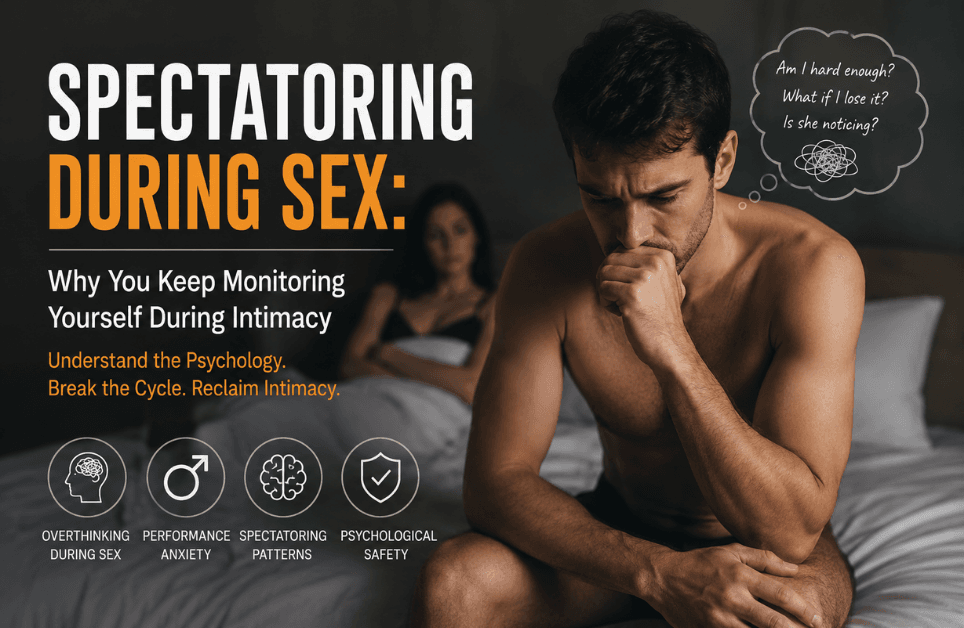
What Is Spectatoring During Sex?
The concept of spectatoring was first described by sex researchers Masters and Johnson. They noticed that many people struggling with sexual performance were mentally removing themselves from the experience and watching from the outside, like a spectator at a game.
Spectatoring during sex is the act of self-observing during intimacy instead of staying present and absorbed in the experience. Rather than feeling sensation, you are monitoring performance. Rather than connecting with your partner, you are tracking your erection, judging your body, and anticipating failure.
It is the difference between experiencing a meal and analyzing every bite while you eat it. The analysis destroys the experience.
Most men who spectate during sex do not realize they are doing it. It feels like concern, like trying to stay in control. In reality, it is hypervigilance that the brain has mistakenly applied to intimacy, a space where vigilance has no useful role.
Spectatoring is strongly linked to sexual performance anxiety, erection anxiety, and psychogenic erectile dysfunction. It involves anxious self-monitoring in real time, thoughts like checking erection quality, scanning partner reactions, and judging personal performance. The more a man monitors himself during sex, the more his nervous system interprets the situation as a threat, and the more arousal breaks down as a direct result.
Signs and Symptoms of Spectatoring During Sex
Spectatoring does not always look dramatic from the outside. Internally, it is relentless. Here are the most common signs.
- Your mind keeps asking “Am I hard enough?” or “Am I still hard?” during sex.
- You are mentally checking your erection every few seconds without choosing to.
- You feel like you are watching yourself perform rather than experiencing intimacy.
- You are scanning your partner’s face for signs of disappointment or boredom.
- You feel physically present but mentally distant during sex.
- Thoughts like “What if I go soft again?” arrive before or during sex, not after.
- You feel pressure to perform rather than pleasure to experience.
- Your erection fades not from lack of attraction but from thinking too much during sex.
- You feel anxious as soon as things begin to escalate, even when you genuinely want to be intimate.
- You replay the encounter afterward, mentally analyzing what went wrong.
If you recognize yourself in several of these, spectatoring is likely a significant part of what is disrupting your sexual experiences.
Why Spectatoring Happens During Sex
Spectatoring does not appear from nowhere. It develops in response to anxiety, past experiences, conditioning, and the mind’s attempt to protect you from perceived failure. Understanding why it starts is the first step to dismantling it.
Performance Anxiety and Self-Monitoring
Sexual performance anxiety teaches the mind that intimacy is a test, not an experience. When a man has lost his erection once, struggled to maintain it, or felt shame around sex, the brain begins filing away intimacy as a situation that requires monitoring.
The mind is trying to help. It is saying, “Last time something went wrong. I need to watch carefully so I can catch it early.” The problem is that watching carefully during sex is counterproductive. The act of monitoring creates the very problem it is trying to prevent.
Sexual self-monitoring pulls cognitive attention away from sensory experience. You stop feeling. You start evaluating. And the moment you stop feeling, arousal has nothing to build on.
Why the Nervous System Shifts Into Threat Mode
The human nervous system has two broad operating modes. The parasympathetic state handles rest, digestion, and sexual arousal. The sympathetic nervous system handles threat responses, including fight, flight, and freeze.
Erections require the parasympathetic state. The body needs to feel safe. Blood flow needs to be directed toward the genitals. Muscles need to relax. None of that can happen efficiently while the sympathetic nervous system is active.
When spectatoring triggers performance pressure during sex, the brain activates the sympathetic nervous system. It treats the sexual situation as a threat. Adrenaline increases. Blood is redirected away from the genitals and toward large muscle groups. The erection softens. This is not a failure of desire. It is a failure of psychological safety.
Anticipatory Anxiety and Sexual Conditioning
After one or two difficult sexual experiences, a pattern of anticipatory anxiety can form. Before sex even begins, the mind is already running through worst-case scenarios. “What if I go soft again?” “What if my partner is disappointed?” “What if this time is worse than last time?”
This anticipatory fear activates arousal interference before anything has gone wrong. The body arrives at intimacy already tense. Already monitoring. Already partially in threat mode. And then the spectatoring begins, because the brain has been conditioned to associate sex with danger rather than pleasure.
Conditioning is powerful. The brain does not need a real threat for anxiety to activate. It only needs to believe that one might exist.
Why Men Keep Monitoring Their Erection During Sex
Fear of Losing Erection During Sex
For many men, checking their erection during sex starts after a single episode of erection loss. It might have happened once. It might have been situational. But the brain logged it as a significant failure and began setting up a monitoring system for all future encounters.
The fear of going soft during sex is deeply tied to identity for many men. Losing an erection feels like failing at something fundamental. So the mind starts checking constantly, almost compulsively, to make sure things are still working.
“Am I still hard?” becomes a background loop. Every few seconds, attention drifts from the experience to the erection. And the checking itself disrupts the erection further, because the act of checking activates anxiety, and anxiety disrupts arousal.
Hyperfocus on Erection Quality
Erection quality naturally fluctuates during sex. Firmness changes with arousal levels, breathing patterns, body position, and mental state. This is completely normal. But for a man caught in spectatoring, any drop in firmness triggers alarm.
The mind interprets a small, natural fluctuation as the beginning of failure. “I am losing it again.” This thought raises anxiety, which lowers arousal further, which reduces firmness further, creating a loop that feels impossible to escape.
The more a man focuses on his erection during sex, the more detached he becomes from the physical sensations that sustain arousal. He stops feeling pleasure and starts monitoring a biological function as though it were a machine that needs constant oversight.
How Spectatoring Affects Erections and Sexual Performance
Anxiety and Sympathetic Nervous System Activation
When the brain detects performance pressure during sex, it releases stress hormones including adrenaline and cortisol. These hormones have a direct physiological effect on erection quality. They narrow blood vessels, increase heart rate, and shift blood flow away from the penis.
This is not a malfunction. It is biology doing exactly what it was designed to do. The sympathetic nervous system does not distinguish between physical danger and psychological pressure. Both trigger the same cascade of events. And both interfere with the parasympathetic state required for erections to form and be maintained.
For men experiencing anxiety during intimacy, the pattern is painfully predictable. Arousal begins. Spectatoring starts. Anxiety rises. Erection softens. More checking. More anxiety. Further softening. This is not about physical health. This is about an overactive anxiety response during intimacy.
Chronic self-monitoring during sex shifts attention away from sensation and into evaluation, which directly interferes with natural arousal.
When erection fades during penetration, spectatoring combined with sympathetic nervous system activation is one of the most common psychological causes.
Why Erections Require Psychological Safety
Erections are not simply a matter of physical arousal. They require a specific psychological environment. The brain must feel safe, non-threatened, and absorbed in pleasurable stimuli. When spectatoring is active, none of those conditions are met.
Sexual confidence is not arrogance. It is the quiet, background sense that intimacy is safe to enjoy. Men who spectate during sex have lost that background sense, often without knowing it. Sex has quietly become a performance review rather than a shared experience.
When this pattern becomes established, it often develops into what clinicians call psychological erectile dysfunction, a form of erection difficulty rooted entirely in psychology rather than physical health. The body works fine. The nervous system response is working against it.
Can Anxiety Cause You To Lose Your Erection During Sex?
Yes. Anxiety is one of the most direct causes of erection loss during sex, and spectatoring is the mechanism through which it usually operates.
When anxiety rises during intimacy, it activates the sympathetic nervous system. Blood is redirected. Muscles tighten. Attention narrows. Erection quality drops. Many men then panic, which intensifies the anxiety response, and the erection softens further.
This is anxiety causing erection loss, not a medical problem with the erection itself. Men who experience this often find that erections function without difficulty in other contexts: during sleep, during masturbation, or during low-pressure situations. The problem appears specifically in performance-laden intimate encounters.
Losing an erection from anxiety is not a sign of physical dysfunction. It is a sign that the nervous system has been conditioned to treat intimacy as threatening. That conditioning can be reversed with the right approach.
Understanding how to stop thinking about your erection during sex is often the most direct way to interrupt this cycle before it becomes entrenched.
Why Thinking Too Much During Sex Interrupts Arousal
Arousal is not just physical. It is fundamentally attentional. Where your attention goes, your arousal follows. When your attention is inside the experience, feeling sensation, warmth, and connection, arousal builds naturally. When your attention is outside the experience, monitoring, evaluating, and managing, arousal has no fuel.
The brain cannot fully process pleasurable sexual stimuli while simultaneously running a performance analysis. Cognitive bandwidth is limited. When thinking too much during sex takes over, the sensory information that would normally build arousal is pushed aside by the analytical process.
Many men describe spectatoring as overthinking during sex to the point that they can no longer stay connected to physical sensation or emotional intimacy.
This explains why so many men feel as though their mind and body are disconnected during sex. They are not experiencing a physical problem. They are experiencing an attentional problem. The mind is in the wrong place.
The internal commentary, “Why can’t I stay present?” “What if I go soft again?” “Why am I thinking so much right now?”, is itself evidence of the attentional split. The brain is observing its own observation. And the deeper it goes into self-monitoring, the further arousal recedes.
Intimacy anxiety is not a personality flaw. It is the result of learned patterns, past negative experiences, and a nervous system that has been quietly trained to treat closeness as risk.
How To Stop Spectatoring During Sex
Stopping spectatoring is not about willpower or telling yourself to relax. The “just relax” advice is well-meaning but largely useless when the nervous system is conditioned into threat mode. Effective change requires specific approaches that work with the nervous system rather than against it.
Grounding Attention During Intimacy
The most evidence-supported approach to stopping spectatoring is redirecting attention toward sensory experience in the present moment. This is the foundation of mindfulness as applied to sex therapy.
Instead of asking “Am I hard enough?”, the practice is to consciously redirect attention to physical sensation. What can you feel right now? Warmth? Pressure? Texture? The sound of your partner’s breathing? The shift from evaluative to sensory attention interrupts the spectatoring loop.
This is not easy at first. The mind has built habits. It will keep returning to evaluation. The practice is simply noticing when it does, and gently returning attention to sensation without judgment. Over time, this redirects the brain’s default pattern during intimacy.
Reducing Mental Performance Checking
Reducing erection-focused thinking during sex requires gradually removing the mental habit of checking. This is different from ignoring the erection. It means deprioritizing erection quality as the measure of sexual success.
Men caught in constant erection monitoring have unconsciously made the erection the entire point of the encounter. When they are encouraged to define intimacy differently, as connection, sensation, and presence rather than erection quality, the compulsive checking often reduces on its own.
Pleasure does not require a perfect erection at every moment. Intimacy does not require constant performance assessment. Reframing what satisfying sex actually means is a practical and powerful step in breaking the checking cycle. The reason men keep monitoring their erection during intimacy almost always traces back to this performance-definition problem.
Sensate Focus and Pressure-Free Intimacy
Sensate focus is a structured approach developed by Masters and Johnson specifically to address sexual anxiety and spectatoring. It involves a series of non-performance-oriented touch exercises designed to rebuild the experience of intimacy without any pressure to achieve erection, orgasm, or specific sexual outcomes.
In sensate focus, the goal is entirely about attention and sensation. There is no test. There is no evaluation. This removes the conditions under which spectatoring thrives and gradually reconditions the nervous system to associate intimacy with safety rather than pressure.
Many men find that during sensate focus exercises, erections return naturally, without effort or monitoring, precisely because the performance pressure has been removed. This experience alone can be profoundly reassuring. It demonstrates that the body functions well when the mind stops interfering.
Can Sex Therapy Help Spectatoring and Erection Anxiety?
Yes. Sex therapy, specifically psychosexual therapy, is one of the most effective approaches for addressing spectatoring, performance anxiety, and anxiety-related erectile dysfunction. It is not a conversation about what is wrong with you. It is a structured clinical process for understanding and reversing the psychological patterns that have disrupted your sexual experience.
Cognitive behavioural therapy within a psychosexual context helps men identify and challenge the distorted beliefs that feed spectatoring. Beliefs like “I must maintain a perfect erection to be a good partner” or “losing my erection once means I am sexually inadequate” can be examined, tested, and replaced with more accurate and genuinely helpful thinking.
Sensate focus exercises are typically prescribed alongside therapeutic conversations, creating both a cognitive and behavioral shift. Many men find that just a few structured sessions produce meaningful changes in how they experience intimacy.
Working with a qualified psychosexual therapist means you do not need to navigate this alone. Online sex therapy for erectile dysfunction is now clinically established and accessible from complete privacy.
If you are unsure where to start, understanding what happens during the first session with a sex therapist can remove much of the uncertainty that keeps men from seeking help early.
Below are the most common questions men ask about spectatoring, performance anxiety, and anxiety-related erection problems.
Frequently Asked Questions
What is spectatoring during sex?
Spectatoring during sex is the act of mentally observing and evaluating yourself during intimacy instead of staying present in the experience. It typically involves anxious self-monitoring such as checking erection quality, tracking partner reactions, and judging your own performance in real time. Spectatoring was first described by sex researchers Masters and Johnson and is closely linked to sexual performance anxiety, erection anxiety, and psychogenic erectile dysfunction in men. It disrupts arousal by diverting attention away from sensation and into evaluation.
Why do I keep checking my erection during sex?
If you keep checking your erection during sex, it is almost always a response to fear, specifically the fear of losing it. After one or more episodes of erection difficulty, the brain begins monitoring intimacy as a potential threat. It sets up a checking loop to catch problems early. Unfortunately, this checking activates the sympathetic nervous system, which directly interferes with arousal and erection quality. The monitoring creates the very problem it is trying to prevent. This is the core mechanism behind sexual self-monitoring and spectatoring in men.
Can anxiety make you lose your erection during sex?
Yes. Anxiety activates the sympathetic nervous system, which redirects blood flow away from the genitals and toward large muscle groups. This directly reduces erection quality during sex. Anxiety also narrows attention, triggering spectatoring and monitoring behaviors that interfere further with arousal. Men experiencing anxiety-caused erection loss often find that erections function normally in low-pressure contexts. This confirms the psychological rather than physical origin. Losing an erection from anxiety is extremely common, does not indicate permanent dysfunction, and responds well to structured psychosexual therapy.
Is spectatoring common in men?
Spectatoring is extremely common in men, particularly those who have experienced sexual performance anxiety, erection difficulty, or shame around sex. It tends to develop gradually and often goes unrecognized because it feels like reasonable concern rather than a psychological pattern. Many men believe they simply have erectile dysfunction when the underlying issue is actually spectatoring and anxiety-driven self-monitoring. Psychosexual therapists consistently identify spectatoring as one of the most frequently reported barriers to arousal and sexual satisfaction in men of all ages.
How do I stop overthinking during sex?
Stopping overthinking during sex requires deliberately redirecting attention toward physical sensation rather than performance evaluation. Mindfulness techniques applied to intimacy help break the spectatoring loop by keeping awareness inside the body and inside the experience. Sensate focus exercises prescribed by a psychosexual therapist systematically remove performance pressure from intimacy, allowing the nervous system to reset. Cognitive behavioural therapy addresses the underlying beliefs that make overthinking feel necessary. Changing the definition of what successful sex means is often the most important first step in reclaiming presence during intimacy.
Can spectatoring cause erectile dysfunction?
Yes. Chronic spectatoring is a direct pathway to psychogenic erectile dysfunction. When a man consistently monitors himself during sex, the resulting anxiety activates the sympathetic nervous system, which blocks the parasympathetic response required for erections. Over time, this becomes a conditioned response. The body begins associating intimacy with threat rather than safety, and erection difficulty becomes automatic rather than situational. This is not physical erectile dysfunction. It is psychologically driven and is highly treatable with psychosexual therapy, sensate focus, and cognitive behavioural approaches.
Why do I mentally monitor myself during sex?
Mental self-monitoring during sex is the brain’s misapplied protection response. After experiencing sexual difficulty, shame, or performance pressure, the brain begins treating intimacy as a situation that requires vigilance. It starts watching for signs of failure so it can intervene early. This hypervigilance feels logical but is counterproductive in sexual situations. Arousal requires the opposite of vigilance. It requires absorbed, present attention on pleasurable stimuli. The more you monitor, the more attention moves away from sensation, which is exactly what disrupts the arousal response and feeds the cycle.
Can sex therapy help with performance anxiety and spectatoring?
Sex therapy is one of the most effective treatments for performance anxiety and spectatoring. Psychosexual therapy combines cognitive behavioural approaches with structured sensate focus exercises that directly target the anxiety and monitoring patterns underlying spectatoring. Most men see meaningful improvement within a structured course of sessions. Therapy works by addressing both the thought patterns that feed monitoring and the nervous system conditioning that makes sex feel threatening. Online psychosexual therapy makes this support accessible without requiring in-person visits, which many men find significantly reduces the barrier to starting.
What causes the fear of losing an erection?
Fear of losing an erection usually begins with a single or repeated experience of erection difficulty during sex. The emotional weight of that experience, often shame, embarrassment, or fear of disappointing a partner, causes the brain to flag intimacy as risky. Anticipatory anxiety then develops. Before sex begins, the mind is already preparing for failure, which activates the very nervous system response that causes erection loss. The fear becomes self-fulfilling. Cultural expectations around male sexual performance often amplify this fear and discourage men from seeking help early.
Can psychogenic erectile dysfunction improve with therapy?
Psychogenic erectile dysfunction responds well to psychosexual therapy and is fully treatable in the majority of cases. Because the dysfunction is rooted in psychological patterns rather than physical health, addressing those patterns directly resolves the erection difficulties. Therapy typically includes cognitive behavioural work to challenge performance-related beliefs, sensate focus to rebuild pressure-free intimacy, and mindfulness practices to interrupt spectatoring. Many men find significant improvement within weeks of starting structured therapy. The earlier intervention begins, the less entrenched the conditioning and the faster meaningful results tend to appear.
Final Thoughts
Spectatoring during sex is not a character flaw. It is not weakness. It is not evidence that something is permanently wrong with your body or your mind. It is a learned anxiety response, one that developed to protect you and ended up working against you.
The good news is that what was learned can be unlearned. The nervous system is not fixed. Conditioned responses to intimacy can be reversed with the right structured approach. Men who once found every sexual encounter dominated by monitoring and self-evaluation go on to experience intimacy that feels natural, connected, and pressure-free.
Spectatoring is extremely common. It is almost always anxiety-driven. And it is treatable. The turning point usually comes when a man stops trying to force his way through the anxiety and starts working with a qualified professional to understand and resolve the underlying pattern.
Awareness of spectatoring is the starting point. Structured psychosexual therapy is the path forward. Erections improve when intimacy stops feeling like evaluation. That shift is possible. It starts with understanding what is actually happening, and it continues with the right kind of support.