There is a particular quality of awareness that takes over during sex when something feels wrong, or when you’re afraid something is about to go wrong. It’s not quite panic. It’s more precise than that. It is a narrow, searching, hyperattentive focus that fixes itself onto one thing: your erection. Is it hard enough? Is it getting softer? Did it just shift? What does that mean? Should I change position? Should I stop? The physical sensation you were feeling just moments ago quietly disappears, replaced entirely by a kind of internal monitoring that feels urgent and involuntary.
Most men who experience this describe it as watching themselves from a distance while simultaneously being trapped inside their own bodies. Intimacy becomes a performance review. The partner becomes an audience. And the erection, the very thing you’re trying not to think about, becomes the only thing in the room.
What makes this so difficult is that the monitoring doesn’t feel irrational in the moment. It feels like a reasonable response to a real problem. And yet it is precisely the act of checking, that constant, anxious self-surveillance, that extinguishes the very thing you’re trying to preserve.
To stop thinking about your erection during sex, you need to stop monitoring it as a performance test. Constantly checking whether you are still hard activates anxiety and disrupts the nervous system state required for arousal. This pattern, known as spectatoring, is one of the most common causes of psychological erection problems and performance anxiety during sex.
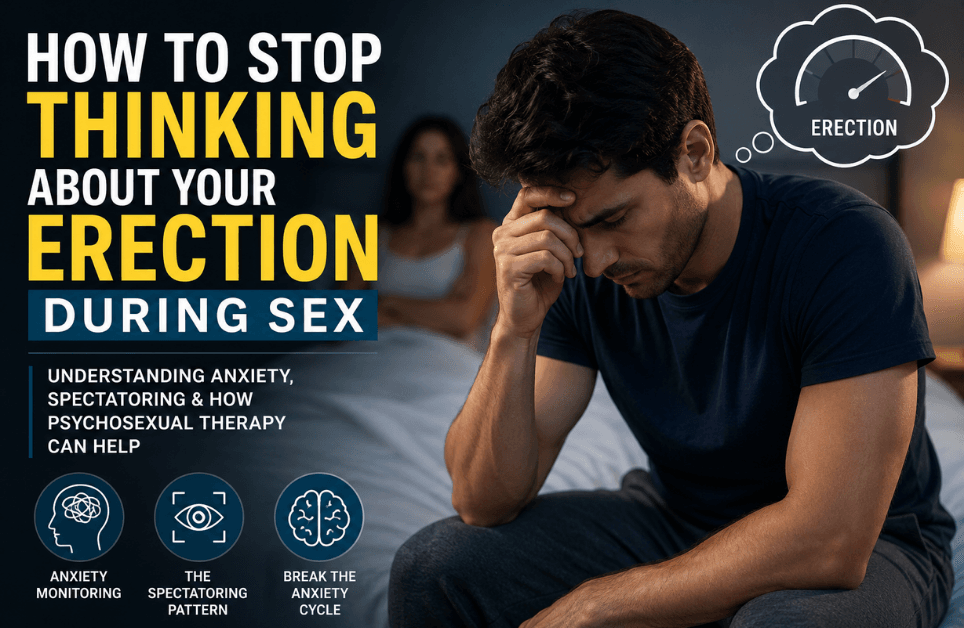
The short answer: To stop thinking about your erection during sex, you need to understand that the checking itself is the problem, not a solution. Erection monitoring during sex activates your body’s threat-response system, which directly suppresses the physiological conditions an erection requires to persist. This is not a failure of attraction, willpower, or masculinity. It is a well-documented psychological pattern called spectatoring, driven by performance anxiety and attentional disruption. Psychosexual therapy, combined with structured behavioural approaches, is the most effective way to break this cycle.
Why Constantly Monitoring Your Erection Makes Anxiety Worse
When you become hyperaware of your erection during sex, your attention has fundamentally shifted from the experience to the evaluation of the experience. This is not a small distinction. It changes everything about what your nervous system is doing.
An erection is not something the conscious mind controls. It is a parasympathetic response. It only works when the body feels safe and genuinely at ease. The moment anxiety enters, the sympathetic nervous system takes over. Adrenaline moves through the body. Attention narrows. The body shifts into threat management mode, not intimacy mode.
Monitoring your erection is an act of threat assessment. You are asking your body: Is something wrong? Should I be worried? And the body hears that question clearly. Every time you check, the nervous system interprets that vigilance as confirmation that something threatening is happening. The checking deepens the anxiety. The anxiety produces erection loss. And the erection loss confirms the fear, which restarts the checking.
This is what psychosexual clinicians refer to as a conditioned anxiety loop. It is not a character flaw. It is a cycle, one that has a beginning, a structure, and, crucially, a way out.
The “Spectatoring” Pattern Explained
The clinical term for what happens when a person mentally steps outside of their own sexual experience to observe and evaluate it is spectatoring. The concept was first described by sex researchers Masters and Johnson, and it remains one of the most clinically accurate frameworks for understanding erection anxiety during intimacy.
Spectatoring is exactly what it sounds like: you become a spectator to your own sex life. Part of your attention remains physically present, you can feel touch, you are aware of your partner, but a significant portion of your cognitive capacity has relocated to a kind of inner broadcast booth, where a running commentary about your performance is being narrated in real time.
Is it staying hard? It was harder a minute ago. Did she notice? Keep going, maybe it’ll come back. Why is this happening again? I’m going to lose it, I can already feel it…
This internal monologue consumes exactly the kind of attention that arousal depends on. Sexual excitement, particularly the sustained arousal needed for partnered sex, requires immersive, embodied, sensory engagement. The moment a significant portion of attention is redirected toward self-surveillance, the sensory input that was sustaining arousal becomes thinner, less vivid, less engaging. The erection, deprived of its neurological fuel, begins to fade. Not because desire is absent. Not because the body is broken. But because the mind has left the room.
Spectatoring can happen to any man, at any age, regardless of relationship history. But it tends to deepen over time if the underlying anxiety cycle is never addressed. What begins as one difficult experience gradually becomes an anticipated event, then a habit of mind, then a near-automatic response every time intimacy begins.
Why Erections Often Disappear the Moment You Start Checking Them
This is the part that many men find most confusing, and most demoralising. The erection is there. Desire is present. Everything feels like it should work. And then the thought arrives: Is this going to last? And within moments, the erection softens.
Why checking erections increases anxiety
Once you understand the physiology, the pattern starts making sense. An erection requires sustained blood flow into penile tissue, maintained through smooth muscle relaxation. Anxiety causes the body to release noradrenaline, which causes vasoconstriction. Blood flow reduces. The physical conditions that sustain an erection are chemically disrupted.
This happens fast. A single anxious thought can alter blood flow dynamics within seconds. The softening that follows is not imaginary. It is real, measurable, and entirely consistent with anxiety activation, but it is caused by the anxiety, not by any structural or vascular problem.
This is why men who experience erection loss during monitoring so often feel like their body has betrayed them. The erection fades, and that fading feels like evidence that something is fundamentally wrong. But the evidence points elsewhere: the very act of mentally checking, of observing the erection with anxious attention, generated a neurochemical environment in which the erection could not persist. The body responded exactly the way an anxious nervous system usually responds under pressure.
Once softening begins, many men enter a second layer of monitoring: checking if still hard, repeatedly scanning whether the erection is “coming back yet.” This recovery checking creates a paradoxical cycle. The continued monitoring keeps the body tense instead of allowing arousal to settle naturally. Losing erection from anxiety is painful enough in the moment. But the compulsive internal assessment of whether recovery is happening often extends the window of disruption significantly. The body never really gets the chance to settle again because the monitoring keeps continuing.
Men who struggle specifically with erections that fade during penetration, a moment that often concentrates anxiety sharply, frequently describe this exact sequence. If that experience resonates, it’s worth exploring why erections fade specifically at the point of penetration, a dynamic with its own distinct psychological architecture.
How Performance Anxiety Conditions the Brain Over Time
Performance anxiety doesn’t just affect a single sexual encounter. Over time, the brain begins associating intimacy with vigilance rather than relaxation. After repeated anxiety-driven experiences, the nervous system arrives at the next encounter already elevated, already scanning for signs of what might go wrong. The anticipatory phase can begin hours before sex, during kissing, during foreplay, well before any physical difficulty has appeared. By the time intimacy begins, the internal bracing has already narrowed the window in which arousal can develop freely.
The nervous system has simply learned to associate intimacy with pressure and vigilance. It has learned something incorrectly about what intimacy means. And because it was learned, it can be unlearned. That process, however, requires more than willpower or positive thinking. It requires a structured, clinically informed approach to interrupting this conditioned response.
Why trying harder usually makes erections worse
Many men also begin trying to consciously maintain the erection once anxiety appears, mentally “holding onto it,” trying to maintain erection through sheer concentration, repeatedly testing erection firmness mid-encounter as a way of assessing whether things are still working. This impulse makes psychological sense: if the erection feels under threat, take control of it. But erections are not sustained through conscious effort. They are not a muscle that responds to will. The harder attention tries to manage them directly, the more a man finds himself mentally checking erections, internally coaching a physical response that was never designed to be coached, the more cognitively fragmented the arousal experience becomes. Trying to stay hard by thinking about staying hard is essentially asking the nervous system to relax while simultaneously activating it.
The Difference Between Attention and Self-Monitoring During Intimacy
There is a meaningful difference between being attentive during sex and monitoring yourself during sex. Both involve a kind of awareness, but they are neurologically and experientially opposite.
Attentive presence during intimacy means your awareness is turned outward and inward simultaneously, you are feeling, receiving, engaging. Sensation flows through you rather than being observed from a distance. You are inside the experience rather than watching it.
Self-monitoring is something else entirely. It is evaluative rather than receptive. Attention is no longer directed at the experience itself but at an assessment of how the experience is going. The questions it generates, Am I hard enough? Is this working? What does she think? Am I going to lose it?, are fundamentally disconnected from the sensory, embodied reality of what’s happening in the room.
This attentional shift is the engine of erection anxiety during intercourse. Once monitoring begins, the nervous system reorganises around it. The erection becomes an object of scrutiny rather than a natural expression of arousal. The body is placed under surveillance by the very mind it is supposed to be collaborating with.
This is also why willpower-based attempts to stop thinking about the erection tend to fail. Simply telling yourself not to monitor the erection redirects attention back to it. The solution is not suppression. It is the cultivation of a different kind of attention, one directed at sensory engagement, bodily presence, and genuine relational contact, rather than at performance evaluation.
The difference between relaxed sexual presence and anxiety-driven erection monitoring often looks like this:
| Presence During Sex | Anxiety Monitoring During Sex |
|---|---|
| Attention on sensation | Attention on erection status |
| Nervous system relaxed | Nervous system vigilant |
| Arousal flows naturally | Arousal interrupted |
| Partner connection | Self-evaluation |
| Embodied experience | Performance surveillance |
How Psychosexual Therapy Helps Break the Checking Cycle
Psychosexual therapy is not a conversation about sex in the abstract. It is a structured, clinically informed process that targets the specific psychological mechanisms driving erection anxiety: the spectatoring, the conditioned threat response, the anticipatory anxiety, the cognitive distraction that fragments arousal. Men struggling with persistent performance anxiety and psychogenic erection problems often benefit most from working with a trusted sex therapist with specific clinical experience in anxiety-based erection difficulties.
One of the foundational tools within psychosexual therapy for erection anxiety is sensate focus, a graduated series of structured intimacy exercises that deliberately remove performance pressure from the equation. Sensate focus works by separating touch, sensation, and physical closeness from any expectation of erection or intercourse. The goal is not to produce an erection. It is to rebuild a nervous system association between intimacy and safety rather than between intimacy and threat.
When erection is removed as the measure of success, the monitoring has nothing to fix itself onto. The same anxiety response described earlier begins to diminish. Over time, with repetition, the nervous system learns a different response. Arousal begins to return more naturally, not because the man is trying harder, but because he has stopped trying in the way that was disrupting arousal in the first place.
Beyond sensate focus, therapy addresses the cognitive layer, the beliefs and predictions that sustain the anxiety loop. Many men with erection monitoring anxiety carry deeply embedded assumptions: that an erection that softens means they are broken, that their partner will lose interest, that sex without a constant erection is a failure. These beliefs are addressed directly, not through reassurance or positive affirmations, but through a precise examination of what is actually happening and what the evidence actually supports.
Men who find that erections work reliably during masturbation but fail consistently with a partner are often dealing with exactly the kind of intimacy-specific anxiety that psychosexual therapy is designed to address. You can read more about why erections work alone but not with a partner and what that pattern means clinically. For a direct pathway into treatment, psychogenic erectile dysfunction treatment offers a structured, evidence-based route out of the anxiety loop.
Practical Ways to Reduce Erection Monitoring During Sex
These are not quick fixes. They are attentional and behavioural strategies that, practised with consistency and without expectation, can begin to shift this self-monitoring habit over time. None of them require effort in the conventional sense, in fact, effort is part of what sustains the problem.
Return to sensory input, not erection status
When you notice your attention has moved toward checking your erection, redirect it, not by suppressing the thought, but by deliberately anchoring to a specific sensory experience. The warmth of skin. The physical weight of closeness. A sound, a texture, a breath. The erection is not the most interesting thing in the room. Train your attention to act accordingly.
Let the monitoring thought arrive and pass
The monitoring thought, check the erection, is it still hard?, is not a command you have to follow. It is a thought, like any other. In the context of mindfulness-informed psychosexual work, the aim is not to banish the thought but to observe it without acting on it. You can notice that the checking thought has appeared without directing your attention downward. Over time, this pause between thought and action creates space in which the thought loses its urgency.
Remove the hidden agenda from sex
Much of erection-monitoring anxiety is sustained by an implicit goal: the goal that the erection must be maintained to a certain standard throughout sex, because if it isn’t, something bad will happen. When you are able to enter intimacy without that hidden agenda, when the presence or absence of a full erection is genuinely allowed to be variable, the nervous system’s threat-monitoring decreases. This is easier to understand intellectually than to practise emotionally, which is why working with a psychosexual therapist is often necessary to internalise it.
Don’t perform recovery
If the erection softens, the instinct is often to immediately try to restore it, to thrust more, to change position, to do something. This action is itself a monitoring response. It signals to the nervous system that something urgent has happened. Sometimes the most effective thing is to slow down, stay present, and allow the body space to respond without interference. The erection that returns without being chased is an erection that is returning from a genuinely more relaxed state.
Talk about it, at the right time
Erection anxiety thrives in silence. The fear of a partner’s judgment is often far more imagined than real, and naming the anxiety, outside of sex, in a calm moment, frequently reduces its intensity significantly. Many partners, when told honestly about the anxiety, respond with more understanding than the man feared. The secret life of erection monitoring is part of what keeps it so isolating.
When Overthinking Erections Becomes a Long-Term Pattern
For many men, the moment that erection anxiety becomes genuinely distressing is not the first time it happens, it is when it has been happening for a while, when avoidance of intimacy has begun, when the anxiety has expanded beyond one or two difficult nights into a settled, pervasive fear that colour-codes every approach to sex.
This dynamic is extraordinarily common in psychosexual practice. Men experiencing erection anxiety often believe they are dealing with something uniquely severe or embarrassing, something that marks them as fundamentally defective. In reality, the underlying mechanism is one clinicians encounter repeatedly across different ages, relationship histories, and life circumstances. The presentation varies. The underlying psychology tends to follow the same path.
At this stage, avoidance often develops as a way to manage the anxiety. Some men begin avoiding sex entirely. Others avoid situations that may lead to intimacy or emotional closeness. Over time, sex starts feeling mentally exhausting instead of spontaneous.
Long-term erection monitoring does not resolve on its own. The cycle that sustains it does not simply fade with time or positive experience. It often requires deliberate clinical interruption to change. But it does change. It responds to the right treatment. This is not a life sentence. If you recognise this longer pattern in your own experience, sexual performance anxiety treatment and what to expect from a first session with a sex therapist are worth reading before you decide whether to seek support.
The Honest Reality About Psychological Erection Anxiety
Here is what is true, stated plainly, without softening it into optimism it doesn’t deserve and without making it heavier than it is.
The erection anxiety you are experiencing is real. The softening is real. The fear is real. The isolation is real. None of that is in your head in the dismissive sense of that phrase. The psychological process that is disrupting your erections is as physiologically concrete as any physical cause, it is simply governed by a different mechanism.
The mechanism is anxiety. Not weakness. Not inadequacy. Not permanent dysfunction. Anxiety, a conditioned, self-reinforcing psychological pattern that has learned to associate intimacy with threat, and that is now reliably activating a physiological response that suppresses erection. At the core, that is what is happening. And it is something with a different ending available.
What makes psychological erection problems difficult is not that they are incurable. It is that they require a different kind of intervention than most men expect. They require honesty about what is happening. They require a willingness to sit with vulnerability rather than manage it. They require working with the nervous system rather than overriding it with effort or medication.
Checking the erection will not save it. Trying to force or mentally control the erection usually intensifies the anxiety cycle instead of resolving it. Avoiding sex to protect yourself from the anxiety will not dissolve it. What changes the dynamic is addressing it directly, with someone who understands it clinically and can guide the process of unwinding what anxiety has wound so tightly.
If you are caught in this loop, you are not broken. You have a learned response that can be unlearned. That distinction matters because it changes the entire way recovery is approached.
Learning how to stop thinking about your erection during sex is not about suppressing thoughts through force. It is about helping the nervous system feel safe enough that attention no longer needs to monitor the erection in the first place.
Men struggling with erection anxiety, spectatoring, or psychological erection problems often improve significantly once the underlying anxiety cycle is identified and worked through in a structured clinical setting. If this article has described your experience accurately, psychosexual therapy for psychogenic erectile dysfunction offers a direct, evidence-based pathway toward recovery.
Frequently Asked Questions
Why do I keep checking my erection during sex?
Erection monitoring during sex is driven by performance anxiety and hypervigilance. Once the fear of erection loss is established, usually after one or more anxiety-provoking sexual experiences, the nervous system begins treating intimacy as a high-stakes situation that requires constant surveillance. Checking the erection feels like a way to stay ahead of the problem, but it is actually the mechanism through which the problem perpetuates itself. The checking activates the threat response, which disrupts arousal, which confirms the fear, which restarts the checking.
Can overthinking cause erectile dysfunction?
Yes. Overthinking during sex, particularly the kind of evaluative self-monitoring associated with performance anxiety, triggers the sympathetic nervous system, which releases noradrenaline and causes vasoconstriction. This directly reduces the blood flow that sustains an erection. Anxiety-related erectile dysfunction is a well-documented clinical phenomenon. It is not metaphorical. The cognitive and physical dimensions are inseparably connected.
Why do erections disappear when I focus on them?
An erection depends on a parasympathetic nervous system state, the physiological environment associated with safety, relaxation, and genuine engagement. Focusing on the erection with anxious attention shifts the body into sympathetic activation, which is the physiological opposite of the state an erection requires. The very act of monitoring disrupts the neurochemical conditions that sustain arousal. This is why erections often fade precisely at the moment attention turns toward them.
Is spectatoring a real psychological phenomenon?
Yes. Spectatoring is a clinically recognised term describing the experience of mentally stepping outside of a sexual encounter to observe and evaluate your own performance rather than remaining present in the experience. It was originally identified by Masters and Johnson and remains central to the psychosexual understanding of performance anxiety and erection monitoring. It is one of the most common patterns seen in men with psychogenic erectile dysfunction.
Why do erections work alone but not during sex with a partner?
During masturbation, there is no performance pressure, no audience, and no social meaning attached to the erection. The nervous system remains in a parasympathetic state and arousal is uninterrupted. With a partner, the erection acquires psychological weight, it becomes a signal of adequacy, desire, and functioning correctly. This introduces performance pressure and the possibility of judgment, which activates the threat response and disrupts arousal. The difference is entirely psychological in origin, not physical.
Can psychosexual therapy help erection anxiety?
Yes, psychosexual therapy is the most effective evidence-based intervention for erection anxiety driven by performance anxiety, spectatoring, and conditioned anxiety responses. It works by addressing both the behavioural patterns (such as spectatoring and avoidance) and the underlying cognitive architecture (the beliefs and predictions that sustain the anxiety loop). Approaches such as sensate focus, cognitive restructuring, and anxiety desensitisation are used within the therapeutic process to interrupt and eventually dissolve the pattern.
Is checking erections during sex normal?
Occasional awareness of erection quality during sex is part of normal sexual experience. What distinguishes anxiety-driven erection monitoring from ordinary awareness is its frequency, its involuntary quality, its evaluative character, and its disruptive effect on arousal and presence. When the checking is happening consistently, feels compulsive, and is interfering with intimacy, it has moved beyond normal variation into a clinically significant pattern worth addressing.
How do I stop monitoring myself during intimacy?
Stopping self-monitoring during intimacy is rarely achieved through willpower alone. The most effective approaches involve redirecting attention to specific sensory experiences rather than suppressing the monitoring thought, reducing the implicit performance agenda around sex, and working with a psychosexual therapist to address the underlying conditioned anxiety response. Sensate focus exercises, mindfulness-informed approaches, and gradually restructuring the meaning of intimacy are all components of a clinically grounded strategy for reducing erection monitoring.