Mismatched sex drives, known clinically as sexual desire discrepancy, means one partner wants sex noticeably more often than the other. It is common in long-term relationships and is not a disorder on its own. The useful first step is checking whether the lower desire is genuine or is really avoidance driven by anxiety, pain or resentment, and then managing the gap together rather than asking one person to change.
Sexual desire discrepancy describes the size and direction of the gap between two partners, not a fault inside either of them. A 2020 study published in Archives of Sexual Behavior described it as among the main reasons couples seek therapy. A European Society for Sexual Medicine position statement the same year found the research still too limited for firm statements.
This article explains how to tell a real difference from avoidance that only looks like low desire, why the gap tends to widen, which partner needs to change, and what genuinely helps, including inside an Indian marriage.
Quick Summary
- Sexual desire discrepancy is a gap between partners, not a diagnosis for either person.
- No reliable prevalence figure exists, but it is one of the main reasons couples seek therapy.
- Low desire is sometimes avoidance in disguise: sex has become a test the body steers away from.
- The gap predicts later sexual distress, not the reverse, so waiting it out rarely works.
- How the higher-desire partner responds to a no is linked to both partners’ satisfaction.
- Partnered strategies outperform solo ones, though none changes desire itself.
Table of Contents
- What does a mismatched sex drive actually mean?
- Is it normal for couples to have different sex drives?
- Is it a real mismatch, or is something else going on?
- Why the gap usually gets wider, not smaller
- Who has to change, the higher-desire or the lower-desire partner?
- How to deal with mismatched sex drives
- When a mismatch is a medical question first
- How a desire gap plays out in Indian marriages
- Frequently asked questions
What does a mismatched sex drive actually mean?
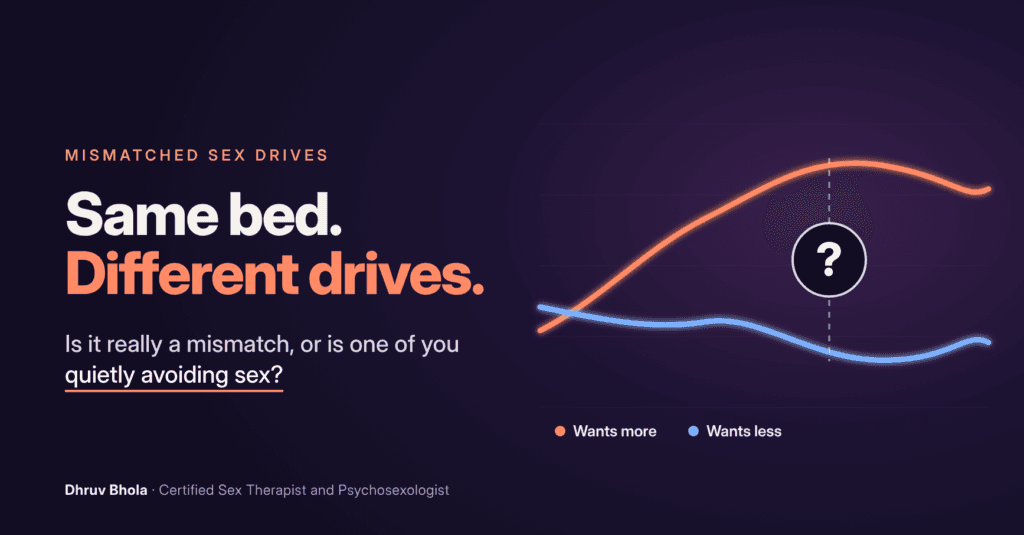
A mismatch means one partner wants sex more often, or with more urgency, than the other, and the difference has started to matter. It is relative: wanting sex twice a week is a high drive next to a monthly partner and a low one next to a daily partner.
Part of the gap is often how desire arrives, not how much exists. Some people feel spontaneous desire, wanting sex before anything has happened. Others feel responsive desire, which only switches on once touch and closeness have already started. A responsive partner can look uninterested when they are actually waiting for the right conditions.
A gap is not the same as a desire disorder. Hypoactive sexual desire disorder (HSDD) applies when a person has persistently low desire and is distressed by it themselves, not simply when they want less sex than their partner. A mismatch describes the couple; it does not label either person.
Is it normal for couples to have different sex drives?
Yes. A 2018 systematic review published in the Journal of Sex Research examined 64 studies and concluded that desire in long-term relationships rises and falls with individual, relational and wider social factors, so two people rarely move in step for years.
Online claims that a specific percentage of couples face this have no solid source behind them. Desire gaps are common and ordinary, and you do not need a statistic to feel normal.
The direction of the gap can matter as much as its size. A 2018 study published in the Journal of Sex Research followed 255 new-parent couples and found mismatched desire was linked to lower sexual satisfaction for both partners, and that which partner held the higher desire changed how satisfied they felt. Different sex drives are normal; the couple’s response shapes the outcome.
Is it a real mismatch, or is something else going on?
Most guides skip this question, yet it changes everything that follows. Sometimes a partner genuinely wants sex less often. Other times desire is still there, but sex has become a test: whether the erection will hold, whether he will finish too fast, whether it will hurt, or whether intimacy will reopen an argument. The body learns to avoid the test, and from the outside avoidance looks exactly like low desire.
| Sign | Genuine difference in desire | Avoidance that looks like low desire |
|---|---|---|
| Pattern over time | Fairly stable, often present from early in the relationship | Started after a difficult experience or a stressful period |
| Feeling before sex | Neutral or mildly uninterested | Dread, tension, or a need to get it over with |
| When sex is off the table | Affection feels the same | Affection becomes easier and warmer |
| Solo desire and fantasy | Usually also lower | Often unchanged |
| What helps first | Negotiation, responsive-desire conditions, shared scripts | Treating the anxiety, pain, ejaculation or resentment underneath |
In my clinical work, men who arrive saying “I just have a lower drive than my wife” often describe something different once we slow the conversation down. They describe inventing reasons to stay up late, and relief when she falls asleep first. That is not low desire. It is performance anxiety that has turned sex into a test, and it responds to a different kind of help than a genuine mismatch does.
Before deciding you are simply incompatible, ask whether one of you is protecting yourself from what sex has come to represent, including pain or years of pressure.
Why the gap usually gets wider, not smaller
Most couples expect a mismatch to settle with time. It rarely does, because each partner’s natural reaction feeds the other’s. The higher-desire partner hears no and feels rejected, then initiates more carefully or more often. The lower-desire partner feels watched, guilty and pressured, and pressure suppresses desire further, until neither person raises it at all.
Research supports the direction of this cycle. A 2021 study published in Archives of Sexual Behavior tracked 229 couples through a 35-day diary and a 12-month follow-up. A larger gap predicted more sexual distress the next day and a year later, while distress did not predict a later gap. Left alone, the gap tends to produce suffering rather than fade.
Key Takeaway
A desire gap rarely stays the same size. Rejection makes the higher-desire partner push or withdraw, pressure makes the lower-desire partner avoid, and avoidance confirms the higher-desire partner’s fear of being unwanted. The loop, not the original difference, is what usually needs treating.
Who has to change, the higher-desire or the lower-desire partner?
Neither, on their own. Online debates split between “the lower-desire partner should try harder” and “the higher-desire partner should accept less”. The authors of the 2021 diary study concluded that treatment should focus on the couple rather than the individual, and the European Society for Sexual Medicine recommends building joint sexual scripts that both partners find satisfying.
What the higher-desire partner does with a no matters. A 2023 study published in The Journal of Sexual Medicine looked at 67 couples where the man had HSDD. When men perceived warm, supportive responses to their low desire, both partners reported greater sexual satisfaction. Critical responses were linked to lower satisfaction for both, and avoidant responses to more distress in the partner. None changed desire itself: kindness is not a technique for producing sex.
Research on women with low desire points the same way. A 2025 study published in Archives of Sexual Behavior followed 232 couples for 56 days: resentful or insecure responses to being turned down were linked to lower satisfaction, while understanding responses lifted relationship satisfaction but also raised same-day sexual distress. Compassion works best alongside an honest plan, not as quiet resignation.
In psychosexual practice, the turning point usually comes when partners stop arguing about whose desire is correct. The higher-desire partner often finds that what they miss is feeling wanted, not frequency. The lower-desire partner often finds that pressure, not a lack of love, is the block. This differs from the situation when a husband’s interest has dropped and his wife is left wondering why, which is a change from an earlier pattern rather than a long-standing gap.
How to deal with mismatched sex drives
The 2020 study in Archives of Sexual Behavior collected 17 strategies from 229 people in long-term relationships. Strategies used together as a couple were linked to higher sexual and relationship satisfaction than strategies used alone, yet no strategy changed desire itself. The goal is managing the gap well, not making two drives identical.
Talk about the pattern, not the person
Choose a calm moment away from the bedroom and describe the cycle, not the other person’s behaviour. “I think we keep ending up in a loop where I ask and you feel pressured” opens a conversation. “You never want me” ends one.
Responding to a no when you have mismatched sex drives
A no to sex is not a no to the relationship. Staying warm and not sulking afterwards protects both partners. If a no hurts, say so later in words rather than through withdrawal.
Separate affection from expectation
Many lower-desire partners stop hugging or kissing because every touch feels like a request. Agree that affection does not have to lead anywhere. For a partner with responsive desire, this often helps more than any persuasion.
Use structure instead of waiting
Planning time together removes the nightly negotiation, as long as you schedule the opportunity rather than the outcome. Where anxiety or avoidance is part of the picture, a structured sensate focus programme rebuilds comfort with touch in stages before sex is back on the table. Sex one partner endures to keep the peace does not work: it teaches the body to dread intimacy.
When a mismatch is a medical question first
Psychological and relational causes are common, but they should never be assumed.
When to seek medical assessment
See a doctor if desire dropped suddenly rather than gradually, if sex has become painful, if the change began after starting a new medication (many antidepressants are a known cause), or if it comes with erection or ejaculation changes, persistent low mood, unusual fatigue, or other new physical symptoms. Psychosexual therapy works alongside medical care, not instead of it.
How a desire gap plays out in Indian marriages
Most advice assumes a couple who can talk openly about sex and close a door behind them. Joint-family living makes privacy something to plan rather than assume, arranged marriages can ask two people to build physical intimacy before trust has fully formed, and pressure to have children can turn sex into a scheduled duty aimed at a result.
The most damaging version is sex treated as a spouse’s obligation. When one partner agrees because refusing feels impossible, the other may never notice a gap, while desire shrinks further each time. If months have already passed without sex, the guide on what happens when a gap has already turned into a sexless marriage covers privacy planning and staged reconnection.
When conversations keep ending in the same argument, speaking with a psychosexual therapist online removes both the privacy barrier and the pressure of solving it alone, with one partner or both.
Frequently asked questions
Is a mismatched sex drive a reason to break up?
It can be, but usually not first. Many couples who believe they are incompatible are actually stuck in a pressure and avoidance loop, or one partner is avoiding sex because of anxiety or pain. Try working on the pattern together, ideally with professional support, before deciding the difference itself cannot be bridged.
Can mismatched sex drives get better, or is it permanent?
The difference may never disappear completely, but the distress around it usually can improve. Couples who handle the gap together, respond warmly to a no, and treat underlying anxiety, pain or resentment often find sex becomes less fraught and more frequent. Change depends on how long the pattern has run and what drives it.
Is a mismatched sex drive the same as low libido?
No. A mismatch describes the gap between two people, and either partner can be perfectly average. Low libido refers to one person’s own desire. Hypoactive sexual desire disorder applies only when someone has persistently low desire and is distressed by it themselves, not because their partner wants more.
Is it okay to have sex when you don’t really feel like it?
It depends on why. Someone with responsive desire may agree when they feel neutral and find desire builds once things begin, which is healthy. Agreeing out of fear, guilt or a sense of duty is different: it tends to deepen avoidance over time. Consent should always be freely given, never owed.
Is masturbating when my partner isn’t in the mood a problem?
Usually not. Masturbation was among the most commonly reported strategies in the 2020 research on how couples manage desire gaps, and for many it relieves pressure on the lower-desire partner. It becomes a problem only if it replaces connection entirely or is hidden in a way that breeds secrecy and resentment.
References
- Vowels, L. M., & Mark, K. P. (2020). Strategies for Mitigating Sexual Desire Discrepancy in Relationships. Archives of Sexual Behavior, 49(3), 1017-1028. https://doi.org/10.1007/s10508-020-01640-y
- Jodouin, J.-F., Rosen, N. O., Merwin, K., & Bergeron, S. (2021). Discrepancy in Dyadic Sexual Desire Predicts Sexual Distress over Time in a Community Sample of Committed Couples: A Daily Diary and Longitudinal Study. Archives of Sexual Behavior, 50(8), 3637-3649. https://doi.org/10.1007/s10508-021-01967-0
- Belu, C. F., Corsini-Munt, S., Dubé, J. P., Wang, G. A., & Rosen, N. O. (2023). Partner responses to low desire among couples coping with male hypoactive sexual desire disorder and associations with sexual well-being. The Journal of Sexual Medicine, 20(7), 955-964. https://doi.org/10.1093/jsxmed/qdad069
- Schwenck, G. C., Bergeron, S., Huberman, J. S., Impett, E. A., Oliveira, H., & Rosen, N. O. (2025). Daily and Prospective Associations Between Responses to Sexual Rejection and Sexual Well-Being and Relationship Satisfaction in Couples Coping with Sexual Interest/Arousal Disorder. Archives of Sexual Behavior, 54(3), 975-995. https://doi.org/10.1007/s10508-024-03066-2
- Rosen, N. O., Bailey, K., & Muise, A. (2018). Degree and Direction of Sexual Desire Discrepancy are Linked to Sexual and Relationship Satisfaction in Couples Transitioning to Parenthood. Journal of Sex Research, 55(2), 214-225. https://doi.org/10.1080/00224499.2017.1321732
- Mark, K. P., & Lasslo, J. A. (2018). Maintaining Sexual Desire in Long-Term Relationships: A Systematic Review and Conceptual Model. Journal of Sex Research, 55(4-5), 563-581. https://doi.org/10.1080/00224499.2018.1437592
- Dewitte, M., Carvalho, J., Corona, G., Limoncin, E., Pascoal, P., Reisman, Y., & Štulhofer, A. (2020). Sexual Desire Discrepancy: A Position Statement of the European Society for Sexual Medicine. Sexual Medicine, 8(2), 121-131. https://doi.org/10.1016/j.esxm.2020.02.008
Dhruv Bhola
Certified Sex Therapist and Psychosexologist
He specialises in sexual performance anxiety, psychogenic erectile dysfunction, premature ejaculation, and relationship and intimacy difficulties, including desire discrepancy between partners. He works with men and couples internationally through online psychosexual therapy.