Death grip syndrome is an informal term for reduced penile sensitivity and difficulty reaching orgasm with a partner, after months or years of conditioning to a very tight, very fast or highly specific masturbation technique. It is not a formal diagnosis, it is not nerve damage, and in most men it reverses with deliberate retraining rather than abstinence.
In clinical sexual medicine the underlying pattern has a proper name. It is called idiosyncratic masturbatory style, abbreviated to IMS, and it describes a masturbation technique that a partner’s hand, mouth or vagina cannot easily reproduce. A 2024 study published in Archives of Sexual Behavior surveyed 2,743 men and found that 10.97% masturbated in a way significantly different from partnered sex, and that those men scored lower on erectile function than men who did not.
Most articles on this subject tell you to take a week off, loosen your grip and use lubricant. That advice is not wrong, but it is incomplete, and for a large number of men it is aimed at the wrong problem entirely. This article explains what is actually happening in the body, how to work out whether this is your problem or whether something else is driving it, and what a structured retraining programme involves.
Quick Summary
- The clinical term is idiosyncratic masturbatory style (IMS), meaning stimulation a partner cannot reproduce.
- Around 10.97% of men in a 2024 survey of 2,743 men reported masturbating in a way significantly different from partnered sex.
- The mechanism is learned expectation, not injury. The body raises the threshold of stimulation required to trigger orgasm.
- Nerve testing shows altered signalling in the penile shaft, while the glans conducts normally.
- Abstinence alone frequently fails, because it removes the behaviour without changing the arousal template underneath it.
- Many men who self-diagnose this actually have performance anxiety, conditioned arousal to pornography, or a medication side effect.
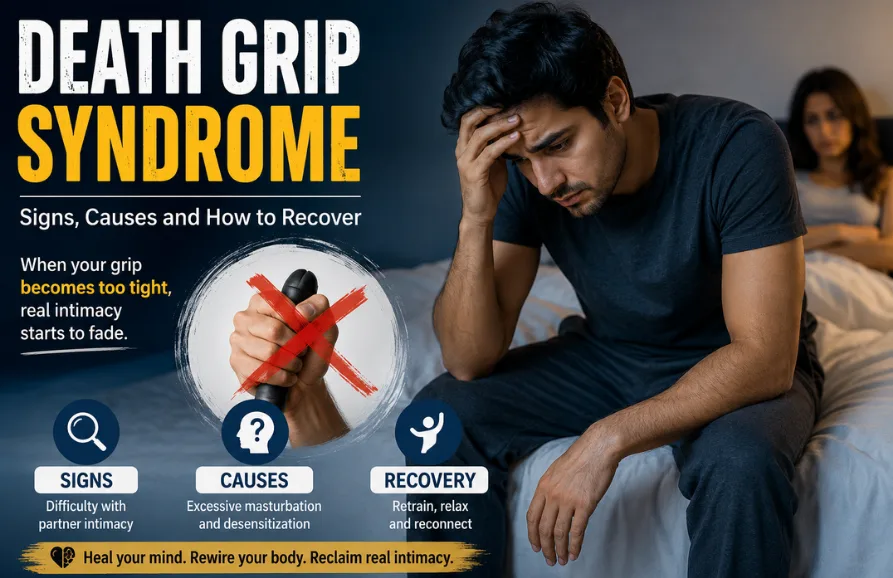
What Is Death Grip Syndrome?
Death grip syndrome describes what happens when the body adapts to a very narrow band of sexual stimulation and then stops responding adequately to anything outside it. The term was popularised by sex columnist Dan Savage in the early 2000s, and it has never been a medical diagnosis, which is part of why the information available about it is so inconsistent.
What the term points at, however, is real and well described in sexual medicine. Michael Perelman, writing in Translational Andrology and Urology, defines idiosyncratic masturbatory style as a technique that cannot easily be duplicated by a partner, and identifies it as a recurring contributor to delayed ejaculation. His model holds that ejaculation depends on an adequate combination of what he calls friction and fantasy, meaning physical sensation and erotic mental content together. When solo sex delivers far more of both than partnered sex does, the partnered version stops reaching the threshold.
Is it a real medical condition
No, and that matters clinically rather than semantically. Because it is not a diagnosis, it has no diagnostic criteria, no prevalence figure and no treatment guideline. What it does have is a recognised clinical parent, which is delayed ejaculation, and a recognised behavioural mechanism, which is idiosyncratic masturbatory style. Both of those have been studied properly, and both give us something more useful than the folk wisdom circulating online.
Signs You May Have Death Grip Syndrome
- You reach orgasm easily and quickly on your own, but rarely or never during partnered sex.
- Oral sex and manual stimulation from a partner feel pleasant but never build towards climax.
- You need to finish yourself off by hand after sex, using your usual technique.
- You have used the same grip, speed and position for years without variation.
- Erections are reliable, including in the morning, so this is not primarily an erection problem.
- Sex lasts a long time and ends through exhaustion or frustration rather than orgasm.
Why Can’t I Finish With My Girlfriend But Can On My Own?
This is the question that brings most men to a sex therapist, and the answer is usually a mismatch across several variables at once rather than grip alone. When you masturbate you control pressure, speed, rhythm, position, temperature, duration and the mental content running alongside it. During partnered sex you control almost none of those, and the difference between the two is frequently much larger than men realise until they compare them deliberately.
| Variable | Typical solo pattern | Typical partnered reality |
|---|---|---|
| Pressure | Firm, often very firm, fully controlled | Soft, variable, outside your control |
| Speed | Fast, frequently accelerating to finish | Slower, rhythmic, set by two bodies |
| Duration | Two to five minutes in many men | Fifteen to thirty minutes or longer |
| Position | Identical every single time | Changes, sometimes mid act |
| Mental content | High intensity visual material | A real person, in real time |
| Attention | Entirely on your own sensation | Split between yourself and your partner |
Read that table again and notice that only the first row is about grip. The advice to simply loosen your grip addresses one variable out of six, which is why so many men follow it faithfully for a month and report no change whatsoever. The conditioning sits across the whole pattern, so the correction has to as well.
What Actually Causes It: Grip, Speed, Position and Fantasy
Grip pressure is the most discussed cause because it gave the phenomenon its name, but in practice speed is at least as important. Men who have masturbated quickly since adolescence, often in circumstances where privacy was limited and finishing fast mattered, train the body to expect a rapid climb to orgasm. Partnered sex has a slower gradient by nature, and a nervous system calibrated to a steep climb interprets a gentle one as going nowhere.
Position contributes too. Prone masturbation, meaning lying face down and pressing against a surface, produces an angle and a pressure distribution that no partnered position replicates. Men who use this pattern often report normal erections and no difficulty finishing alone, alongside complete inability to climax during intercourse.
The fourth variable, and the one almost every article omits, is mental content. If your arousal has been paired for years with high intensity visual material, then the physical sensation of partnered sex arrives without the erotic input it has learned to expect. This is where death grip overlaps with porn-induced erectile dysfunction, and why treating the two as entirely separate problems tends not to work.
Is This Actually Death Grip, Or Is It Something Else?
This is the section that no other article on this topic provides, and it is the most important one on the page. A very large number of men arrive at a therapy session having self-diagnosed from a health blog, having spent three to six months on abstinence, and having got worse rather than better. In most of those cases the original diagnosis was wrong, and the months were spent treating the wrong mechanism.
Sexual medicine research offers a genuinely useful first filter here. A 2025 study published in the Journal of Sexual Medicine separated men with delayed ejaculation into two groups: those who struggle during partnered sex only, and those who struggle during both partnered sex and masturbation. That single distinction narrows the field enormously, because a conditioning problem produces difficulty with a partner while solo function stays intact.
| Pattern | Can finish alone | Can finish with partner | Distinguishing feature |
|---|---|---|---|
| Idiosyncratic style (death grip) | Yes, easily and reliably | Rarely or never | Technique is fixed, intense and long established. Erections are fine. |
| Performance anxiety | Yes | Varies by situation and partner | Erection often fades. Worse with new partners, better once relaxed. |
| Conditioned arousal to pornography | Yes, but usually needs the material | Difficulty arousing rather than finishing | Arousal itself is weak without visual input. |
| Medication related | Also difficult | Also difficult | Onset tracks a new prescription. Antidepressants are the usual culprit. |
| Physical or neurological | Also difficult | Also difficult | Sudden onset, numbness, pain, or an existing medical condition. |
The pattern in the first row is the one that responds to retraining. If your difficulty appears in both columns, the cause is more likely to be medical, pharmacological or mood related, and no amount of grip modification will resolve it. If your erection is the thing that fails rather than your orgasm, you are probably looking at a different problem, and the article on why you can get hard alone but lose your erection with a partner will fit your experience more closely.
What the Evidence Says About Penile Sensitivity
Almost every page on this subject tells you that the penis becomes desensitised, which is imprecise enough to frighten people unnecessarily. The measured data is more specific and considerably more reassuring than the popular version.
A 2013 study published in Andrology compared 24 men who had lifelong delayed ejaculation with 24 age matched controls, using somatosensory evoked potentials to measure how the penile nerves actually conduct signals. The men with delayed ejaculation showed higher sensory thresholds and slower conduction in the dorsal nerve of the penile shaft. Conduction from the glans, however, showed no significant difference between the two groups at all.
That distinction matters. It suggests altered signalling in one specific pathway rather than generalised damage across the organ, and the same study found those men also reported higher masturbation frequency, some with idiosyncratic styles, alongside higher anxiety and depression scores. This is a small study of one particular subgroup, so it should not be over read, but it is far better evidence than the vague desensitisation claim that dominates the search results.
Does Stopping Masturbation Fix Death Grip?
Usually not on its own, and this is the single most consequential misunderstanding surrounding the topic. Abstinence removes the behaviour without altering the arousal template underneath it, so when a man returns to sexual activity after thirty or ninety days, the same expectations are still installed and the same technique reasserts itself within days.
Perelman’s clinical guidance is explicit on this point. He advises that men who continue to masturbate should alter their style to approximate what they would experience with a partner, and he describes full suspension as something that provokes resistance and often has to be negotiated rather than imposed. The therapeutic target is not zero stimulation, it is different stimulation.
There is a second reason to be cautious about blaming masturbation frequency. A 2025 study published in Sexual Medicine assessed 5,331 sexually active men and found delayed ejaculation in 5.16% of them. Frequent masturbation was one of eight factors significantly associated with the condition, but it was the weakest of the eight, with an odds ratio of 1.24. Psychotropic medication came in at 2.41, pelvic trauma at 2.39, low partnership satisfaction at 2.27 and erectile dysfunction at 2.04.
Read plainly, that means how satisfied you are in your relationship is associated with delayed ejaculation almost twice as strongly as how often you masturbate. Any approach that focuses entirely on your hand while ignoring your medication list, your mood and your relationship is working on the smallest variable available.
Key Takeaway
The mechanism here is learned expectation, not damage. Your nervous system has calibrated the threshold for orgasm to one specific combination of pressure, speed, position and mental content, and partnered sex falls below that threshold. Because the calibration was learned, it can be recalibrated, but only by changing the stimulation rather than removing it. This is why abstinence alone so often fails and why deliberate retraining succeeds.
How Do You Retrain: The Four Phase Protocol
What follows is the structure used in psychosexual practice, adapted so it can be worked through independently. It is a behavioural programme rather than a set of tips, and the phases matter because each one builds on the last.
Phase one, roughly one to two weeks: interrupt the pattern
A short break is genuinely useful, but the purpose is to break automaticity rather than to heal anything. Ten to fourteen days is sufficient for most men. Longer breaks add difficulty without adding benefit, and a very long abstinence period usually ends in a relapse to the old technique, which sets the work backwards.
Phase two, two to four weeks: rebuild the physical inputs
Return to masturbation, but change every variable you can. Use the opposite hand, which by itself prevents the automatic pattern from running. Use generous lubricant, because lower friction forces lighter pressure. Deliberately slow down and extend the session to fifteen or twenty minutes. Change position, and if you have used prone masturbation, stop it completely.
Expect this phase to be frustrating and expect orgasm to be difficult or absent at first. That difficulty is the point. You are demonstrating to your nervous system that arousal can build under conditions that resemble partnered sex.
Phase three, three to six weeks: rebuild the mental inputs
Physical retraining without mental retraining leaves half the problem in place. Move away from streaming video towards imagination, memory and, where a partner is involved, thoughts of that specific person. Many men find this harder than the physical changes, because attention wanders and arousal drops, and that reaction is itself diagnostic of how much the mental pairing has been driving the pattern.
Phase four, ongoing: transfer it to partnered sex
The final phase moves the gains into the bedroom, and this is where structured sensate focus exercises earn their reputation. The principle is to remove orgasm as the goal for a defined period, which lowers the pressure that has usually built up around sex by this stage, and to rebuild responsiveness to a partner’s touch without a performance target attached to it.
On lubricants, sex toys and supplements, a brief note is warranted. Lubricant is a useful tool because it reduces friction and enforces a lighter touch. Toys can help some men bridge the gap. Neither repairs anything, and no supplement has evidence behind it for this purpose. Anything that promises to restore sensitivity chemically is selling you something.
How Long Does It Take to Recover From a Death Grip?
Most men see meaningful change somewhere between four and twelve weeks of consistent work. That figure comes from clinical observation and from what men report to one another, not from controlled trials, because no controlled trial of this exists. Treat it as a reasonable expectation rather than a schedule.
Three things predict a longer timeline: how many years the pattern has been established, whether heavy pornography use is part of it, and whether anxiety about performance has developed on top of it. The third factor is the one men underestimate most, because by the time someone seeks help, several failed encounters have usually generated a fear response that now suppresses arousal independently of the original technique problem.
Progress is also rarely linear. A common pattern is little apparent change for three or four weeks, followed by a noticeable shift. Men who abandon the programme at week three, concluding it has not worked, usually stop just before the point at which it starts to.
How Do I Help My Boyfriend With Death Grip?
If you are the partner of someone dealing with this, the experience is genuinely difficult and it is almost entirely absent from the material written about the subject. The most common thing partners describe is a slow erosion of self esteem, alongside a conclusion that he is not attracted to them, or that they are not enough, or that something is being hidden.
That conclusion is understandable and it is usually wrong. A man who reaches orgasm easily alone and not with you is demonstrating a calibration problem in his nervous system, not a verdict on your desirability. The two feel identical from the outside, which is precisely why this needs saying directly.
- What helps: naming it calmly, outside the bedroom, as a shared problem rather than his failure.
- What helps: taking orgasm off the table for a defined period, which relieves pressure on you both.
- What helps: protecting your own experience, because sex that exists only to solve his problem stops being sex.
- What makes it worse: extending sessions for an hour in the hope he finishes, which teaches you both that sex ends in failure.
- What makes it worse: monitoring, checking and asking how it is going during sex, which raises the anxiety already present.
- What makes it worse: framing it as a choice he is refusing to correct, which turns a treatable pattern into a relationship conflict.
What I See in Clinical Practice
In my clinical work, the men who arrive convinced they have this condition tend to fall into two distinct groups, and telling them apart in the first session changes everything that follows. The first group describe their technique without prompting and in precise detail, they know exactly how they finish, and their erections have never been in question. That group responds well and comparatively quickly to behavioural retraining.
The second group describe something different once you ask carefully. They report that they were fine with an earlier partner, or that it happens with one person and not another, or that they spend the twenty minutes before sex monitoring themselves and predicting failure. They have usually read the same article everyone else has read, concluded the problem is their hand, and spent months on abstinence. What they actually have is anxiety, and the abstinence has added shame on top of it. The single most useful thing I do in those sessions is take the wrong diagnosis away.
When to See a Doctor Rather Than a Therapist
A behavioural explanation is only appropriate when the presentation actually fits a behavioural cause. Some of what gets labelled as this condition is a physical problem that needs proper medical assessment, and delaying that assessment while working through a retraining programme is a real risk worth taking seriously.
See a doctor before assuming this is behavioural
- The change was sudden rather than gradual, or you can date it to a specific week.
- You started a new medication around the same time, particularly an antidepressant or a blood pressure drug.
- There is genuine numbness, tingling or altered sensation, especially if it extends beyond the genitals.
- There is pain during erection, during ejaculation or afterwards.
- You have diabetes, a neurological condition, or a history of pelvic or spinal injury or surgery.
- Difficulty is present during masturbation as well, not only with a partner.
When This Is Part of a Broader Pattern
This rarely arrives on its own. It commonly sits alongside heavy pornography use, performance anxiety built up over repeated difficult encounters, and a relationship under strain from months of unspoken tension around sex. Each of those maintains the others, which is why single variable fixes disappoint so consistently.
If your central question is whether frequency itself is the problem, the wider article on whether masturbation causes erectile dysfunction covers that ground, including the guilt and cultural beliefs that frequently sit underneath it. This page is narrower and deals specifically with technique conditioning. Where the pattern has become entrenched, or where anxiety is now doing more of the work than technique, structured psychosexual therapy addresses both layers at once rather than sequentially.
One final note on help seeking. In that 2025 Japanese survey, 58.18% of men with delayed ejaculation said they wanted treatment, while only 11.88% had actually sought any. The gap between wanting help and asking for it is where most of the suffering in this condition happens.
Frequently Asked Questions
How long does it take to recover from a death grip?
Most men notice meaningful change between four and twelve weeks. That range comes from clinical observation rather than controlled trials, so treat it as a guide. Recovery depends on how long the pattern has been established, whether pornography is involved, and whether anxiety is also suppressing arousal during partnered sex.
Is death grip syndrome permanent?
No. Death grip syndrome is a learned conditioning pattern, not structural nerve damage. Somatosensory testing shows altered signalling in the penile shaft rather than injury, and the glans conducts normally. Because the change is learned, it can be unlearned, though the retraining has to be deliberate and consistent rather than simply stopping.
Is it possible to cure death grip syndrome?
Yes, in the sense that normal partnered sensitivity usually returns. Sex therapists treat it as a conditioning problem, so the work involves changing grip, speed, lubrication and mental content until solo stimulation resembles partnered sex. Where anxiety or a medication is also involved, that has to be addressed alongside the technique.
Is there a female version of death grip syndrome?
Yes, the same conditioning principle applies. Women who consistently use one narrow form of stimulation, often a specific vibrator setting at high intensity, can find partnered touch insufficient by comparison. The mechanism is identical, because the body learns to expect one pattern. The remedy is also the same, which is widening the range.
Is death grip harmful?
Not physically, in the sense of lasting injury. The evidence points to altered nerve signalling in the penile shaft rather than damage. The harm is functional and relational, because men lose the ability to finish with a partner, and partners frequently interpret that as rejection, which then creates a second problem.
Can you recover after years of the same habit?
Yes. Length of habit affects how long retraining takes, not whether it works. Men who have used the same technique since their early teens often need longer, because the arousal template formed before they had any partnered experience to compare it against. The direction of progress stays the same.
Does lube or coconut oil actually fix it?
Lubricant helps, but it is a tool rather than a treatment. It lowers friction, which forces you to work with lighter pressure and slower movement, and that is the part doing the work. No oil repairs nerves. Any lubricant that is comfortable and skin safe serves the same purpose.
Why can I only finish with my own hand?
Because your hand delivers a combination of pressure, speed and rhythm that a partner cannot reproduce. Over time the body treats that exact combination as the threshold for orgasm, and anything gentler registers as insufficient. This is learned expectation rather than a physical limit, which is why it responds to retraining.
Does it cause erectile dysfunction or premature ejaculation?
It is associated with erectile difficulties but not with premature ejaculation. In a 2024 survey of 2,743 men, those using atypical masturbation scored lower on erectile function, while premature ejaculation rates and ejaculation latency showed no significant difference. If you ejaculate very quickly, look for a different explanation.
References
- Wang C, Chen X, Liu Z, Zhang Y. The Association Between Atypical Masturbation and Male Sexual Dysfunction: A Study Based on Men in Heterosexual Relationships. Archives of Sexual Behavior. 2024;53(8):3165-3172. PMID: 38918329. Funded by the China Scholarship Council.
- Shirai M, Tsujimura A, Fukuhara S, et al. Prevalence and associated factors of delayed ejaculation: insights from a nationwide internet-based, cross-sectional survey on male sexual dysfunction in Japan. Sexual Medicine. 2025;13(4):qfaf072. PMID: 40937118. No conflicts of interest declared.
- Xia JD, Han YF, Pan F, et al. Clinical characteristics and penile afferent neuronal function in patients with primary delayed ejaculation. Andrology. 2013;1(5):787-792. doi:10.1111/j.2047-2927.2013.00119.x.
- Perelman MA. Psychosexual therapy for delayed ejaculation based on the Sexual Tipping Point model. Translational Andrology and Urology. 2016;5(4):563-575. PMID: 27652228. The author has served on ISSM committees and the DSM-5 Task Force.
- Rowland DL, McNabney SM, Kovi Z, Hevesi K. Are some forms of delayed/inhibited ejaculation more intractable than others? Journal of Sexual Medicine. 2025;22(8):1363-1372. PMID: 40500996.
- Bronner G, Ben-Zion IZ. Unusual masturbatory practice as an etiological factor in the diagnosis and treatment of sexual dysfunction in young men. Journal of Sexual Medicine. 2014;11(7):1798-1806. PMID: 24674621. Case series of four patients.
Dr. Dhruv Bhola
Certified Sex Therapist and Psychosexologist
He specialises in psychogenic erectile dysfunction, delayed and premature ejaculation, sexual performance anxiety, pornography related sexual difficulties and intimacy problems in couples. He works with men and couples internationally through online psychosexual therapy.