In most cases, this happens because of performance anxiety, psychogenic erectile dysfunction, reduced stimulation during position changes, or pelvic floor tension rather than a serious physical problem.
You are kissing your partner. The arousal is real. You are fully erect. Then you shift position. You move to lie down, and within seconds, the erection disappears.
Your mind immediately jumps to the worst explanation. Most men fear a serious physical problem. The reality is usually far less alarming and far more treatable.
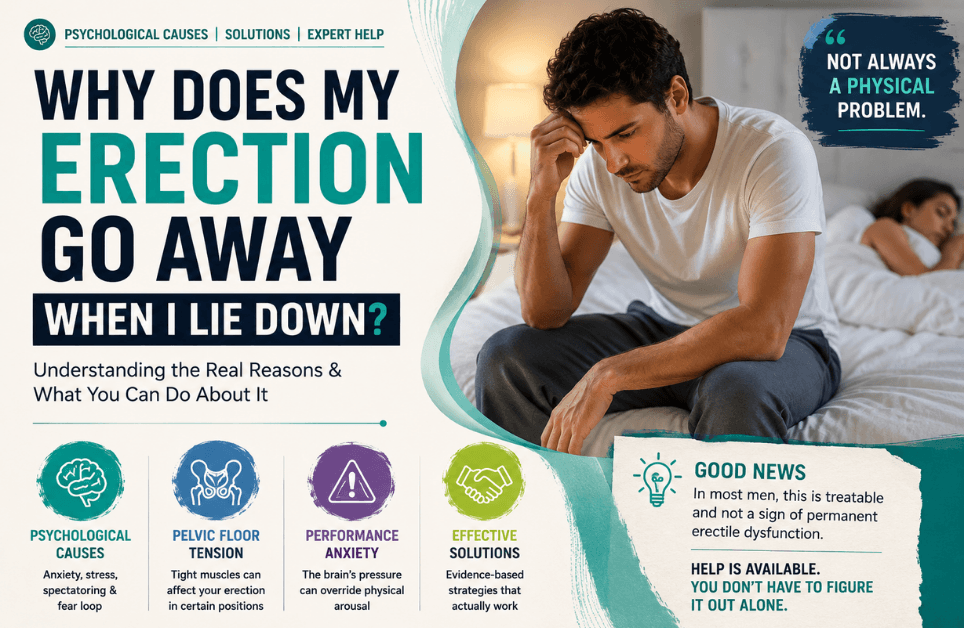
What Causes An Erection To Go Away When Lying Down?
In most cases, an erection goes away when lying down because of performance anxiety, psychogenic erectile dysfunction, reduced stimulation during the position change, or pelvic floor tension. Not a structural problem. The overall erection pattern matters far more than the position: if morning erections and masturbation erections remain strong, the likely cause is psychological, not vascular. Position-dependent erection loss alone is not sufficient to diagnose any specific organic condition.
Key Takeaways
- Losing an erection when lying down or changing positions is common and does not automatically indicate a serious physical problem.
- The most frequent causes are performance anxiety, reduced stimulation during transitions, spectatoring, and psychogenic erectile dysfunction, all treatable without invasive procedures.
- Spectatoring, mentally stepping out of the sexual experience to evaluate your erection, is a major but widely underrecognised driver of erection loss at transition moments.
- If morning erections remain intact and masturbatory erections are normal, psychological causes are significantly more likely than vascular ones.
- Pelvic floor tension is a distinct physical cause of position-specific erection loss that responds well to targeted physiotherapy.
- Performance anxiety creates a self-reinforcing loop: the fear of losing the erection during the transition becomes the primary reason it is lost.
- Psychosexual therapy has strong evidence for performance anxiety and psychogenic ED, producing lasting improvement without medication in many cases.
Is It Normal To Lose An Erection When Changing Positions?
Yes. An erection is a dynamic physiological event. It requires continuous arousal signals, adequate blood flow, and the absence of inhibitory signals from the sympathetic nervous system. Position changes break physical stimulation, shift attention from sensation to logistics, and create a brief gap. For men with a relaxed arousal response, this gap is unremarkable. For men carrying performance anxiety, that same gap is enough to lose the erection entirely, because anxiety fills it faster than stimulation resumes.
Occasional erection loss during transitions is not a clinical disorder. When the pattern is consistent and distressing, it is worth addressing.
Why Do Erections Disappear During Position Changes?
This is the section most online resources get wrong. They list “anxiety” as a bullet and move on. The mechanisms are specific, compound each other, and understanding them is what creates the path forward.
Performance Anxiety
Performance anxiety is the single most common cause of positional erection loss in men who otherwise have healthy erectile function. It does not require a diagnosed anxiety disorder. It can emerge from one bad experience, a new partner, or simply attaching too much significance to what happens during the transition.
The mechanism is physiological. Anxiety activates the sympathetic nervous system, triggering vasoconstriction in the penile vasculature. This is the direct opposite of the vasodilation erection requires. Position changes are high-risk moments because they are transition points: the man must perform the next step, and the anticipatory anxiety around what will happen after the transition is often enough to activate the sympathetic response before the transition has even completed. If you are dealing with this pattern, structured sexual performance anxiety treatment addresses the nervous system response directly, not just the symptom.
Spectatoring
Spectatoring, a concept developed by Masters and Johnson, refers to mentally stepping outside a sexual experience to observe and evaluate yourself. Instead of being inside the erotic moment, the man is monitoring it: “Is my erection still there? Will I lose it when I move? What will she think?”
This self-monitoring withdraws attention from the erotic stimuli that maintain arousal and redirects it toward self-evaluation. Arousal requires attentional presence. It cannot be fully sustained while the mind is elsewhere. Position changes are the most common trigger for spectatoring because they create a natural pause in which the evaluating mind steps in. Many men benefit from understanding why they keep checking their erection during sex and how to stop.
The Fear Loop
Once a man has experienced an erection going away during sex or during a position change, anticipatory fear of recurrence develops. That fear, not any physical problem, becomes the dominant cause of subsequent losses. The original trigger may have been entirely unremarkable: fatigue, distraction, alcohol. But the conditioned anxiety that followed now operates on its own. This is why men report: “There was nothing different. I don’t know why it happened again.” This loop is closely connected to what happens when an erection fades during penetration. The mechanism is the same conditioned anxiety response.
Psychogenic Erectile Dysfunction
Psychogenic erectile dysfunction means the physical erection mechanism is intact. The problem is in the psychological state regulating access to the arousal response. It commonly presents in exactly the situational pattern described here: normal erections in solo contexts, impaired or position-dependent erections with a partner. The situational quality is its defining clinical feature, distinguishing it from organic dysfunction where the problem is consistent across all contexts. Psychogenic erectile dysfunction treatment is highly effective for this presentation, particularly when the difference between psychogenic ED and physical ED has been properly assessed.
Pelvic Floor Tension
The pelvic floor muscles, specifically the ischiocavernosus and bulbocavernosus, contribute directly to erection rigidity by supporting intracavernosal pressure. When these muscles are chronically tight or poorly coordinated, they can create position-specific interference with erection quality. Pelvic floor tension can also compress the pudendal nerve in certain positions, altering sensation and the erectile response. Men with pelvic pain, a history of long-distance cycling, or position-specific loss without obvious psychological pattern may benefit from pelvic floor assessment alongside psychosexual evaluation.
Reduced Stimulation
Physical contact is interrupted during position changes. The erotic context briefly disappears. For most men this is trivial. For men carrying anxiety, this stimulation gap is the opening through which erection loss enters. Maintaining physical contact and connection through the transition, slowing down, staying in touch, can significantly reduce the gap and break the pattern.
Why Am I Hard Standing Up But Not Lying Down?
Many men find they are hard standing up but not lying down and interpret this as proof of a vascular problem. In most cases, the explanation is psychological. When standing, stimulation is often more direct, the role is active, and there is less anticipatory weight attached to the position. When lying down, the situation changes psychologically, it is the position associated with penetration, with the high-stakes moment. That psychological signal activates the sympathetic nervous system, and the erection fades in response to the nervous system state, not the posture itself.
The vascular pressure difference between standing and lying is not clinically significant in men without established cardiovascular disease. What changes is the psychological context, and that is addressable.
Does Losing An Erection When Lying Down Mean Venous Leak?
This question drives the most anxiety around this topic. The answer is consistently misrepresented online, often by sites with a commercial interest in vascular diagnoses.
What venous leak actually is: Venous leak is a condition where the veno-occlusive mechanism of the penis fails during arousal. Blood drains out faster than it is supplied because the emissary veins are not adequately compressed. It is a structural vascular condition. It is not diagnosed by observing what happens during position changes.
Why this is not what most men have: For venous leak to be the likely diagnosis, the clinical picture would include consistently poor erection quality across all situations, including masturbation; absent or very weak morning erections; rapid loss of rigidity even with direct stimulation; and frequent failure to respond to oral PDE5 inhibitors. When masturbatory erections and morning erections are intact and erection loss is situational and position-specific, the picture points away from structural vascular pathology.
How it is actually diagnosed: Venous leak requires specialist clinical investigation: penile Doppler ultrasound with intracavernosal injection, and in some cases cavernosometry. It cannot be self-diagnosed from positional erection observations.
Erection Strong During Masturbation But Weak During Partner Sex
When masturbatory erections are full and reliable but the erection goes away during sex, especially during position changes, two things are clinically established: the erectile mechanism is physically intact, and the cause is contextual. Partner sex introduces performance expectation, fear of judgment, and anticipatory anxiety around specific transition moments. These are psychogenic factors. The penis is working. The environment in which it must work is creating interference.
This pattern is common in men who can get hard alone but lose their erection with a partner. It is also relevant for men dealing with porn-induced erectile dysfunction, where solo erections are conditioned to a specific type of stimulation that partner sex does not replicate.
Position-Dependent ED vs Venous Leak: Key Differences
| Feature | Position-Dependent ED (Psychogenic) | Venous Leak (Organic) |
|---|---|---|
| Morning erections | Intact | Reduced or absent |
| Masturbation erections | Normal, often strong | Difficult or impossible to maintain |
| Erection loss pattern | Situational, specific positions or transition moments | Consistent across all situations |
| Erection quality generally | Normal in low-anxiety contexts | Consistently poor regardless of context |
| Speed of erection fading | Variable, linked to anxiety spikes | Rapid even with sustained direct stimulation |
| Response to PDE5 inhibitors | Often effective when combined with anxiety reduction | Frequently inadequate; oral medication often fails |
| Diagnosis method | Clinical and psychosexual history | Specialist vascular testing required |
| Treatment | Psychosexual therapy (high success rate) | Injections, vacuum device, or surgical intervention |
Signs The Cause May Be Psychological
- Morning erections are intact: confirms the vascular and neurological mechanism is functioning.
- Masturbatory erections are normal: removes the physical mechanism from the equation entirely.
- The problem is situational: better with some partners, in some contexts, when relaxed and not under pressure.
- Onset followed a specific event: one experience of erection loss became the seed for an anxiety cycle.
- You monitor your erection during sex: if you find yourself checking erection status rather than being present in the moment, spectatoring is active and maintaining the problem.
- New partner anxiety is present: extremely common; does not reflect any physical deterioration.
Signs The Cause May Be Physical
- Erection problems are consistent across all contexts, including masturbation and on waking.
- Morning erections have progressively declined over months or years.
- Known medical risk factors are present: diabetes, cardiovascular disease, hypertension, or hormonal disorders.
- Medications may be contributing: SSRIs, certain antihypertensives, and other drug classes can impair erection quality.
- PDE5 inhibitors produce no benefit even in low-anxiety conditions.
- Pelvic pain or cycling-related symptoms are present: may indicate pelvic floor or pudendal nerve involvement.
How To Stop Losing Erections When Lying Down
Stop monitoring your erection. Every moment of attention directed toward erection status is a moment withdrawn from erotic presence. The goal is not to force the erection but to stop evaluating it. This works by redirecting the nervous system response rather than trying to override it with willpower.
Sensate focus. This structured programme removes the goal of penetration and erection maintenance, allowing the nervous system to calm and the natural arousal response to re-establish without evaluation pressure. Sensate focus exercises for erectile dysfunction and anxiety are among the most evidence-supported approaches available for this presentation.
Reduce transition significance. Slow down when changing positions. Maintain physical contact through the movement. Treat the transition as part of the erotic experience, not a threshold test. This alone breaks the pattern for many men.
Communicate with your partner. A partner who understands what is happening and responds with calm rather than concern removes significant pressure. Naming the pattern openly, without shame, is often a turning point.
Psychosexual therapy. For persistent erection loss when changing positions, structured psychosexual therapy is the most targeted and evidence-based intervention available. It addresses the anxiety cycles, spectatoring, and conditioned fear responses that maintain the problem, not the symptom in isolation.
When To Seek Professional Help
Seek support if the pattern has been present for more than three months, if you are avoiding sex or significantly modifying your behaviour because of it, or if it is causing distress or relationship strain. Seek medical evaluation alongside psychosexual assessment if morning erections have declined, if physical risk factors are present, or if erection loss is occurring across all contexts including masturbation.
Dr. Dhruv Bhola is a Certified Sex Therapist and Psychosexologist who helps men experiencing position-dependent erectile dysfunction, performance anxiety, erection loss during sex, and psychogenic erectile dysfunction through structured psychosexual therapy and counselling. Based in Gurugram, available for consultations across India. Book a consultation here.
Frequently Asked Questions
Why does my erection go away when I lie down?
In most cases, performance anxiety, psychogenic erectile dysfunction, or reduced stimulation during the position change. The lying-down position often carries psychological significance. It is the moment preceding penetration, when anticipatory anxiety peaks. The nervous system responds with vasoconstriction that opposes erection maintenance. If morning erections and masturbatory erections remain strong, psychological causation is significantly more likely than any structural cause.
Is it normal to lose an erection when changing positions?
Yes. Occasional erection loss when changing positions is common and not inherently abnormal. Position changes interrupt stimulation and can trigger performance anxiety in men who have previously experienced loss at this moment. When the pattern is consistent and distressing, it is worth addressing with a psychosexual specialist.
Does losing an erection when lying down mean venous leak?
Not automatically, and in most cases, no. Venous leak is characterised by consistent failure to maintain erections across all situations including masturbation, combined with absent or very weak morning erections. Position-dependent erection loss in isolation, particularly when other erections remain intact, is not sufficient to diagnose any specific vascular condition. Proper diagnosis requires specialist clinical testing, not self-diagnosis from positional observations.
Why am I hard standing but not lying down?
Most commonly a psychological rather than physical explanation. Standing is an active role with less anticipatory weight. Lying down signals the imminent high-stakes moment of penetration, activating performance anxiety at the transition. The erection responds to the nervous system state, not the physical posture. The vascular pressure difference between standing and supine is not clinically meaningful in men without established cardiovascular disease.
Can anxiety make erections disappear?
Yes. Anxiety activates the sympathetic nervous system, which triggers vasoconstriction in the penile vasculature, the opposite of what erection requires. Even brief anticipatory anxiety at a specific moment, like a position change, is enough to collapse an erection. This is not physical dysfunction, it is normal nervous system physiology responding to a perceived threat.
Can psychogenic ED cause erection loss during sex?
Yes. Psychogenic ED commonly presents as situational erection loss: during position changes, during partner sex, or right before penetration. The physical mechanism is intact but is being inhibited by anxiety, spectatoring, and conditioned fear. It is one of the most treatable forms of erectile dysfunction, with psychosexual therapy producing evidence-based outcomes consistently across this presentation.
How do I stop losing erections when changing positions?
Reduce erection self-monitoring during sex. Maintain physical contact through position transitions to keep the stimulation gap small. Slow down and treat the transition as part of the erotic experience rather than a test. Communicate openly with your partner to reduce performance pressure. For persistent patterns, working with a psychosexual therapist on sensate focus and structured anxiety reduction is significantly more effective than willpower alone.
Can pelvic floor dysfunction cause erection loss when lying down?
Yes. Tight or poorly coordinated pelvic floor muscles can create position-specific interference with erection quality and may compress the pudendal nerve in certain positions. Assessment by a pelvic floor physiotherapist is beneficial when symptoms suggest pelvic floor involvement, particularly in men without obvious psychological factors or with a history of pelvic pain or long-distance cycling.
When should I see a sex therapist for this?
If the problem has been consistent for more than three months, if you are avoiding sex or modifying your behaviour because of it, or if it is causing distress or affecting your relationship. A psychosexual specialist can assess both the psychological and clinical picture and determine the most appropriate pathway forward.
References
- Bancroft, J., & Janssen, E. (2000). The dual control model of male sexual response: A theoretical approach to centrally mediated erectile dysfunction. Neuroscience & Biobehavioral Reviews, 24(5), 571–379. doi: 10.1016/s0149-7634(00)00024-5
- Perelman, M. A. (2009). The sexual tipping point: A mind/body model for sexual medicine. Journal of Sexual Medicine, 6(3), 629–632. doi: 10.1111/j.1743-6109.2008.01143.x
- Günzler, C., & Berner, M. M. (2012). Efficacy of psychosocial interventions in men and women with sexual dysfunctions: a systematic review of controlled clinical trials. Journal of Sexual Medicine, 9(12), 3108–3125. doi: 10.1111/j.1743-6109.2012.02843.x
- Pyke, R. E. (2020). Cognitive behavioral sex therapy: An emerging treatment option for nonorganic erectile dysfunction in young men. Sexual Medicine Reviews, 8(3), 426–437. doi: 10.1016/j.sxmr.2019.09.003
- Yaacov, D., Nelinger, G., & Kalichman, L. (2022). The effect of pelvic floor rehabilitation on males with sexual dysfunction: A narrative review. Sexual Medicine Reviews, 10(1), 162–167. doi: 10.1016/j.sxmr.2021.02.001
- Di Serafino, M., et al. (2023). MRI-Cavernosography: A new diagnostic tool for erectile dysfunction due to venous leakage. Diagnostics, 13(13), 2178. doi: 10.3390/diagnostics13132178