Quick Summary
- Nightfall happens because the ejaculatory reflex can activate during sleep once puberty begins. The clinical term is nocturnal emission (NE).
- It affects roughly 70 to 90 percent of adolescent boys, and the first episode usually arrives between 12.6 and 15.6 years of age.
- It does not need an erotic dream to happen, and often occurs with no memory of one.
- The popular explanation, that semen builds up and must be released, is not supported by the current evidence.
- Semen is the fluid and sperm are the cells inside it. Most pages answering “how much sperm” actually give a fluid volume.
- There is no reliable “normal number” per month, because research on frequency remains scarce and inconsistent.
- Most of the harm attached to nightfall comes from anxiety and semen-loss beliefs, described clinically as Dhat syndrome, rather than from the event itself.
Why nightfall happens in boys comes down to a single mechanism: the ejaculatory reflex can activate during sleep once puberty begins, with no conscious control involved and nothing going wrong. It is a normal stage of sexual development, not a disease, not a weakness, and not something a boy has caused through his habits.
The clinical term is nocturnal emission (NE). A 2026 systematic scoping review published in Sexual Medicine Reviews examined 157 sources and found that nocturnal emission affects an estimated 70 to 90 percent of adolescent boys, with the first episode arriving most often at 13 or 14 years of age. In other words, this is close to a universal experience, and it is one of the first encounters most boys have with their own sexuality.
This is one of the most searched sexual health questions in India, and one of the worst answered. This article explains the actual mechanism, corrects the explanation almost every other page repeats, and addresses the part nobody writes about: the worry loop that grows around nightfall and does far more damage than nightfall ever does.
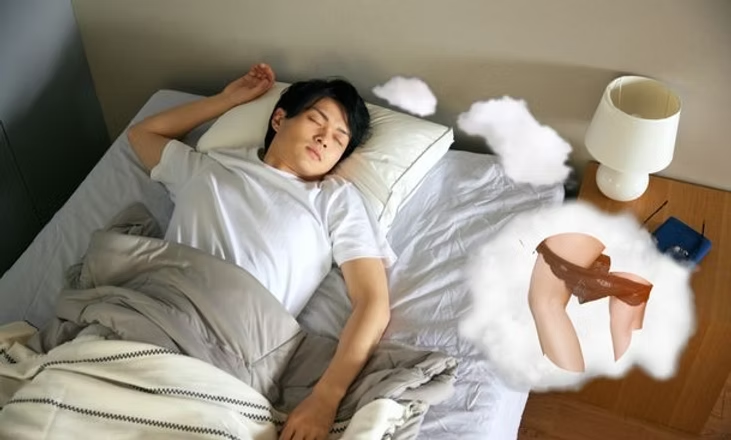
Why nightfall happens in boys
Ejaculation is a spinal reflex. The nerve pathways that produce it sit in the lower spinal cord and can fire without instruction from the conscious brain. Once puberty establishes sperm production and the reproductive tract becomes fully active, that reflex becomes capable of triggering during sleep. That is the whole mechanism.
Why nightfall happens in boys during puberty specifically
Puberty brings three changes at once. Sperm production begins, the tissues involved in ejaculation mature, and sexual awareness sharpens. The reflex arc becomes functional at roughly the same moment the boy starts noticing sexual feelings at all. This is why the first episode clusters so tightly around ages 13 and 14 across very different cultures.
Frequency tends to settle as a man gets older, which reflects a maturing nervous system rather than the depletion of any finite resource.
What actually triggers it during sleep
Several things lower the threshold on any given night. Sexual arousal during REM sleep is one. Physical contact with bedding is another. Broken or shortened sleep matters, because sleep quality shapes how often the body cycles through the stage where arousal thresholds are lowest.
Here is the part that surprises most people. The reflex does not require a dream. The 2026 review found that nocturnal emission occurs with or without erotic dreams, and evidence from men with spinal cord injury confirms that these episodes can arise without input from the brain at all. A boy who wakes up with no memory of any dream has not experienced something unusual.
Nightfall meaning in boys
Nightfall means semen is released during sleep without the boy choosing it or being awake for it. It is the same physical event as any other ejaculation. The only difference is that it happens while he is asleep.
You will also see it called a wet dream, a nocturnal emission, or swapnadosh in Hindi. That last word carries a problem worth naming. Dosh means fault or defect. The language a boy inherits tells him he has done something wrong before anybody has explained anything to him, and that framing shapes how he feels about a completely ordinary bodily event.
What the newest research says, and where the usual explanation is wrong
The most common explanation for nightfall, that semen builds up until the body has to release the excess, is not supported by current evidence. That explanation appears on almost every page on this topic in India, across fertility clinic blogs, hospital sites and health portals. It is intuitive and it sounds mechanical, which is probably why it has survived.
The current evidence does not support it. The 2026 systematic scoping review states directly that the evidence did not support the historical view of nocturnal emissions as a compensatory release under conditions of low sexual outlet. Put plainly, nightfall is not the body emptying a full tank.
This matters more than it might seem. The accumulation model is what convinces a boy that his body is keeping score, that abstinence causes pressure, and that frequency reveals something about his internal state. Remove the model and most of the anxiety loses its foundation.
| What most pages say | What the 2026 review found |
|---|---|
| Semen builds up and has to be released | Evidence did not support this compensatory-release model |
| It only happens after an erotic dream | Episodes occur with or without erotic dreams |
| High testosterone causes it | Hormonal influences appear modest |
| One to four times a month is the normal range | Frequency data are scarce and inconsistent |
That last row deserves attention. Boys measure themselves against a normal range they read online, then panic when they fall outside it. The best available review of the literature says that range does not rest on solid evidence. If you want the fuller picture on frequency, read how many nightfalls per month is normal, which covers that question in depth.
How much sperm is released during nightfall?
A nocturnal emission releases roughly the same volume of semen as any other ejaculation, typically a few millilitres. How many sperm cells that fluid contains is a separate measurement entirely, because the question mixes up two different things. Semen is the fluid, measured in millilitres. Sperm are the microscopic cells carried inside it, counted in millions.
The distinction matters, because nearly every page answering this question gives a fluid volume and calls it sperm. A volume figure tells you nothing about sperm count. If sperm count is what you are actually worried about, only a semen analysis answers that, and no article can.
There is also no single reliable sperm-count figure for one night’s emission, and anyone offering one is overstating what is known. Sperm concentration varies widely between men, and between two samples from the same man. A 2022 review published in Human Reproduction examined the reference population behind the World Health Organization semen standards, 3,589 fertile men across 12 countries and 5 continents, and concluded that the pooled data could not be treated as coming from a single population. If the reference ranges themselves do not transfer cleanly between populations, a confident number for a single night certainly does not.
What can be said clearly is this. Nightfall does not reduce sperm count and does not damage fertility, because sperm production runs continuously rather than drawing down a fixed store. You will also read that nightfall clears out old sperm. That claim rests on the same compensatory-release model the 2026 review found unsupported, so it should be treated with the same caution.
“I have nightfall every night” and what that usually means
Nightly or near nightly episodes are genuinely uncommon and worth taking seriously. In practice, though, the explanation is rarely a physical disorder.
Three things account for most cases. Sleep is broken, often by late screen use or an irregular schedule. Sexual content is being consumed close to bedtime, keeping arousal pathways active into sleep. Or the boy has become so anxious about nightfall that he goes to bed braced for it every single night.
The third one is the least recognised and the most common in the men I see. Chronic stress also plays a direct role, which is covered in more detail in how stress affects sexual function.
Does nightfall make you weak?
No. There is no mechanism by which it could. Sperm production runs continuously, the volume released is tiny, and no measurable effect on strength, stamina, testosterone or fertility has ever been demonstrated.
The tiredness some boys report is real, but it comes from disturbed sleep and from the mental effort of worrying, not from the fluid.
| Belief | Reality |
|---|---|
| Nightfall drains strength and vitality | No evidence supports this. Semen is produced continuously. |
| It reduces sperm count or causes infertility | No documented effect on sperm count, quality or fertility. |
| “Weak veins” cause nightfall | Not a recognised mechanism. This claim has no evidence base of any kind. |
| It stunts height or muscle growth | No relationship exists. Growth depends on nutrition, sleep and training. |
| It is a disease requiring treatment | It is a normal reflex. Only the distress around it may need attention. |
These beliefs are widespread enough in South Asia to have a clinical name. Dhat syndrome describes distress built around the fear of losing semen, through ejaculation, nocturnal emission or other means. A 2022 review published in Health Psychology Research characterised it as a culture-bound condition in which the anxiety, and not the semen loss, produces the fatigue, poor concentration and low mood that patients report. The 2026 scoping review notes that misconceptions remain widespread particularly in South Asia, where nocturnal emissions sit at the centre of Dhat syndrome. One caveat is worth stating plainly. A 2021 systematic review published in Asian Journal of Psychiatry assessed 89 papers on the condition and found the research base sparse and much of it of poor quality. The distress is well documented. The evidence beneath it is thinner than most articles admit.
Why trying to stop nightfall permanently makes it worse
Trying to suppress nightfall usually deepens the distress around it, and often raises the frequency too, because bracing for it before sleep keeps the nervous system alert and fragments sleep. Search any forum and you will find the same request phrased a hundred ways. How do I avoid nightfall permanently. How do I cure it. What stops it completely. Every reply says the same thing: it is normal, stop worrying. Nobody explains why the worrying is not incidental.
In my clinical work, the young men who come in distressed about nightfall almost never present with the episodes as the real complaint. They present with the hour before sleep. They describe checking their bedsheets each morning, keeping a mental tally of dates, and lying awake trying not to think about sex because thinking about it feels like it will cause an episode. By the time they reach a consultation, the monitoring has become the problem and the reflex has become almost incidental to their distress.
The mechanism is straightforward. Vigilance raises baseline arousal. A nervous system braced for something all evening does not settle into deep sleep easily. Fragmented sleep raises the chance of an episode. The episode confirms the fear, so the vigilance intensifies. The loop tightens on itself.
This is the same self-monitoring pattern that drives sexual performance problems in adults, where watching yourself during sex reliably interferes with the response you are watching for. I have written about that mechanism in the context of checking and monitoring yourself during sex. It is the identical loop, running at night instead of during intimacy.
The way out is to stop treating the reflex as a target. When boys and young men stop counting, stop inspecting and stop trying to suppress, the anxiety usually settles first and the frequency follows. That sequence matters: the calm comes before the change, not after it.
Key Takeaway
Nightfall is a spinal reflex that becomes active at puberty, not a sign of excess, deficiency or damage. The semen-accumulation story that most articles repeat is not supported by current evidence, and neither is the tidy monthly range boys measure themselves against. What causes real harm is the surveillance that builds around it: counting, checking and bracing for sleep raise baseline arousal, fragment sleep and make episodes more likely, which then justifies more surveillance. Breaking that loop matters far more than changing anything about the reflex itself.
When to see a doctor about nightfall
Nightfall itself does not require medical treatment. Some accompanying symptoms do, and a psychological explanation should never delay proper assessment of a physical one.
Get medical assessment if any of these apply
- Pain or burning during or after an episode, or on passing urine
- Blood in semen or urine
- Swelling, lumps or pain in the testicles or groin
- Fever, or discharge unrelated to sleep
- Episodes starting suddenly in an adult after years without any
- Unexplained weight loss, persistent fatigue or night sweats alongside the episodes
These point to conditions such as infection or inflammation of the reproductive tract, and a doctor should assess them properly. None of them is caused by nightfall, but they can appear at the same time and should not be dismissed as part of it.
Support from a therapist is worth considering when the distress, rather than any physical symptom, is what has taken over: persistent shame, dread before sleep, avoidance of relationships, or a preoccupation that is affecting studies, work or mood. That is treatable, and psychosexual therapy addresses it directly. For practical approaches that do not involve medication, see nightfall treatment without medicine.
A 2026 review published in International Journal of Impotence Research argued that medically unfounded claims about nocturnal emissions persist today, and that this leaves a clear opportunity for sexual health clinicians to clarify and destigmatise the topic, particularly for adolescents encountering it for the first time. That is precisely the gap this article exists to close.
Frequently Asked Questions
Why nightfall happens in boys and when does it usually start?
Nightfall happens in boys because the ejaculatory reflex can activate during sleep once puberty begins. A 2026 systematic scoping review found the first episode usually occurs between 12.6 and 15.6 years, most often at 13 or 14. It affects an estimated 70 to 90 percent of adolescent boys.
Is nightfall good for boys?
Nightfall is neither good nor bad. It is a normal physiological event that most adolescent boys experience. It carries no proven health benefit and no proven harm. The distress boys report almost always comes from what they have been told about nightfall, not from the event itself.
Does nightfall mean high testosterone?
No. Testosterone rises during puberty and nightfall becomes more common in the same period, but frequency does not measure hormone levels. The 2026 evidence describes hormonal influence on nocturnal emission as modest. You cannot infer anything about your testosterone from how often nightfall happens.
Does nightfall happen to girls?
Girls and women can experience orgasm during sleep, sometimes with increased vaginal lubrication. There is no semen involved, so the term nightfall does not apply in the same way. The underlying mechanism, sexual arousal during sleep, is shared across sexes and is equally normal.
How to confirm nightfall?
You may wake with damp underwear or bedding, sometimes after a sexual dream and sometimes with no memory of one. No test confirms it and none is needed. Boys who inspect themselves each morning to check usually find their anxiety grows rather than their certainty.
Why do I have nightfall every night?
Nightly episodes are unusual and worth discussing with a clinician. In most cases the cause is not physical. Disturbed sleep, sexual content before bed, and intense anxiety about nightfall itself all raise the likelihood. Frequency data in the research remain scarce, so treat confident numbers elsewhere with caution.
Can nightfall be stopped permanently?
No, and stopping it entirely is not a sensible goal. Nightfall is a normal reflex, not a fault to be removed. Episodes typically become less frequent with age. Boys who try hardest to suppress it often report the most distress, because the effort keeps their attention fixed on it.
Is 2 drops of sperm enough?
Enough for what depends on the question. For conception, the quantity of fluid matters far less than sperm concentration and motility, which only a semen analysis measures. A very small visible amount can still contain millions of sperm cells. Volume alone tells you almost nothing about fertility.
Can sperm refill in 2 hours?
Sperm production is continuous rather than a tank that refills on a schedule. The full maturation cycle takes weeks, not hours, but the body is always producing, so there is no waiting period after nightfall. Fluid volume recovers within a day or so.
Does nightfall cause weakness or reduce sperm count?
No. Sperm production is continuous and nocturnal emission does not deplete it. No evidence links nightfall to weakness, hair loss, weight loss or reduced fertility. Tiredness that boys notice afterwards usually reflects disturbed sleep and worry, not the small volume of fluid released.
References
- Maiolino G, Fernández-Pascual E, Lledó-García E, Martínez-Salamanca JI. Nocturnal emissions or wet dreams: modern evidence from a systematic scoping review. Sexual Medicine Reviews. 2026;14(1):qeag003. https://pubmed.ncbi.nlm.nih.gov/41665964/
- Rabil MJ, Cahill EM, Honig SC. It Comes at Night: A Nocturnal Emissions Historical Review. International Journal of Impotence Research. 2026. https://pubmed.ncbi.nlm.nih.gov/42362913/
- Strong YN, Li A, White ME, Razzak AN, Anderson DJ, Kaye AD, et al. Dhat Syndrome: Epidemiology, Risk Factors, Comorbidities, Diagnosis, Treatment, and Management. Health Psychology Research. 2022;10(4):38759. https://pubmed.ncbi.nlm.nih.gov/36425228/
- Paffoni A, Somigliana E, Boeri L, Viganò P. The statistical foundation of the reference population for semen analysis included in the sixth edition of the WHO manual: a critical reappraisal of the evidence. Human Reproduction. 2022;37(10):2237-2245. https://pubmed.ncbi.nlm.nih.gov/35849333/
- Kar SK, Menon V, Arafat SY, Singh A, Das A, Shankar A, et al. Dhat syndrome: Systematic review of epidemiology, nosology, clinical features, and management strategies. Asian Journal of Psychiatry. 2021;65:102863. https://pubmed.ncbi.nlm.nih.gov/34563955/
Dr. Dhruv Bhola
Certified Sex Therapist and Psychosexologist
He specialises in psychogenic erectile dysfunction, premature ejaculation, sexual performance anxiety, porn-related sexual difficulties and semen-loss anxiety, working without medication. He works with men and couples internationally through online psychosexual therapy.