Most delay condoms side effects are mild and short-lived: reduced sensation, temporary numbness, mild skin irritation, and numbness that transfers to a partner. Some men also lose their erection while using one. Serious allergic reactions happen, but published cases remain rare. The more useful question is not whether these side effects are dangerous. It is what the numbing quietly teaches you about sex.
Researchers have a name for the erection part of this: condom-associated erection problems, or CAEP. CAEP means losing or beginning to lose an erection while putting a condom on, or while wearing one during intercourse. A 2015 study published in Sexual Health found that 14% to 28% of men lose their erection during condom application, and 10% to 20% lose it during intercourse. Delay condoms sit directly on top of this problem, because they work by removing the sensation an erection depends on.
Below is what the side effects are, what randomised trials show about the extra time these condoms buy, how to use them properly, and the question men ask constantly but never get answered: why the numbing can work perfectly and change nothing.
Quick Summary
- Delay condoms carry benzocaine on the inner surface, commonly at 4.5% or 5% in products sold in India. The 2026 trial tested 3% and 5%.
- Long lasting, extra time, climax delay, desensitizing and anaesthetic condoms are the same product under different marketing names, with identical side effects.
- Common side effects: reduced sensation, numbness, skin irritation, partner numbness and erection loss.
- Erection loss during condom use is called condom-associated erection problems (CAEP), affecting 10% to 28% of men.
- A 2026 randomised trial found a 5% benzocaine condom added about 172 seconds, against 108 seconds for a plain condom. The numbing is worth roughly one extra minute, and the condom itself does the rest.
- They need five to ten minutes of contact before penetration, so they do not work instantly.
- If you last far longer alone than with a partner, numbing cannot help, because sensitivity is not your limiting factor.
Table of Contents
- What is actually inside a delay condom?
- What are the benefits of delay condoms?
- Long lasting condoms side effects: are they different?
- What are the delay condoms side effects?
- Do delay condoms actually work?
- Do condoms make you last longer, even without numbing?
- How long should sex actually last?
- How to use delay condoms properly
- The numbing worked but I still finished fast
- Why you struggle to get hard again for a second round
- Can delay condoms cause erectile dysfunction?
- Why relying on them can make things worse over time
- What works better than numbing
- When to see a doctor
- Frequently asked questions
What is actually inside a delay condom?
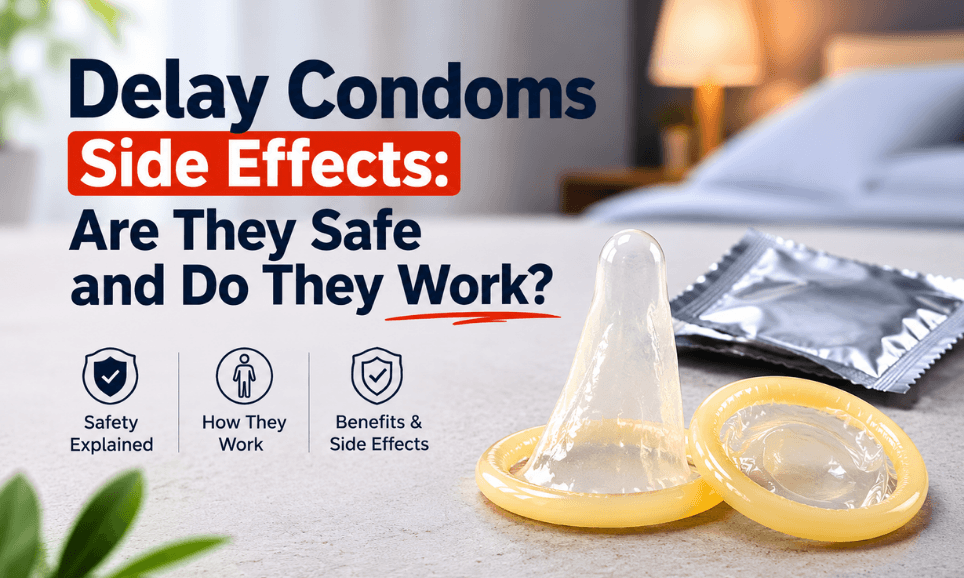
A delay condom is an ordinary latex condom with a local anaesthetic coated on the inner surface. That anaesthetic is almost always benzocaine. Products sold in India commonly state 4.5% or 5%, which is why searches for benzocaine 4.5% in condoms are so frequent. The 2026 randomised trial tested 3% and 5% formulations, and only the 5% version beat a plain condom by a meaningful margin. Benzocaine use in condoms is treated as an ancillary action, meaning the delay effect is secondary to contraception.
Benzocaine blocks nerve signals at the skin surface. It dulls sensory input travelling from the glans to the spinal cord, raising the stimulation needed to trigger the ejaculatory reflex. It does not enter your bloodstream in meaningful amounts, and it does not reach the vascular or hormonal systems that produce an erection.
What are the benefits of delay condoms?
A fair account has to state these plainly.
- They produce a real, measured increase in time to ejaculation, confirmed in a randomised trial.
- They keep full contraceptive and STI protection, unlike creams or sprays used alone.
- Side effects are the mildest of the topical options, and no prescription is needed.
- Used occasionally, they can lower the dread around a specific encounter while you work on the underlying pattern.
The problem is not the product. It is expecting it to solve something it was never designed to reach.
Long lasting condoms side effects: are they different?
No. This is the single most common source of confusion, and the answer saves you money. Long lasting condoms side effects are identical to delay condom side effects, because they are the same product. Brands market one benzocaine coating under many names.
| Marketing name | What it actually contains | Side effect profile |
|---|---|---|
| Long lasting condoms | Benzocaine, inner surface | Identical |
| Extra time condoms | Benzocaine, inner surface | Identical |
| Climax delay condoms | Benzocaine, inner surface | Identical |
| Desensitizing condoms | Benzocaine, occasionally lidocaine | Near identical |
| Anesthetic condoms, also sold as numbing condoms | Benzocaine or lidocaine | Near identical |
| Delay condoms | Benzocaine, inner surface | Identical |
Extra time condoms side effects, long lasting condoms side effects and condom desensitization all describe one mechanism: a surface anaesthetic reducing sensation. Comparing brands on side effects is therefore not useful. Comparing them on fit is, because fit affects erection loss far more than the coating does.
What are the delay condoms side effects?
They divide into three groups: what happens to your sensation, your skin, and your partner. Most resolve once the condom comes off.
Delay condoms side effects on your erection
This gets the least honest coverage online, and it matters most. An erection is not a switch you flip once. Your body maintains it through continuous arousal input, much of which is physical sensation. Remove enough sensation and arousal drops below the level needed to stay hard.
Men describe this as going soft for no reason, or feeling disconnected from their own body mid-act. It is not erectile dysfunction. It is an arousal problem created by the product working slightly too well. This differs from the pattern where you lose your erection while putting on a condom, which interruption and attention drive rather than numbing.
Skin irritation and allergic reactions
Mild burning, tingling, redness or itching can follow use. Benzocaine belongs to the ester group of local anaesthetics, which trigger allergic reactions more often than amides such as lidocaine. Among the esters, benzocaine produces the most positive patch test results. This is why benzocaine condoms side effects skew towards skin reactions rather than systemic ones, and why the side effects of using benzocaine condoms differ slightly from lidocaine versions.
Severe reactions stay genuinely rare. A 2018 case report in BMJ Case Reports documented an Indian man who developed allergic contact dermatitis and then superficial penile gangrene after using a 5% benzocaine condom. Fewer than six comparable cases appear in the literature since 1996. Worth knowing, not worth panic. If you already react to topical anaesthetics at the dentist, patch test before first use.
Benzocaine or lidocaine condoms: does it matter which?
Most condoms sold as delay or desensitizing use benzocaine. Lidocaine in condoms is less common than in sprays and creams, though some brands sell condoms with lidocaine coatings. The practical difference is allergy risk rather than performance, because both blunt sensation through the same surface mechanism.
| Benzocaine | Lidocaine | |
|---|---|---|
| Anaesthetic class | Ester | Amide |
| Allergy risk | Higher, most positive patch tests among esters | Lower |
| Usual form | Condom coating | Spray, cream, gel |
| Trial evidence in condoms | Randomised trial, 2026 | Tested mainly as spray or cream |
A 2025 trial in World Journal of Urology compared benzocaine condoms against lidocaine spray and EMLA cream in 273 men with lifelong premature ejaculation. All three helped, but the condoms produced the smallest improvement. If you have reacted to a topical anaesthetic before, lidocaine is the lower-risk option, and a patch test still applies.
Can delay condoms numb your partner?
Yes. The anaesthetic sits inside, but lubricant migrates, and transfer happens through handling, oral contact or slippage. Partners report temporary genital numbness. Wiping the outside before contact lowers this considerably. A product meant to improve shared sex can quietly reduce your partner’s pleasure while improving your timing, and couples rarely discuss that trade.
Do delay condoms actually work?
Yes, modestly. Until recently no randomised trial had tested them properly. That changed in May 2026, when the Journal of Sexual Medicine published a randomised three-way crossover trial in 148 men who felt sex sometimes ended sooner than they wanted. The headline number misleads, so read the bottom row first.
| Condom used | Extra time gained from baseline | Compared with a plain condom |
|---|---|---|
| 5% benzocaine condom | About 172 seconds | Significantly better (p = 0.017) |
| 3% benzocaine condom | About 128 seconds | No significant difference (p = 0.443) |
| Plain condom, no anaesthetic | About 108 seconds | Reference |
A plain condom with no numbing agent added roughly 108 seconds. The 5% version added roughly 172. The anaesthetic therefore contributes about 64 seconds, a little over one minute. The rest comes simply from wearing a condom, which already reduces sensation. The 3% version performed no better than plain to any meaningful degree. For transparency: Reckitt Benckiser Health Limited, the company behind Durex, funded that trial.
Do condoms make you last longer, even without numbing?
Yes, and this is the finding almost nobody reports, because it undermines the product being sold. In that same trial the plain control condom, with no anaesthetic at all, produced a statistically significant delay on its own. An ordinary condom already reduces sensation, which is the same mechanism a delay condom uses, just weaker.
So condoms that make you last longer do not need a numbing agent to do it. If you want more time and are not currently using condoms, an ordinary one captures around 63% of the total benefit measured in that trial, at a fraction of the price and with none of the numbing side effects described above. Try that before buying anything marketed as extra time.
How long should sex actually last?
Almost nobody answers this, and it drives the entire market. Men buy delay condoms while comparing themselves to a standard they have never seen measured. A 2005 multinational survey published in the Journal of Sexual Medicine timed intravaginal ejaculation latency, the interval between penetration and ejaculation, with a stopwatch across five countries. The median was about 5.4 minutes, with half of all men falling between roughly 3 and 10 minutes.
That median is far shorter than pornography implies. If you last four minutes, you sit near it already, and the problem may be comparison rather than timing.
How to use delay condoms properly
Most disappointment comes from using them wrong. Knowing how to use delay condom products correctly matters more than which brand you buy, because they are not instant and the waiting step is the one men skip.
- Patch test the first time. Rub a little of the internal lubricant on your forearm and leave it for a day.
- Check the fit. In the 2015 Sexual Health study, nearly half of men who lost erections during application blamed fit.
- Apply to a full erection, not a partial one, with the numbing side inward.
- Wait five to ten minutes before penetration. Starting immediately gives you reduced sensation without the delay benefit, which is the worst of both.
- Wipe the outside before contact, to limit transfer to your partner.
- Use water or silicone-based lubricant only. Oil degrades latex.
- Never stack them with a delay spray or cream. Doubling the anaesthetic is how men lose erections and numb their partners.
The numbing worked but I still finished fast
This is the most common complaint I hear about delay condoms, and no article online addresses it. A man uses one correctly. He waits. The numbing takes effect, so much that he can barely feel anything. He still finishes in the same time, and concludes his problem must be untreatable.
One detail almost always resolves it. Ask the same man how long he lasts during masturbation, and the answer is frequently twenty or thirty minutes, sometimes needing effort to finish at all. Thirty minutes alone. Ninety seconds with a partner. Identical body, identical nerve endings.
That gap tells you something precise. If penile sensitivity were the limiting factor, it would limit you equally in both situations. It does not. Something present with a partner and absent alone drives the timing, and that something is anxiety and attention. Benzocaine acts on skin. It cannot reach a response generated in the brain.
In my clinical work, the men who describe this rarely arrive talking about sensation. They arrive describing the ten minutes before sex. They describe monitoring a clock in their head, checking how aroused they feel, and running a silent commentary on whether tonight goes the same way as last time. By the time penetration begins they have been in high sympathetic arousal for several minutes and the ejaculatory reflex is already primed. A numbing agent on the surface of the penis was never going to touch that.
If this describes you, the useful next step is establishing whether your premature ejaculation is psychological or physical, because the two need completely different treatment.
Why you struggle to get hard again for a second round
Men report this constantly and no ranking page covers it. You last longer, then cannot get an erection again afterwards, and it feels like the product broke something.
Three things stack. The refractory period after ejaculation already suppresses erection. Residual benzocaine still blunts the sensory input that would rebuild arousal. Then worry about the missing erection adds sympathetic activation, which opposes erection directly. The numbing damaged nothing. It removed the sensory route back to arousal at the point your body relied on it most, and sensation returns as the anaesthetic wears off.
Can delay condoms cause erectile dysfunction?
No. Delay condoms do not cause erectile dysfunction as a direct chemical effect. Benzocaine acts on surface nerve endings, while erections depend on blood flow, nerve signalling and hormonal status. The anaesthetic does not meaningfully reach any of these.
What happens instead is a sequence. Reduced sensation lowers arousal. Lower arousal produces a softer erection. You notice the softness, and noticing triggers worry. Worry activates the sympathetic nervous system, which actively opposes erection. The erection problem is real, but benzocaine did not cause it. The chain it started did.
The evidence supports this. In the 2015 Sexual Health study, 82.0% of men with frequent erection loss blamed worry about having lost an erection with a condom before, against 42.0% of men with only occasional problems. That difference is not about condoms. It is about memory and expectation, the same self-monitoring pattern involved in monitoring yourself during sex.
Key Takeaway
Delay condoms reduce sensation, and sensation drives both ejaculation timing and erection maintenance. Dulling it buys roughly one extra minute over a plain condom, while risking the arousal your erection depends on. If you last far longer alone than with a partner, anxiety is the limiting factor rather than sensitivity, and no surface anaesthetic reaches it. The product treats the organ. The difficulty usually lives in attention.
Why relying on them can make things worse over time
Occasional use causes no lasting problem. One correction first, because most websites get this part wrong. Many claim regular use permanently desensitises the penis or trains your body to need numbing. No trial evidence supports that. In the 2026 crossover trial, men used the condoms across four-week periods with no serious adverse events. The physical desensitisation claim is repeated widely and rests on nothing.
The real problem is behavioural. Used every single time, a delay condom functions as an avoidance behaviour. Anxiety reduces through disconfirmation, meaning the experience of the feared outcome not happening, and reaching for the safety aid every time means you never collect that evidence. Confidence transfers to the product rather than to you, so forgetting the condoms produces disproportionate panic. A timing concern becomes a broader performance concern, which is harder to treat.
What works better than numbing
Numbing lowers sensation. The alternatives raise your tolerance for it, which produces control that stays with you.
- Arousal awareness training. Identifying moderate arousal, not just the point of no return.
- Stop-start and squeeze techniques. Rebuilding the link between arousal and control.
- Pelvic floor training. Strengthens the muscles involved in the ejaculatory reflex.
- Attention retraining. Moving focus from self-monitoring back to your partner.
- Psychosexual therapy. Addresses the anxiety and relationship dynamics maintaining the pattern.
Structured sensate focus exercises deliberately increase sensory awareness while removing performance pressure, the exact opposite of numbing. If the pattern has persisted for months, premature ejaculation treatment with a qualified therapist addresses the cause rather than masking the symptom.
When to see a doctor
See a doctor promptly if you notice
- Blistering, open sores, skin breakdown, or darkening of penile skin.
- Numbness lasting more than a few hours after removing the condom.
- Swelling, spreading redness, discharge, or pain that worsens rather than settles.
- Difficulty breathing, facial swelling, or widespread rash, which need emergency care.
- Erection difficulty continuing without a condom, including absent morning erections.
- Erection problems alongside diabetes, high blood pressure, heart disease, or new medication.
That final pair matters. Erectile difficulty is sometimes an early marker of cardiovascular or metabolic disease. Do not assume a psychological explanation because it feels less alarming.
Frequently asked questions
What are the most common delay condoms side effects?
The most common are reduced sensation, temporary numbness, mild skin irritation and partner numbness. Most men notice nothing beyond dulled feeling that fades within an hour of removing the condom. Some also lose their erection, because reduced sensation lowers arousal input. Allergic reactions to benzocaine occur but remain uncommon in published reports.
Do long lasting condoms have different side effects?
No, they are the same product. Long lasting, extra time, climax delay, desensitizing and delay condoms all describe a benzocaine coating on the inner surface. The side effect profile is identical across these names. Choose on fit and price rather than marketing language, because fit affects erection loss considerably more.
Do condoms make you last longer?
Yes. In the 2026 Journal of Sexual Medicine trial, an ordinary condom with no anaesthetic increased time to ejaculation by about 108 seconds from baseline. A 5% benzocaine condom reached about 172 seconds. So the condom itself delivers most of the benefit, and the numbing agent adds roughly one minute.
How much time do delay condoms increase?
Roughly one extra minute beyond what a plain condom already gives you. In the 2026 trial, a 5% benzocaine condom raised ejaculation latency by about 172 seconds from baseline. A plain condom raised it by about 108 seconds. The anaesthetic accounts for the difference, not the whole gain.
Is it harmful to use delay condoms?
No, occasional use is not harmful for the large majority of men. In the 2026 Journal of Sexual Medicine trial, no serious adverse events occurred and all condoms were well tolerated. Harm becomes more likely with daily use, with broken skin, or if you already react to topical anaesthetics.
Do delay condoms work instantly?
No. They need roughly five to ten minutes of skin contact before the anaesthetic takes effect. Men asking do numbing condoms work often started immediately, which gives reduced sensation without the added time, and that is why the product feels like it failed.
What are the side effects of long term usage of delay condoms?
No trial has found lasting physical damage from repeated use. The documented long term risk is behavioural rather than physical: the condom becomes a safety aid you cannot perform without, which keeps the original anxiety intact. Skin sensitisation to benzocaine can also build with repeated exposure in susceptible men.
How long does benzocaine last in condoms?
The numbing takes about five to ten minutes to reach full effect and fades within roughly an hour of removing the condom. Sensation usually returns completely once the anaesthetic clears. Numbness persisting beyond a few hours is not normal and needs medical assessment rather than watchful waiting.
Is benzocaine harmful to the body?
At the doses coated inside a condom, benzocaine acts locally and does not enter the bloodstream in meaningful amounts. The realistic risk is allergic contact dermatitis, since benzocaine is an ester anaesthetic and these sensitise more readily than amides such as lidocaine. Systemic reactions are rare.
Can delay condoms cause ED?
No, delay condoms do not cause erectile dysfunction as a direct chemical effect. Benzocaine acts on surface nerve endings and does not reach the blood vessels or hormones producing an erection. Erection loss during use reflects condom-associated erection problems (CAEP), where reduced sensation and worry lower arousal below threshold.
Is my premature ejaculation more mental or physical?
One test separates them quickly. Compare how long you last alone against how long you last with a partner. A large gap points to anxiety and attention rather than sensitivity, because nerve endings do not change between the two situations. A similar time in both suggests a physical contribution worth assessing medically.
Why did the numbing work but I still finished fast?
Because your ejaculation timing is driven centrally, not by penile sensitivity. If you last far longer alone than with a partner, sensitivity is not the limiting factor. Anxiety and attention are. Numbing the skin cannot change a response that starts in the brain, which is why the product feels useless.
Do delay condoms make you lose your erection?
They can, and this is one of the most under-discussed effects. Erections need continuous arousal input. Strip out too much sensation and arousal falls below the level required to stay hard. Men often read this as erectile dysfunction. It usually resolves once the condom comes off and normal sensation returns.
Can premature ejaculation improve without delay condoms?
Yes, and psychological approaches address the cause rather than masking it. Behavioural techniques, arousal awareness training and anxiety-focused psychosexual therapy build ejaculatory control that stays with you. Delay condoms borrow time for one encounter. Improvement varies between individuals and depends on consistent practice rather than any fixed timeline.
References
- Coupland CA, Su L, McGirr MEA, Hood S. Prolonging ejaculatory latency with benzocaine paste-containing natural rubber latex condoms: findings from a randomized, three-way, cross-over study. Journal of Sexual Medicine. 2026;23(6):qdag134. https://pubmed.ncbi.nlm.nih.gov/42153745/
- Hamarat MB, Kafkasli A, Kucuktopcu O, Ecer G, Yazici O, Karatas B. Comparative efficacy of EMLA cream, lidocaine spray, and benzocaine condoms in treating lifelong premature ejaculation: a randomized clinical study. World Journal of Urology. 2025;43(1):629. https://pubmed.ncbi.nlm.nih.gov/41144023/
- Hill BJ, Sanders SA, Crosby RA, Ingelhart KN, Janssen E. Condom-associated erection problems: behavioural responses and attributions in young, heterosexual men. Sexual Health. 2015;12(5):397-404. https://pmc.ncbi.nlm.nih.gov/articles/PMC4712123/
- Waldinger MD, Quinn P, Dilleen M, Mundayat R, Schweitzer DH, Boolell M. A multinational population survey of intravaginal ejaculation latency time. Journal of Sexual Medicine. 2005;2(4):492-497. https://pubmed.ncbi.nlm.nih.gov/16422843/
- Sharma A, Agarwal S, Garg G, Pandey S. Desire for lasting long in bed led to contact allergic dermatitis and subsequent superficial penile gangrene: a dreadful complication of benzocaine-containing extended-pleasure condom. BMJ Case Reports. 2018;2018:bcr2018227351. https://pmc.ncbi.nlm.nih.gov/articles/PMC6169717/
Dr. Dhruv Bhola
Certified Sex Therapist and Psychosexologist
He specialises in premature ejaculation, psychogenic erectile dysfunction, sexual performance anxiety, porn-related sexual difficulties and intimacy concerns in relationships. He works with men and couples internationally through online psychosexual therapy.