If you have tried Viagra, Cialis, or another ED medication and it has not worked, or has stopped working as well as it once did, sex therapy is very likely to be the missing piece of your treatment. Erectile dysfunction medication works by increasing blood flow to the penis during arousal. What it cannot do is address anxiety, resolve performance pressure, repair the psychological relationship between your mind and your body during sex, or treat the conditioned fear responses that are at the root of most cases of erectile dysfunction in men under 50. Sex therapy, specifically psychosexual therapy delivered by a certified specialist, does exactly this. This article explains why medication fails when ED has a psychological component, what sex therapy involves, and the clinical evidence supporting it as a first-line or adjunct treatment for psychological erectile dysfunction.
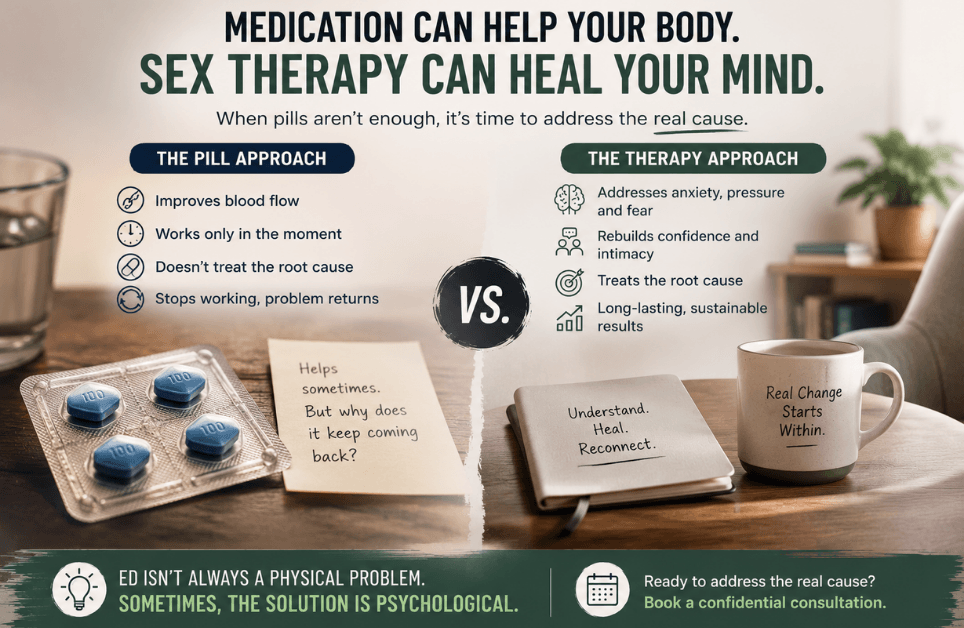
Why Medication May Not Be Working for Your ED
PDE5 inhibitors, the class of drug that includes sildenafil (Viagra), tadalafil (Cialis), and vardenafil (Levitra), work by relaxing the smooth muscle in the blood vessels of the penis, allowing increased blood flow when you are sexually aroused. They do not create arousal. They do not create desire. They do not override anxiety. They simply make it easier for the physical mechanism of erection to occur when the psychological conditions are right.
When those psychological conditions are not right, the medication has significantly reduced or no effect. Specifically, if your sympathetic nervous system is activated through anxiety, performance pressure, or fear of sexual failure, your body is in a state that is physiologically incompatible with erection. The stress response redirects blood flow away from the genitals, raises cortisol, and suppresses the parasympathetic response that initiates erection. No amount of blood-flow medication overrides this when the underlying psychological state is one of threat.
Signs Your ED Has a Psychological Component That Medication Is Missing
- You can achieve erections during masturbation or upon waking, but lose them during partnered sex.
- Your ED worsens when you are under stress or during periods of anxiety, regardless of whether you are taking medication.
- Your ED appeared after a specific event: a failed sexual encounter, relationship conflict, a new partner, or a period of high emotional pressure.
- You feel significant anxiety before or during sex: monitoring your erection, watching for signs of failure, trying to control your arousal mentally.
- The medication produces an erection initially, but you lose it at the point of penetration or shortly after, because anxiety peaks at that moment.
- ED medication has worked inconsistently for you: effective in low-pressure situations, ineffective in high-pressure ones.
- You are under 50 and have no diagnosed cardiovascular, hormonal, or neurological condition that would explain organic ED.
If several of these describe your experience, you are almost certainly dealing with psychogenic erectile dysfunction, a form of ED driven by psychological rather than primarily organic factors. Research suggests that psychogenic ED accounts for approximately 40% of all ED cases overall, and up to 85% in men under 40. In these cases, medication is symptom management at best, not treatment. To understand more about how this form of ED develops and what drives it, read the full guide to psychogenic erectile dysfunction.
Why Viagra and Cialis Cannot Treat Psychological ED
This is the critical point that almost no article about sex therapy for ED addresses directly, yet it is the most important thing for men using medication to understand.
Erectile dysfunction driven by performance anxiety, relationship stress, or conditioned fear is maintained by a self-reinforcing psychological cycle. It works like this: you have a sexual encounter where your erection fails or is poor. You feel embarrassed or inadequate. Before your next sexual encounter, you already anticipate the possibility of failure. This anticipatory anxiety activates your sympathetic nervous system, which produces adrenaline and cortisol, reduces genital blood flow, and inhibits the parasympathetic response needed for erection. You then either fail to get an erection, or you get one but lose it at a critical moment, confirming your fear. The cycle repeats and deepens over time.
Medication can partially disrupt this cycle in some men by providing enough physiological support to achieve an erection despite moderate anxiety. But in men with severe performance anxiety or deeply conditioned psychological patterns, the level of sympathetic activation is too high for medication to overcome. More importantly, even when medication does work temporarily, it does nothing to resolve the underlying anxiety or the conditioned fear response. The moment you stop the medication, or encounter a situation where the anxiety is higher than usual, the ED returns.
This is why men often report that medication “works sometimes but not others,” or that it worked initially and then became less effective as anxiety about their ED grew. The medication was never treating the condition. It was temporarily compensating for it.
Can Sex Therapy Help If Medication Isn’t Working for ED? What the Evidence Shows
Yes. Sex therapy has a strong and well-established evidence base for treating psychological erectile dysfunction, and it produces outcomes that medication cannot replicate.
A study published in Sexual Medicine examined the effects of cognitive behavioral sex therapy (CBST) on young men with nonorganic (psychological) erectile dysfunction, compared against a control group receiving sildenafil. The researchers found that cognitive behavioral sex therapy produced similar improvements in erection quality to sildenafil, and significantly greater improvements in anxiety scores. In other words, sex therapy matched medication for the physical outcome while also addressing the psychological root cause that medication cannot reach.
For men with stress-related ED whose partner is willing to participate in therapy, studies have shown resolution rates of 50 to 70 percent. This is a treatment outcome no oral medication can claim, because medication does not resolve the interpersonal and psychological conditions driving the ED.
The clinical evidence consistently supports sex therapy, and specifically psychosexual therapy, as the primary treatment for psychological erectile dysfunction. For men whose ED has an organic component alongside psychological factors (which is common), a combined approach using both medication and sex therapy produces the best outcomes.
What Sex Therapy for ED Actually Involves
One of the reasons many men avoid sex therapy is that they do not know what it involves. It does not involve sexual contact with a therapist. It does not involve demonstrating sexual performance. It involves structured psychological and behavioural work, conducted in sessions with a certified psychosexologist, designed to address the specific factors driving your ED.
Breaking the Anxiety-Erection Cycle
The first and most important focus of sex therapy for psychological ED is interrupting the anxiety cycle that maintains the problem. A psychosexologist will help you understand exactly how your nervous system has been conditioned to associate sex with threat, and work with you systematically to recondition that response. This involves both cognitive work, changing the beliefs and expectations that generate anticipatory anxiety, and behavioural exercises that gradually reintroduce sexual activity under low-pressure conditions. For a deeper understanding of how performance anxiety drives ED, see the full guide to sexual performance anxiety.
Sensate Focus
Sensate focus is a core technique in sex therapy for ED developed by Masters and Johnson. It involves a structured programme of graduated physical intimacy that removes all pressure to achieve or maintain an erection. The exercises begin with non-genital touch and progress slowly, rebuilding the association between physical intimacy and pleasure rather than performance. The removal of the erection imperative is specifically designed to reduce the anticipatory anxiety that prevents erection from occurring naturally.
Cognitive Restructuring
Men with psychological ED almost universally hold a set of distorted beliefs about their sexual performance: that they must always be erect, that a lost erection means failure, that their partner’s satisfaction depends entirely on penetration, or that ED means they are inadequate as a man. These beliefs generate and sustain the anxiety that causes ED. Cognitive restructuring identifies and actively challenges these beliefs, replacing them with accurate, realistic perspectives that reduce the psychological pressure attached to every sexual encounter.
Relationship and Communication Work
In many cases, ED exists within a relationship context where both partners are affected: the man by shame and performance pressure, the partner by confusion, self-doubt, or frustration. Psychosexual therapy addresses this relational dimension directly, improving sexual communication, reducing the pressure dynamic that worsens ED, and helping couples rebuild intimacy that does not depend on erection quality.
Medication vs. Sex Therapy vs. Combined: Which Approach Is Right for You?
The right approach depends on the primary driver of your ED. The following comparison gives you a framework for understanding which option is most appropriate for your situation.
| Approach | Best For | What It Addresses | What It Cannot Address |
|---|---|---|---|
| Medication only (Viagra, Cialis) | Organic ED with mild anxiety overlay; situational support | Blood flow, physical erection mechanism | Anxiety, performance pressure, conditioned fear, relationship factors |
| Sex Therapy only | Psychogenic ED, performance anxiety, conditioned fear response | Anxiety cycle, beliefs, conditioning, relationship dynamics | Organic vascular or hormonal dysfunction |
| Combined: Medication plus Sex Therapy | Mixed ED with both organic and psychological components; men whose medication works inconsistently | Blood flow support while therapy addresses psychological root cause | Nothing: this approach covers both dimensions |
For many men whose medication is not working, the most effective initial strategy is to begin psychosexual therapy while using medication in a reduced-pressure role, not as the primary solution but as a confidence bridge while the psychological work takes effect. As the anxiety cycle is resolved through therapy, many men find they no longer need medication at all, or need it only occasionally.
How Long Does Sex Therapy Take to Work for ED?
This is one of the most common questions men have, and one that almost no competitor article addresses with any specificity. The honest answer depends on the individual, but general clinical experience provides useful benchmarks.
Most men with psychological ED begin to notice meaningful changes within four to eight sessions of structured psychosexual therapy. A full course of treatment typically runs between eight and twenty sessions, depending on the complexity of the underlying psychological factors, whether a partner is involved, and how deeply the anxiety pattern has become conditioned over time.
Men who have had ED for a shorter period, whose ED is clearly situational (better during masturbation than partnered sex), and who are genuinely engaged in the therapeutic process tend to respond faster. Men whose ED has been present for many years, or who have developed significant secondary anxiety around their ED, may require a longer course.
In all cases, sex therapy produces durable results because it addresses the mechanism that maintains the problem, not just the symptom. This is the fundamental difference between pharmacological and psychosexual treatment: medication provides temporary support, therapy provides lasting resolution.
Who Is Sex Therapy Most Likely to Help When Medication Isn’t Working?
Sex therapy for ED is most likely to produce strong outcomes in the following situations:
- You are under 50 with no significant medical condition explaining your ED.
- Your ED is clearly situational: present in some contexts (partnered sex) but not others (masturbation, morning erections).
- Your ED worsens with stress, new partners, or high-pressure sexual situations.
- Your ED began after a specific event: a failed encounter, a relationship breakdown, a period of significant personal stress.
- ED medication has worked inconsistently, suggesting the problem is partly psychological.
- You experience significant anxiety before or during sex, regardless of whether you are on medication.
- You are willing to engage honestly with the psychological dimensions of your sexual health.
Sex therapy can also help men with predominantly organic ED, where psychological factors have developed alongside the physical cause. Even men who will always require some level of medical support for erection quality can significantly benefit from the anxiety reduction, improved sexual confidence, and relationship improvements that psychosexual therapy delivers.
Frequently Asked Questions: Can Sex Therapy Help If Medication Isn’t Working for ED?
Can sex therapy help if medication isn’t working for ED?
Yes. When ED medication is not working, it is often because the ED has a significant psychological component that medication cannot address. Sex therapy, specifically psychosexual therapy, targets the anxiety cycle, conditioned fear responses, and performance pressure that maintain psychological erectile dysfunction. Clinical studies show sex therapy produces erection improvements comparable to sildenafil, while also producing significant reductions in anxiety that medication cannot achieve.
Why would Viagra or Cialis stop working for ED?
PDE5 inhibitors like Viagra and Cialis work by improving blood flow during arousal. They cannot override a sympathetic nervous system that is in an anxiety-activated state. If your anxiety or performance pressure has increased over time, or if the psychological component of your ED has intensified, medication may become progressively less effective because the psychological barrier is too strong for the physical mechanism to overcome. This is a sign that the root cause needs to be addressed psychologically, not with a higher dose.
Is psychological erectile dysfunction curable without medication?
Yes, in most cases. Psychological erectile dysfunction is highly treatable through psychosexual therapy without the need for ongoing medication. Because the root cause is a learned anxiety and performance pressure pattern rather than a physical deficiency, resolving the psychological pattern through structured therapy produces lasting results. Many men who complete psychosexual therapy are able to achieve and maintain erections naturally, without pharmaceutical support.
How is sex therapy different from simply taking a higher dose of ED medication?
A higher dose of ED medication still does not address the psychological root cause of your ED. It may increase blood flow marginally more, but if your ED is driven by performance anxiety or a conditioned fear response, the mechanism of failure is neurological and psychological, not simply a blood flow deficit. Sex therapy resolves the actual mechanism that is causing your ED. A higher dose of medication simply tries harder to bypass a mechanism that will not be bypassed through pharmacology alone.
How many sessions of sex therapy does it take to treat ED?
Most men with psychological ED begin noticing meaningful improvements within four to eight sessions of psychosexual therapy. A full treatment course typically involves eight to twenty sessions depending on the complexity of the psychological factors involved and whether a partner is participating in the process. Compared to a lifetime of medication dependence, this is a time-limited investment in a permanent solution.
Should I use ED medication and sex therapy at the same time?
For many men, a combined approach is the most effective starting point. Medication can provide short-term physiological support and restore some confidence while psychosexual therapy addresses the underlying anxiety and conditioning. Over time, as the psychological work takes effect, the need for medication typically reduces. A qualified psychosexologist can advise you on the most appropriate approach for your specific situation.
The Next Step: Address the Root Cause, Not Just the Symptom
If ED medication is not working for you, the most important shift you can make is to stop thinking of medication as the solution and start asking what the real cause of your ED is. In the majority of men where medication has failed or produced inconsistent results, the answer is a psychological pattern: performance anxiety, conditioned fear, relationship pressure, or a combination. These patterns are treatable. They have a clear and proven treatment pathway in psychosexual therapy. And resolving them produces something that medication never can: a genuinely different, confident, and sustainable relationship with your own sexuality.
Dr. Dhruv Bhola is a certified sex therapist and psychosexologist with specialist expertise in psychogenic erectile dysfunction and the psychological treatment of ED when medication has not provided the results you need. Confidential consultations are available online and in-clinic. Book your consultation here.