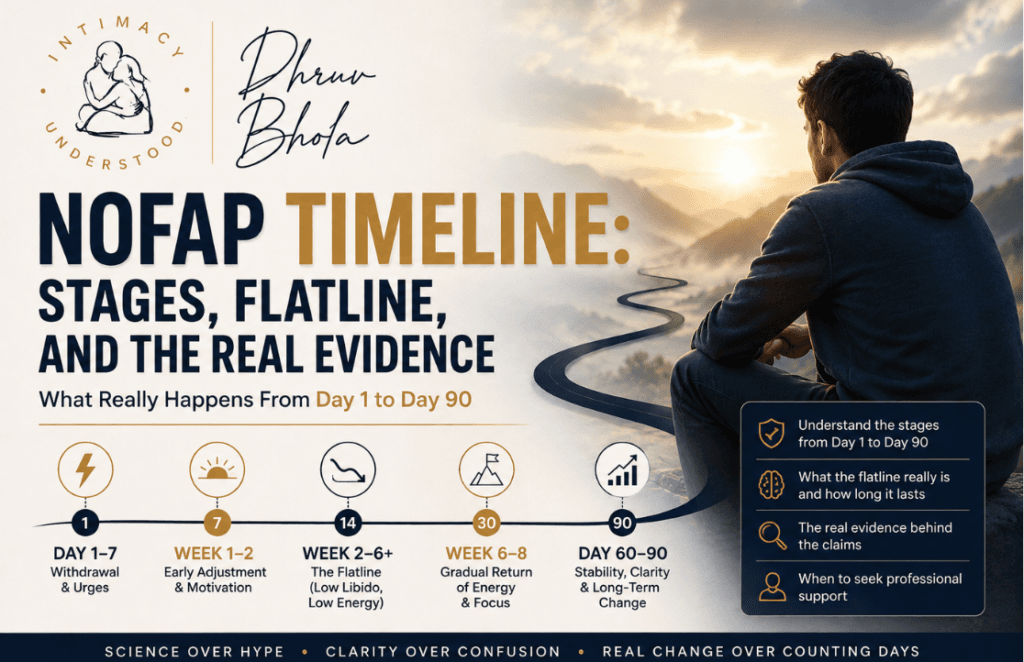
The nofap timeline is a set of stages, usually mapped from day 1 to day 90, that online communities describe when someone stops masturbating or watching pornography. Most versions include an early week of strong urges, a dip called the flatline, and a gradual return of energy and focus. The stages are widely shared online, but only loosely supported by clinical evidence.
What many people following this timeline are actually managing is closer to what clinicians call compulsive sexual behaviour, recognised by the World Health Organisation’s ICD-11 as persistent difficulty controlling sexual urges despite real problems it causes. Not everyone who tries NoFap meets that description; for many, the motivation is closer to a belief that masturbation itself is harmful, a different starting point with a different likely outcome.
This article works through what each stage commonly involves, what the flatline actually is, and where the evidence genuinely stands, including a widely cited study behind some of these claims that has since been retracted.
Quick Summary
- The nofap timeline maps stages people report during a period without masturbation or pornography, usually day 1 to day 90.
- The flatline, a temporary dip in libido and motivation, is the most consistently reported stage.
- Many following this timeline are managing what clinicians call compulsive sexual behaviour, though motivation to abstain often reflects beliefs about masturbation rather than a diagnosable pattern.
- A widely cited 2003 study claiming a day 7 testosterone spike from abstinence was formally retracted in 2021.
- A 2021 pilot study found no significant change in testosterone-to-cortisol ratios after masturbation, easing the opposite fear.
- Persistent low mood during a flatline can overlap with signs worth discussing with a professional, not just waiting out.
Table of Contents
- What Is the NoFap Timeline, and Where Does It Actually Come From?
- The First Week: Withdrawal and Urges
- The NoFap Flatline: What It Is and How Long It Actually Lasts
- Is the NoFap Timeline Backed by Evidence, or Is It Bro Science?
- When Flatline Symptoms Need More Than Patience
- What Changes for Most People by 60 to 90 Days
- What a Psychosexologist Sees That an App Tracker Does Not
- Frequently Asked Questions
What Is the NoFap Timeline, and Where Does It Actually Come From?
The nofap timeline did not come from a clinical trial. It grew out of the r/NoFap community on Reddit and similar forums, where people compared notes over time and compressed those accounts into a shared narrative: a rough day-by-day map from day 1 to day 90, sometimes extended to a year. Versions differ in detail, but the shape repeats: strong early urges, a middle stretch where energy seems to spike, a dip commonly called the flatline, then a slower climb back toward feeling normal.
Much of this language, urges, reboot, flatline, comes from the community that built it, not from a diagnostic manual. That does not make it worthless, but it should be read as a shared account of lived experience rather than a validated clinical protocol. Some people concerned about porn-induced erectile dysfunction find the structure useful for tracking change. Others find it sets expectations the evidence cannot back up.
The First Week: Withdrawal and Urges
The first seven days are usually described as the hardest: strong, intrusive urges, restlessness, poor sleep, irritability over small things. People often call this withdrawal, but no substance is leaving the body the way it does with a drug. More likely, it is a disrupted habit loop: a behaviour that had become a fast way to manage stress or boredom is suddenly unavailable, and the brain keeps signalling for it out of pure repetition. Treating that as identical to chemical withdrawal can make the early days feel more alarming than they need to.
What tends to help is unremarkable: a structured day, something to occupy attention when urges typically hit, and not treating one lapse as proof the attempt has failed.
The NoFap Flatline: What It Is and How Long It Actually Lasts
The flatline is the most consistently reported stage, and the one causing most alarm: a sudden drop in libido, flattened mood, low energy, a sense of numbness appearing anywhere from week two onward. Reported length varies enormously, from under two weeks to well beyond a month. There is no reliable clinical data establishing a typical duration, because this has not been studied as a defined phenomenon, only described anecdotally, in large volume, by a fairly consistent community. That consistency is worth taking seriously as a real, common experience. It does not mean a specific length can be predicted for any one person.
A flatline is not a sign the attempt has failed, and not evidence that something has gone wrong physically. For most people, energy and interest return gradually rather than all at once.
Is the NoFap Timeline Backed by Evidence, or Is It Bro Science?
This is the question the NoFap community itself asks more than any outsider does. Search forums for the timeline and you will find as many people calling it unscientific as people defending it, and that scepticism deserves a straight answer.
The most frequently cited evidence behind claims about abstinence and testosterone is a small 2003 study that measured serum testosterone in 28 men and reported a sharp peak, to 145.7 percent of baseline, on the seventh day of abstinence. That figure has circulated for two decades as proof of a measurable hormonal reward. The study was formally retracted in 2021. Claims built on it should be treated as unverified.
The opposite fear, that masturbation itself meaningfully drains testosterone, does not hold up well either. A 2021 randomised, controlled pilot study measuring hormones directly after masturbation found no significant change in the ratio between testosterone and cortisol, though the authors called for larger trials before drawing firm conclusions either way.
A separate 2020 study in Archives of Sexual Behavior looked at why people attempt abstinence in the first place. Surveying over a thousand people, the researchers found that motivation to abstain correlated far more strongly with attitudes, specifically the belief that masturbation is unhealthy, along with conservatism, religiosity, and lower trust in science, than with any measurable behavioural marker of addiction. For a meaningful share of people following the nofap timeline, what is driving the attempt is a belief about masturbation rather than a diagnosable compulsive pattern.
| Common Claim | What the Evidence Actually Shows |
|---|---|
| Testosterone spikes on day 7 of abstinence | The main study behind this claim was retracted in 2021 |
| Masturbation drains testosterone | A 2021 pilot trial found no significant change in the testosterone-to-cortisol ratio after masturbation |
| The flatline is a measurable dopamine reset | No study has established this mechanism; expectancy and attention are better-supported explanations |
| Everyone follows the same day-by-day stages | Abstinence motivation is linked more to personal beliefs about masturbation than to a fixed biological timeline |
Key Takeaway
The nofap timeline describes a real, widely shared pattern of experience, but specific claims like a day-seven testosterone spike do not hold up under scrutiny. What most consistently explains the flatline is expectancy: closely tracking your own mood and libido against a script that predicts how you should feel creates its own pressure. Taking the experience seriously and taking the folklore literally are two different things, and most of the timeline’s confusion comes from treating them as one.
When Flatline Symptoms Need More Than Patience
Most of what gets described as a flatline resolves with time and needs no professional input. There is a point where that stops being true: if low mood is severe, lasts beyond a few weeks without any lift, comes with loss of interest in things outside the attempt itself, or includes thoughts of self-harm, that is no longer something to wait out. Speaking to a doctor or therapist directly is not a sign the attempt failed.
When to Seek Support
If low mood, hopelessness, or thoughts of self-harm appear alongside a flatline and do not lift, this needs a conversation with a doctor or mental health professional, not more patience. This is common enough to take seriously and is not something to manage alone.
What Changes for Most People by 60 to 90 Days
By the two to three month mark, most accounts describe something more stable than dramatic: urges ease, sleep and mood level out, and the sense of being ruled by compulsive checking fades. How much of that reflects abstinence itself versus weeks of consistent, intentional behaviour change is hard to separate from self-reported accounts alone. Relapse also gets more psychologically complicated here, not less. Early urges are straightforward cravings; by this stage, what pulls someone back is closer to habit and self-belief, a stressful moment where the old response is still fastest, or a quiet assumption the point has already been proven. Neither is weak willpower. Both are ordinary parts of changing an established behaviour.
What a Psychosexologist Sees That an App Tracker Does Not
In my clinical work, the men who ask about the nofap timeline are rarely just curious about day counts. Underneath the question is usually something more specific: whether porn has changed how they respond to a real partner, and whether stopping will fix that on its own. A streak counter cannot answer that, because the answer depends on what is driving the pattern, not how many days have passed. Working through that distinction is a core part of porn addiction treatment, and it looks different from person to person.
In psychosexual practice, the flatline itself is often less about brain chemistry and more about attention. Spend weeks monitoring every flicker of libido against a schedule that says you should feel a certain way by a certain day, and ordinary variation starts to read as crisis. That pattern, watching yourself closely for signs something is wrong, mirrors what happens in sexual performance anxiety, where the monitoring itself becomes the obstacle. Recognising that overlap tends to matter more than any specific day on the calendar.
Frequently Asked Questions
Is the nofap timeline the same for everyone?
No. The stages describe commonly reported patterns, not a fixed schedule. Some people notice little resembling a flatline at all, while others describe one lasting well beyond the two to six weeks most accounts mention. Treat the timeline as a rough map of other people’s experience, not a prediction for yours.
How long does the flatline actually last?
Most accounts describe somewhere between two and six weeks, though shorter and considerably longer flatlines are both commonly reported. There is no clinical data establishing a typical duration, because it has not been studied as a defined phenomenon.
What happens if I don’t masturbate for 7 days?
Most people report strong urges easing somewhat by this point, alongside better sleep and mood for some. The specific claim that testosterone spikes measurably on day seven comes from a study that has since been retracted, so it should not be treated as established fact.
Is not masturbating healthy?
Yes, masturbation is not required for health, and there is no evidence that voluntarily not masturbating causes harm. Equally, there is no strong evidence that regular masturbation is harmful. Most flatline symptoms during abstinence appear to reflect psychological adjustment rather than a physical health change.
Does nofap actually work?
It depends what “work” means. For someone managing a genuine pattern of compulsive sexual behaviour, many describe real benefit from the structure and intentionality involved. As a fixed, predictable neurochemical reset on a set schedule, the evidence behind that specific claim does not hold up.
Is the day 7 testosterone spike real?
The study most often cited for this claim was retracted in 2021 and should not be relied on as evidence, whatever the original finding was.
Can the changes from a nofap attempt last, or does a relapse undo everything?
A single relapse does not erase whatever progress has been made. Most of what changes, better sleep, steadier mood, more intentional habits, comes from sustained behaviour change rather than an unbroken streak, and does not reset to zero because of one lapse.
References
- Zimmer, F., & Imhoff, R. (2020). Abstinence from Masturbation and Hypersexuality. Archives of Sexual Behavior, 49(4), 1333-1343. https://pubmed.ncbi.nlm.nih.gov/32130561/
- Jiang, M., Xin, J., Zou, Q., & Shen, J.W. (2003). A research on the relationship between ejaculation and serum testosterone level in men. Journal of Zhejiang University Science, 4(2), 236-240. Retracted 2021. https://pubmed.ncbi.nlm.nih.gov/12659241/
- Isenmann, E., Schumann, M., Notbohm, H.L., Flenker, U., & Zimmer, P. (2021). Hormonal response after masturbation in young healthy men, a randomized controlled cross-over pilot study. Basic and Clinical Andrology, 31(1), 32. https://pubmed.ncbi.nlm.nih.gov/34937544/
Dhruv Bhola
Certified Sex Therapist and Psychosexologist
He specialises in psychosexual therapy for performance anxiety, psychogenic erectile dysfunction, premature ejaculation, and porn-related sexual difficulties. He works with men and couples internationally through online psychosexual therapy.