What is performance anxiety and how do you combat it? Performance anxiety, clinically called sexual performance anxiety, is fear about sexual performance that blocks the arousal response you are afraid of losing. You combat it by removing the outcome: shift attention from monitoring your erection to physical sensation, and treat the fear with therapy rather than pills alone.
The mechanism is simple: anxiety switches your body into fight-or-flight, and fight-or-flight shuts down the arousal system that produces an erection. The clinical name is sexual performance anxiety (SPA), and no psychiatric manual recognises it as a diagnosis, which is why men get told nothing is wrong. A 2020 review published in Sexual Medicine Reviews found that sexual performance anxiety affects 9 to 25 percent of men and 6 to 16 percent of women.
Quick Summary
Sexual performance anxiety (SPA) is fear about sexual performance that blocks the arousal response it worries about losing, and a 2020 review in Sexual Medicine Reviews found it affects 9 to 25 percent of men and 6 to 16 percent of women. Two mechanisms run at once. Anxiety floods penile tissue with noradrenaline and blocks the parasympathetic relaxation an erection needs, while your attention shifts to monitoring your erection instead of feeling the sex. Each failure then teaches your brain that sex is a threat, so the loop tightens. Normal morning and solo erections confirm the cause is psychological.
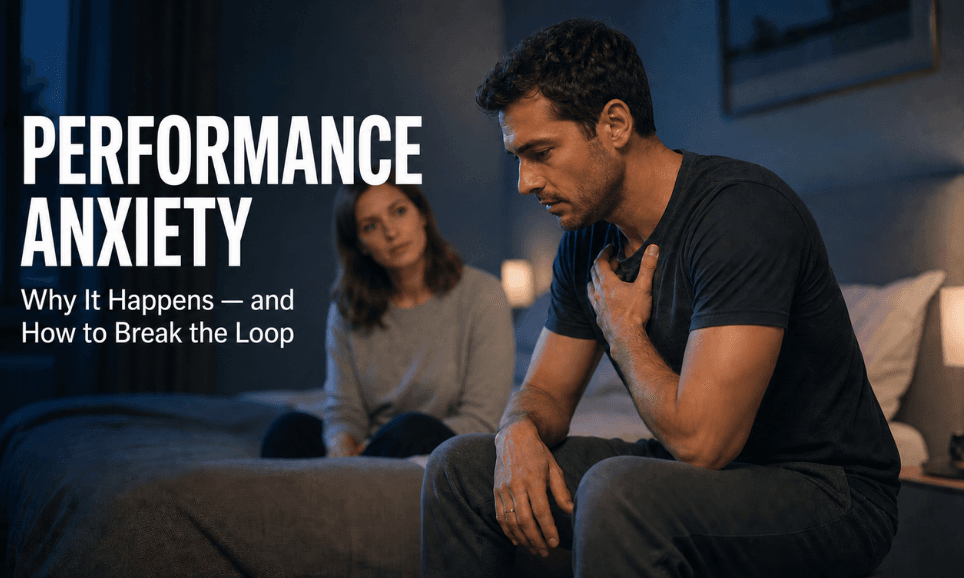
What Is Performance Anxiety and How Do You Combat It? The Short Version
Performance anxiety turns sex into an evaluation, and your nervous system reacts to an evaluation exactly as it reacts to a threat. Most men assume this means losing an erection. It presents in four ways.
| How it presents | What you notice | Clinical name |
|---|---|---|
| Erectile | Fades at penetration, or never arrives with a partner | Psychogenic erectile dysfunction |
| Ejaculatory, fast | You finish within a minute or two | Premature ejaculation |
| Ejaculatory, blocked | You stay hard but cannot finish with a partner | Delayed ejaculation or anorgasmia |
| Desire | You want sex in theory, dread it in practice | Anxiety-driven low desire |
Men often carry two at once, because performance anxiety and premature ejaculation both run on raised sympathetic tone. Women experience the same condition through reduced lubrication and difficulty reaching orgasm, though it is diagnosed far less often in women.
Why Can I Get Hard Alone but Not With My Partner?
Because evaluation exists with a partner and does not exist when you are alone. This separates a psychological cause from a physical one faster than any blood test. Erections during sleep, called nocturnal penile tumescence, occur four to five times a night and use the same vascular equipment partnered sex uses. If you wake with erections and get hard reliably alone, your blood vessels, nerves and hormones all work. Clinicians call this situational erectile dysfunction.
A 2013 study published in The Journal of Sexual Medicine found that 114 of 439 men seeking first medical help for new-onset erectile dysfunction were aged 40 or under, and those younger men carried far fewer comorbidities than older patients.
| Performance anxiety | Organic erectile dysfunction | |
|---|---|---|
| Onset | Sudden, traceable to one bad night | Gradual, over months or years |
| Morning erections | Present and firm | Reduced or absent |
| Erections alone | Normal | Weak everywhere |
| Pattern | Situational, worse with new partners | Global and consistent |
| Typical age | Any, common under 40 | Rises after 50 |
| First-line treatment | Psychosexual therapy | Medical assessment first |
Why Does My Mind Race the Second Sex Starts?
Because your brain has classified sex as a threat, and threat detection runs faster than arousal. Two mechanisms then operate at once. The first is autonomic: an erection needs your parasympathetic nervous system to dominate, releasing nitric oxide so penile smooth muscle relaxes and blood fills the tissue. Anxiety activates the opposing branch, releasing adrenaline and noradrenaline so that muscle contracts and blood leaves.
The second is attentional, and it explains why willpower fails. Attention has a limited budget during sex, so if you spend it monitoring your erection you spend nothing on the erotic input driving arousal. A 2011 study published in Archives of Sexual Behavior found that more frequent performance-related thoughts during sex predicted more sexual problems in both men and women.
Sex therapists call this self-watching spectatoring, and the audience position kills arousal. This is where popular advice goes wrong. Several major health websites still tell men to distract themselves during sex, which inverts the evidence: distraction from erotic cues is the mechanism of the disorder, not the cure.
Why the Anticipation of Failing Makes It Happen
Because the prediction and the outcome share a cause. One difficult night is normal, since alcohol, exhaustion or stress flattens anyone’s response occasionally. The problem starts with what your brain does next: it encodes that night as a threat memory and retrieves it before the next encounter. The loop then runs in four steps.
- Anticipation. Sympathetic tone rises before your partner touches you.
- Monitoring. You check your erection instead of feeling the encounter, and erotic input drops.
- Shutdown. Arousal fades, starved of the right physiology and the right attention.
- Confirmation. Your brain files the evidence that sex is dangerous, so anticipation starts higher next time.
Key Takeaway
Sexual performance anxiety is self-reinforcing because failure supplies its own evidence. Each difficult encounter teaches your nervous system that sex is a threat, so the next one opens with anticipatory anxiety already switched on. Your body is not deteriorating; your brain is simply getting better at predicting a danger it invented. Break any single step in the loop and the chain weakens, which is why treatment targets attention and appraisal rather than blood flow.
What Actually Causes Performance Anxiety in Bed?
The psychological drivers
- One encoded failure. A single embarrassing night your brain never reclassified as harmless.
- Fear of disappointing her. The stronger your feelings, the higher the stakes your brain assigns.
- Comparison. Knowing a partner’s sexual history invites mid-encounter self-measurement.
- Pornography-set expectations. Continuous rigidity and instant readiness are production standards, not human ones.
- Body image. Worry about weight, size or ageing pulls attention inward.
- Relationship tension. Unresolved resentment does not pause for intimacy.
- Work stress. A nervous system that ran hot all day will not switch to receptive mode on demand.
The physical causes worth ruling out first
Cardiovascular disease, diabetes, thyroid disorders, low testosterone, sleep apnoea and medications including SSRIs, beta blockers and finasteride all affect erectile function, and alcohol impairs it directly despite the belief that a few drinks help. Poor sleep, smoking and a sedentary routine worsen both anxiety and blood flow, so exercise and consistent sleep genuinely move the needle.
One myth needs correcting. Men often read that chronic stress lowers testosterone and that low testosterone explains everything, but the study above found the opposite: young men with new erectile dysfunction had higher mean total testosterone than older patients. Performance anxiety operates on healthy hormones.
Why Viagra Sometimes Makes Performance Anxiety Worse
Because the pill fixes blood flow and leaves the fear untouched. PDE5 inhibitors such as sildenafil and tadalafil restore the vascular pathway efficiently, but they do not change how your brain classifies sex. You take the pill and it works, so your brain concludes the pill is the reason and you cannot perform without it. The next encounter carries a second fear: what if it fails tonight?
The evidence supports combining, not substituting. A 2007 study published in The Journal of Sexual Medicine randomised 53 couples with psychogenic erectile dysfunction and found that after four weeks, 48 percent of men on sildenafil plus cognitive-behaviour sex therapy met the success criterion, against 29 percent on sildenafil alone. See whether Viagra helps performance anxiety.
What I See in Clinical Practice That the Research Does Not Describe
In my clinical work with men presenting with sexual performance anxiety, one pattern appears in almost every first session and no research paper captures it properly. These men do not describe sex as an experience, they describe it as a statistic. They tell me their success rate, or that it works six times out of ten. They arrive with data.
That scorekeeping is not a side effect of the anxiety, it is the engine driving it. The moment a man records outcomes he has installed a permanent observer in the bedroom, and an observer cannot also be a participant. I have watched men with entirely normal physiology stay stuck for years because they could not stop counting, and the same difficulty resolve within weeks once the counting stopped.
How to Combat Performance Anxiety in Bed
What is performance anxiety and how do you combat it in the moment?
When the monitoring starts, do not fight the thought and do not distract yourself. Move your attention to one physical channel instead: temperature, texture, pressure, your partner’s breathing. Give attention a sensory destination rather than trying to empty it. Slow your exhale at the same time, breathing in for four seconds and out for six, because a longer exhale raises vagal tone and restores the parasympathetic state your erection depends on.
Remove the goal, and the response returns
Sensate focus remains the most reliable structured technique here. You and your partner agree in advance that penetration is off the table, then take turns giving and receiving touch with no expectation attached to your erection. Removing the outcome removes the test, and removing the test removes the threat response. Work through the graded steps in the guide to sensate focus exercises.
Cognitive restructuring runs alongside it. Identify the automatic prediction, usually “it will fail again and she will be disappointed”, then write a replacement you can believe: not “I will be fine”, which your brain rejects instantly, but “we can both enjoy this regardless of what my erection does”. Structured sexual performance anxiety treatment combines both.
What Your Partner Should and Should Not Do
Tell her, and tell her early, because silence guarantees she invents an explanation and it is almost always that you no longer want her. Her reaction then shapes the outcome, since visible disappointment tightens the loop.
- Do respond neutrally. Stay close, stay warm, change activity without commentary.
- Do initiate contact with no implied endpoint, so touch stops signalling a test.
- Do say plainly that you do not read his erection as a measure of his interest in you.
- Do not ask what went wrong during or straight afterwards. Talk the following day.
- Do not suggest medication first, because it reinforces the idea that his body is broken.
- Do not withdraw physically. Withdrawal confirms the exact fear driving the problem.
When to See a Doctor About Performance Anxiety
Book a medical assessment before starting therapy if any of the following apply:
- Your erections are weak or absent in every context, including on waking and alone.
- The change came on gradually over months rather than suddenly.
- You are over 40 with new symptoms and no obvious psychological trigger.
- You have diabetes, high blood pressure or high cholesterol, or you smoke.
- Symptoms began within weeks of starting a new medication.
- You notice genital numbness, difficulty urinating, or curvature or pain.
The cardiovascular point matters and men ignore it constantly. The arteries supplying the penis are narrower than the coronary arteries, so they clog earlier, and erectile difficulty present in every situation can precede a cardiac event by years. Treat global erectile failure as a circulatory warning sign.
Performance anxiety also rarely stays in one lane, and it commonly arrives alongside premature ejaculation, avoidance of intimacy, or a wider anxiety pattern outside the bedroom. When the difficulty is situational, when medication has not resolved it, or when your relationship is suffering, work with a certified sex therapist rather than a general counsellor.
Frequently Asked Questions
What is performance anxiety and how do you combat it?
Performance anxiety is fear about sex that blocks the physical response you fear losing. You combat it by removing the outcome. Cognitive Behavioural Therapy, sensate focus and attentional retraining shift your focus from monitoring your erection to feeling sensation. Sexual performance anxiety responds well to structured psychosexual therapy.
Is performance anxiety in bed permanent?
No. Performance anxiety is a learned threat response, and learned responses reverse. Duration does not predict outcome. Men who have carried the pattern for years recover on the same mechanisms as men who developed it last month, because the underlying loop is identical and equally treatable.
What is the root cause of sexual performance anxiety?
The root cause is threat appraisal, not a physical fault in the body. Your brain classifies sex as an evaluation you can fail. That judgement triggers the sympathetic nervous system, which suppresses the parasympathetic state an erection requires. One bad experience usually installs the pattern.
Will Viagra fix performance anxiety?
Not on its own. Viagra restores blood flow but leaves the fear intact. A 2007 study in The Journal of Sexual Medicine found 48 percent of men succeeded on sildenafil combined with cognitive-behaviour sex therapy, against 29 percent on sildenafil alone. Many men become psychologically reliant on the pill.
Why can I get hard alone but not with my partner?
Because pressure exists with a partner and does not exist when you are alone. Solo erections and morning erections prove your blood flow, nerves and hormones work. The failure appears only where evaluation appears. Clinicians call this situational erectile dysfunction, and it points clearly to a psychological cause.
Does stopping masturbation cure performance anxiety?
No. No clinical trial shows that stopping masturbation resolves sexual performance anxiety. Reducing very frequent, high-intensity solo habits helps some men regain sensitivity to partnered touch. Treating abstinence as the cure delays real treatment, and many men who never watch pornography develop the same anxiety loop.
What is sexual anxiety in men?
Sexual anxiety in men is fear or dread attached to sexual situations. It covers performance worry, fear of judgement, body image concerns and avoidance of intimacy. Sexual performance anxiety is the most common form, and it drives psychogenic erectile dysfunction and premature ejaculation in otherwise healthy men.
References
- Pyke RE. Sexual Performance Anxiety. Sexual Medicine Reviews. 2020;8(2):183-190. doi:10.1016/j.sxmr.2019.07.001. PubMed
- Banner LL, Anderson RU. Integrated sildenafil and cognitive-behavior sex therapy for psychogenic erectile dysfunction: a pilot study. The Journal of Sexual Medicine. 2007;4(4 Pt 2):1117-1125. doi:10.1111/j.1743-6109.2007.00535.x. PubMed
- Capogrosso P, Colicchia M, Ventimiglia E, et al. One patient out of four with newly diagnosed erectile dysfunction is a young man. The Journal of Sexual Medicine. 2013;10(7):1833-1841. doi:10.1111/jsm.12179. PubMed
- Nelson AL, Purdon C. Non-erotic thoughts, attentional focus, and sexual problems in a community sample. Archives of Sexual Behavior. 2011;40(2):395-406. doi:10.1007/s10508-010-9693-1. PubMed
Dr. Dhruv Bhola
Certified Sex Therapist and Psychosexologist
Dr. Dhruv Bhola specialises in sexual performance anxiety, psychogenic erectile dysfunction, premature ejaculation and porn-related sexual difficulties, and he has spent over eight years working exclusively in male psychosexual health. He treats men and couples internationally through confidential online psychosexual therapy, using Cognitive Behavioural Therapy and sensate focus rather than medication.